Warehouse Typologies UK: A Developer's Guide to Industrial Building Types
2026 UK warehouse typologies for developers, planning teams, and pre-let agents: what each building type must prove before occupiers, committees, and investors can read the scheme clearly.
How UK Warehouse Typologies Change Planning and Pre-Let Evidence
For commercial developers, a UK warehouse typology is not just a label for the occupier mix. It decides which evidence the planning team, leasing agent, and tenant-side reviewer expect to see first: yard geometry for a distribution centre, parcel-van movement for a last-mile depot, roof plant and acoustic exposure for cold storage, or LVIA-tested height for a high-bay ASRS scheme.
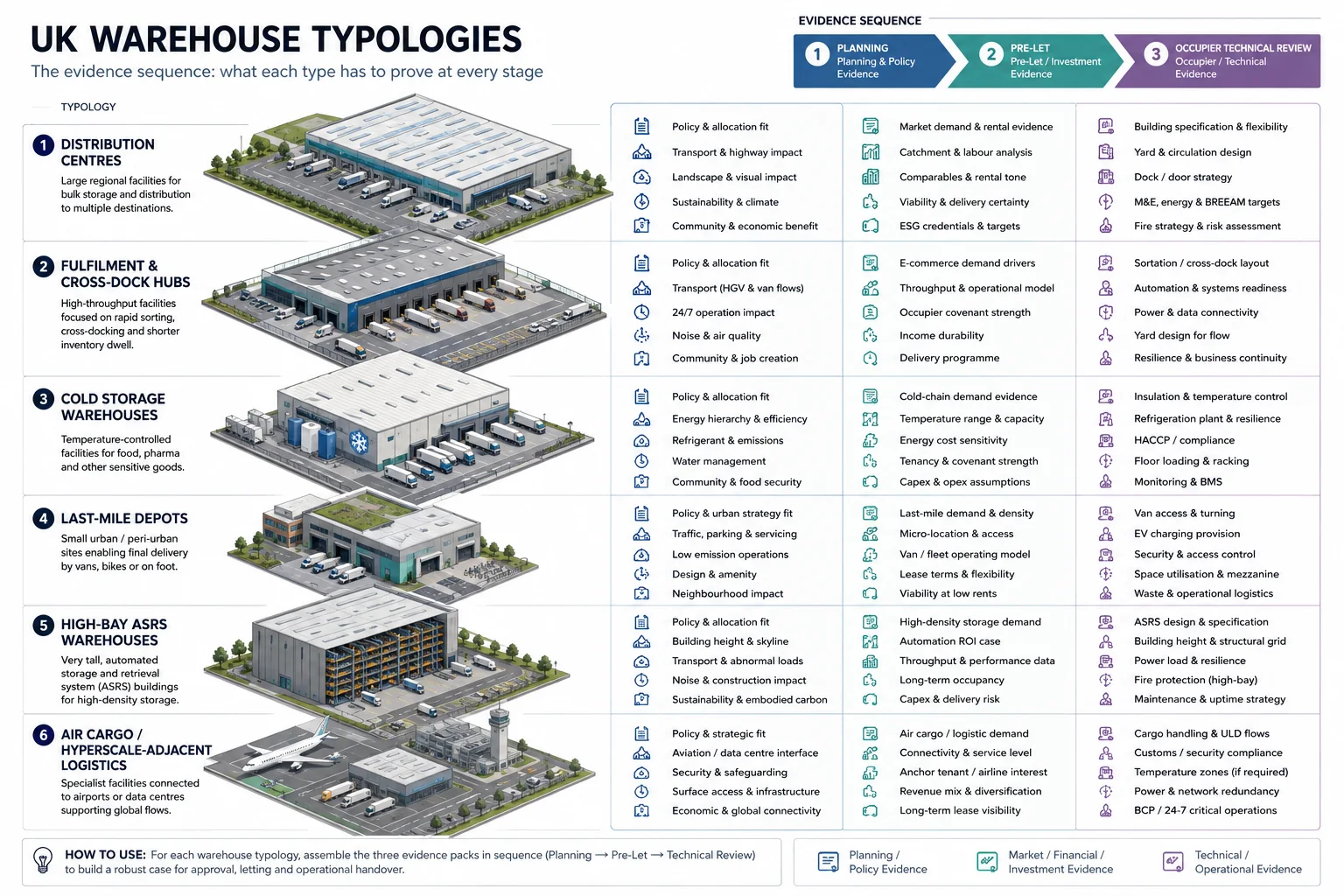
UK warehouse typology evidence board: six building forms mapped to planning, pre-let, and occupier technical review proof points.
Commercial developers usually feel the problem when a generic shed GA moves into pre-app, pre-let, or heads-of-terms review. If the image set cannot show why the yard, doors, plant, charging bays, office block, or ridge line belongs to the intended warehouse type, the CGI starts behaving like decoration instead of evidence.
This guide maps six UK warehouse typologies to the evidence sequence behind the image set: distribution centres, fulfilment and cross-dock hubs, cold storage, last-mile depots, high-bay ASRS warehouses, and air cargo or hyperscale-adjacent logistics. Each type is treated by what it has to prove at planning, pre-let, and occupier technical review, so the typology table can be used as a production brief rather than a glossary.
The scope is visualisation and marketing, not engineering specification. Rack heights, slab loadings, refrigeration plant sizing, HMRC-authorised customs warehouses, and bonded warehouses sit outside the scope. What this guide does cover is how the visible markers of a high-specification warehouse, the clear internal height, dock rhythm, yard depth, plant deck, and power infrastructure, have to read in the CGI for the planning officer, the leasing agent, and the occupier review.
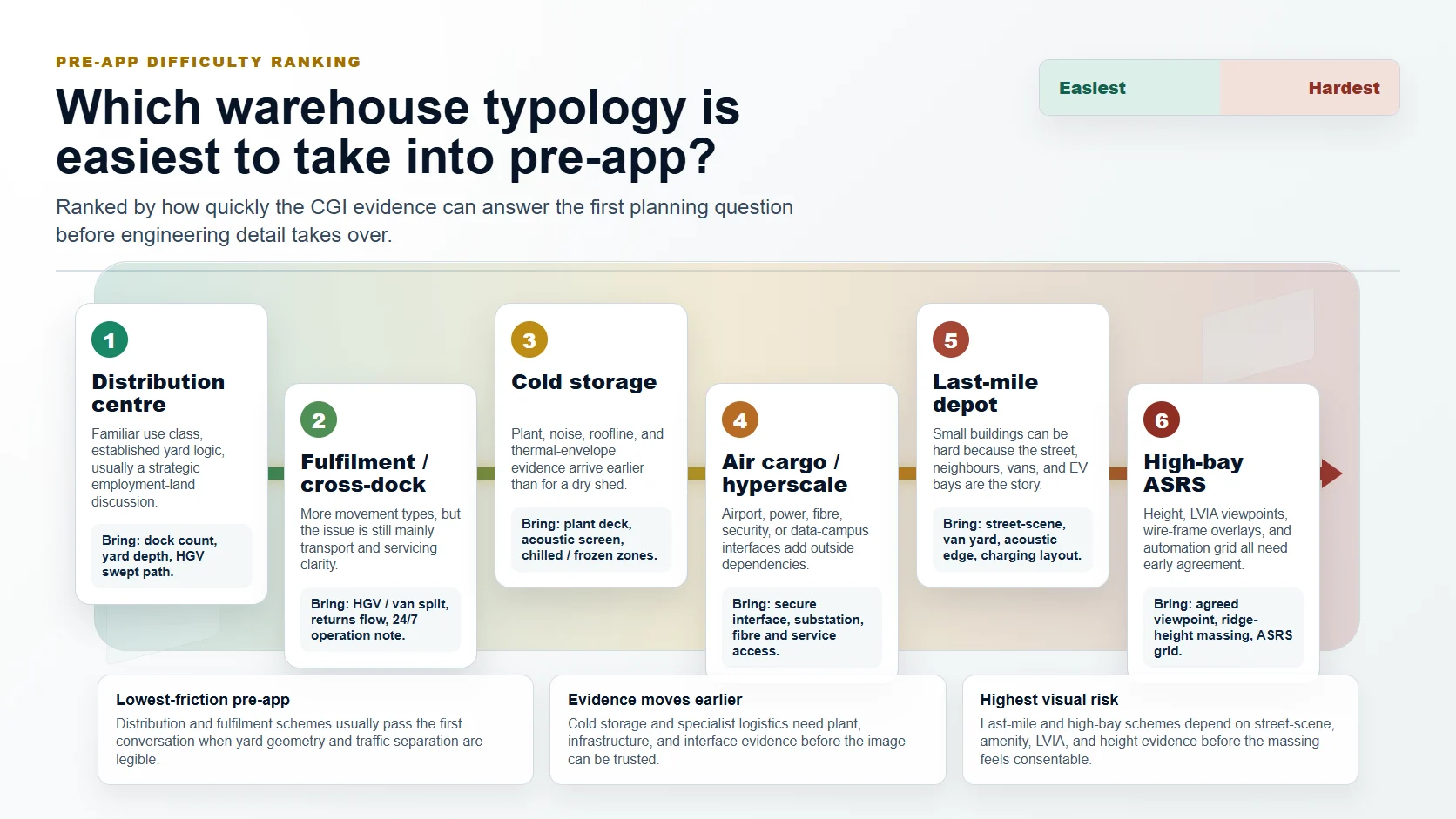
Pre-app difficulty ranking: distribution and fulfilment schemes usually need the least explanation; last-mile and high-bay ASRS schemes need the strongest early visual evidence.
The same scheme is presented six different ways depending on typology. A big-box DC leads with a yard-level HGV approach. A last-mile depot leads with a street-scene at pedestrian eye-line. A cold store leads with a dock elevation showing thermal seals and the refrigeration plant deck. Each typology section below names the lead view, the supporting crops, and the evidence each image has to carry into planning committee or onto a leasing portal. Stratum's warehouse and logistics production runs that sequence on one coordinated 3D model.
Six typologies, one comparison table
UK Warehouse Typologies, Occupiers, GIA, and Evidence Requirements
The table maps six UK warehouse typologies to occupier profile, GIA range, and the evidence question that has to be answered before the image set can do planning or leasing work.
Typology
Typical GIA
Primary occupier
Primary planning or pre-let evidence question
Distribution centre
100,000 to 1,000,000+ sq ft
3PL, grocery, general merchandise
Does the yard prove 16.5 m artic circulation at 50 m baseline depth?
Fulfilment hub / cross-dock variant
80,000 to 600,000 sq ft
E-commerce, parcel carriers, omni-channel retail
Can the elevation show HGV docks and van despatch without confusing the planning read?
Cold storage
30,000 to 400,000 sq ft
Food retail 3PL, pharma, food manufacturer
Are the insulated envelope, dock thermal seals, and plant deck legible in one exterior frame?
Last-mile depot
Sub-60,000 sq ft
Parcel carriers, urban 3PL, EV fleet operators
Does the street-scene view prove amenity and EV charging rather than just a van yard?
High-bay / ASRS
100,000 to 500,000 sq ft
E-commerce automation, national 3PL, cold-chain ASRS
Does the ridge height read correctly in landscape context, from an agreed LVIA viewpoint?
Air cargo / hyperscale-adjacent
Site-specific, terminal or campus-led
Airfreight handlers, logistics operators adjacent to data centre campuses
Does the image set prove operational interface geometry rather than only the envelope?
Big-box, 100k to 1m sq ft
Distribution Centre Evidence for UK Big-Box Warehouses
The distribution centre is the dominant UK big-box typology. Single-temperature general merchandise, full HGV yard on at least one face, dock count derived from throughput modelling, and service yard designed around 16.5 m articulated lorries. GIA runs from 100,000 sq ft regional units to one million sq ft national hubs. The Golden Triangle, specifically the M1/A1 corridor through the East Midlands, carries much of the speculative big-box distribution market.
SEGRO Logistics Park East Midlands, Prologis Park Kettering, Symmetry Park Kettering, Magna Park Milton Keynes, Omega Business Park Warrington, and DP World London Gateway are the reference schemes agents cite when briefing occupiers on benchmark yard, dock, and covenant signals in this corridor and along the M6/M62. Each typology in the list below maps to a different evidence sequence the leading UK industrial architects (Chetwoods Architects, Stephen George + Partners, UMC Architects, RPS Group) and supporting M&E and PM consultants (Hannan Associates, Knight Webb) set on the GA before the CGI brief lands. Distribution centre occupiers include 3PL operators running public warehouse contracts, grocery retailers, general-merchandise operators, and automotive-parts distributors. Covenant quality matters: a marketing pack with SEGRO, Prologis, or Tritax lease evidence carries a stronger investor signal than an unnamed speculative shed.
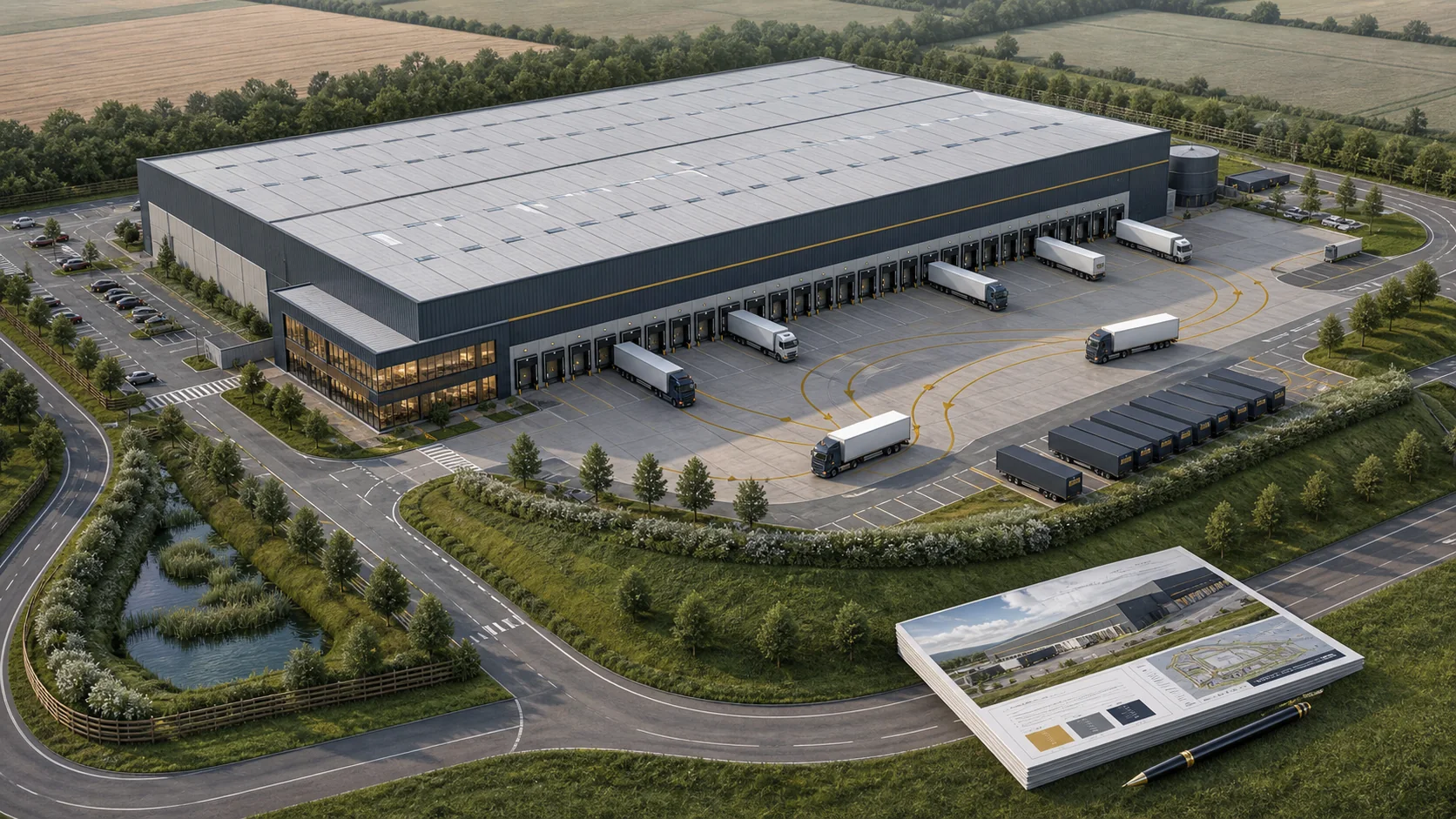
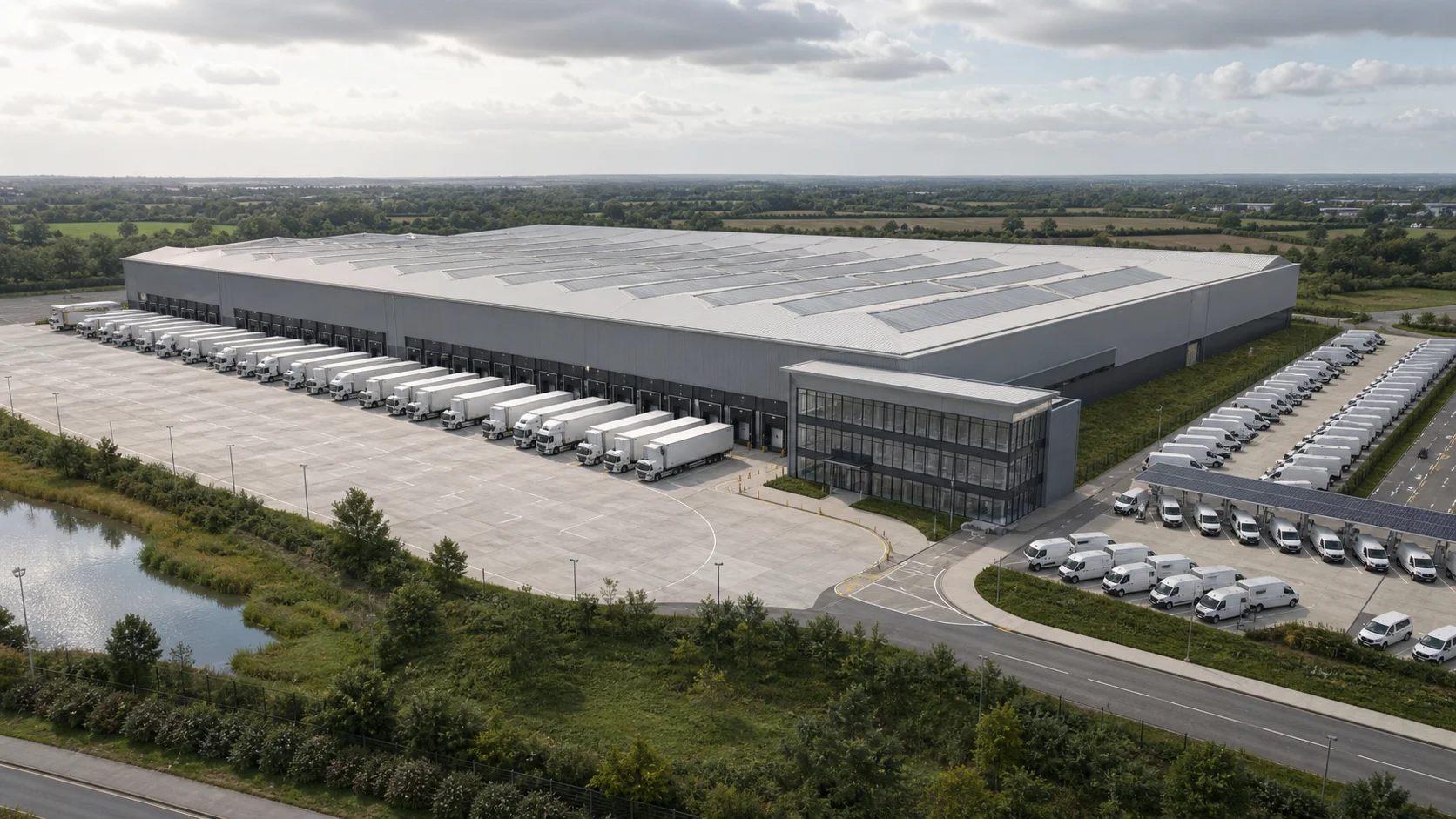
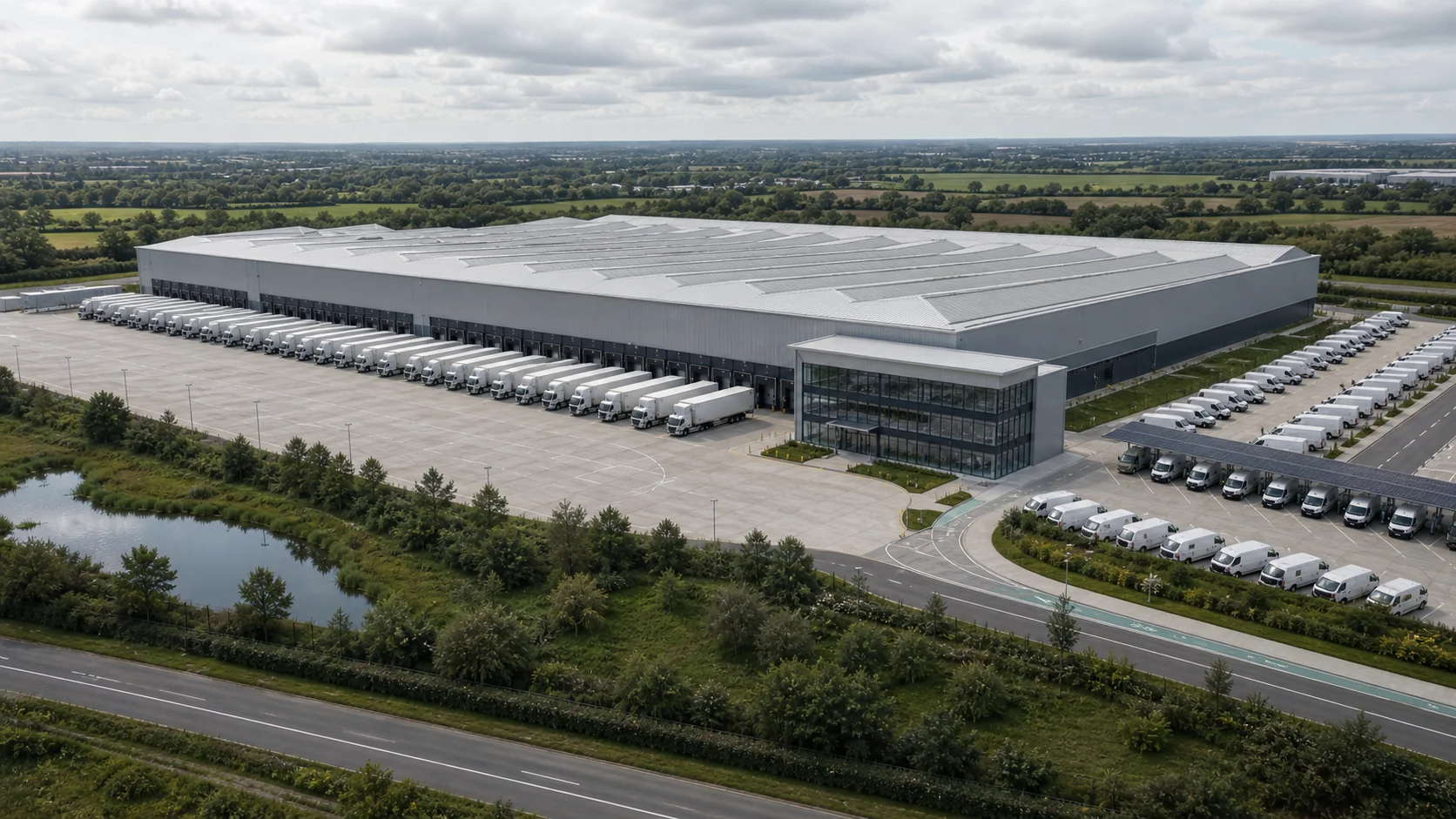
Distribution centre evidence image: dock rhythm, yard depth, HGV movement, attenuation, and investor-ready scheme context are visible before the facade becomes the focus.
The CGI brief for a distribution centre is relatively easy to define, but often underspecified. The yard is the subject, not the building. A planning officer reviewing a distribution centre application in a rural greenbelt location will read the HGV yard logic before looking at the elevation: swept-path radius, service road geometry, landscaping bund on the residential boundary. A pre-let agent showing the scheme to a grocery 3PL will read dock count and yard depth before asking about internal clear height.
UK distribution centres run on two operating models, and the pre-let CGI brief differs across them:
Public warehouse (3PL-operated)
A 3PL runs the building on behalf of multiple brand owners. The CGI shows branded trailer pools, occupier signage zones, and a yard configuration supporting more than one shipper.
Private warehouse (owner-occupied)
A single tenant owns or leases the building outright. The CGI emphasises single-occupier identity and supply chain integration with the rest of the operator's logistics estate.
An underdeveloped version of this brief arrives with an architectural elevation and a request to show context. The resulting planning image shows the road view, not the yard logic. Planning officers in local authorities that have processed multiple big-box applications will read that gap quickly.
UK Class A distribution centre: yard depth, dock rhythm, and HGV swept paths legible in the frame
Distribution Centre Pre-Let Visual Evidence
Distribution centre CGI must show yard depth, dock count, and credible HGV swept paths in the frame. A render that crops the yard to enlarge the building fails both planning and leasing audiences.
Yard depth: 50 m baseline, 55 to 65 m for cross-dock and trailer-swap layouts
Dock doors: one per approximately 1,000 sq ft GIA for standard distribution
HGV swept path: 16.5 m artic standard per UNECE Regulation 107, modelled and visible
Landscape screening: boundary treatment and attenuation pond visible from the agreed planning viewpoint
Production pass: build the yard model first, lock swept-path geometry at brief stage, and verify dock count and HGV apron depth against the GA before the camera is approved.
Fulfilment Centre and Cross-Dock Evidence for Dual Throughput
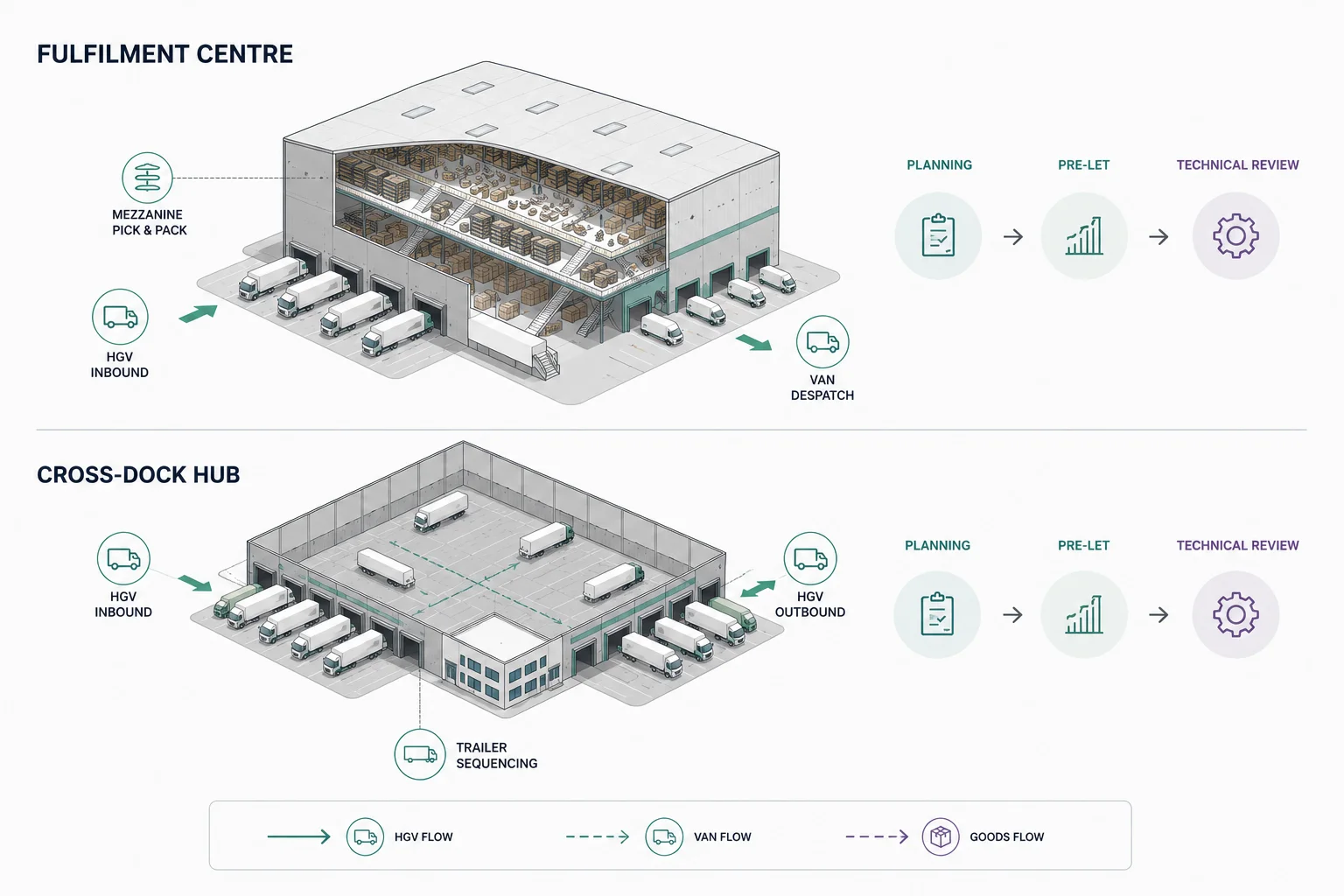
The fulfilment centre processes individual orders rather than moving pallet loads between nodes. That operational difference has a physical consequence: the building must accommodate HGV inbound docks, van despatch bays, and mezzanine-level pick-and-pack decks in the same envelope.
National e-commerce operators and omnichannel retailers occupy this class. Parcel carriers commission the cross-dock variant: a building with active HGV dock faces on two sides, no storage function, and trailer sequencing as the central operational activity. The building specification changes accordingly:
Fulfilment and cross-dock evidence image: mezzanine pick-and-pack, HGV inbound, van despatch, trailer sequencing, and goods flow are mapped against planning, pre-let, and technical review.
Internal clear height runs higher (typically 15 to 18 m) to accommodate mezzanine levels or automation systems.
Van access sits alongside HGV docks rather than being an afterthought.
The building envelope must flex across standard-throughput, cross-dock, and van-heavy e-commerce order fulfilment configurations without structural change.
The CGI brief for a fulfilment centre is harder to compose than a distribution centre because the planning officer and the pre-let occupier read different things in the same image. The planning officer wants to see how traffic management separates HGV and van access. The occupier wants to see internal volume, mezzanine potential, and whether the van despatch zone can absorb a shift-change surge.
A single exterior viewpoint cannot satisfy both reads. The standard Stratum pack for a fulfilment centre is three frames: an aerial showing the full yard layout with HGV and van zones distinct, an elevation from the van access side showing the despatch canopy and EV charging apron, and an internal still showing clear height with mezzanine potential legible.
The cross-dock variant requires both yard faces to be active in the same aerial. Trailer sequencing between the two faces is the subject of the image, not the building. Planning officers reviewing a cross-dock application on a constrained employment land site want to know that HGV circulation from both approaches is workable. A perspective that shows one dock face and implies the other is there is insufficient.
Fulfilment centre with dual outbound rhythm: HGV trunking face and last-mile van despatch apron in one frame
Fulfilment Centre Pre-Let Visual Evidence
Fulfilment centre CGI must show flexibility across HGV trunking, van despatch, mezzanine fit-out, and cross-dock modes inside the approved envelope.
Multi-mode throughput visible: HGV dock face and van despatch zone in the same frame or adjacent frames
Clear height legible: the internal volume must read as 15 m plus from an external elevation
Cross-dock variant: dual-yard, both faces active, trailer sequencing between the elevations
Mezzanine signal: roof monitor or sawtooth roofline detail to signal the internal fit-out potential
Production pass: model the mezzanine in the shell-and-core pass, and lock the 9 m panel van, 12 m Sprinter, and HGV swept paths together because highways comments often test all three.
Cold Storage Evidence for Temperature-Controlled Facilities
Cold storage and temperature-controlled facilities are warehouses designed around chilled, frozen, or controlled-ambient operations, and their CGI brief separates into two production passes because planning officers and occupiers ask questions about different parts of the building.
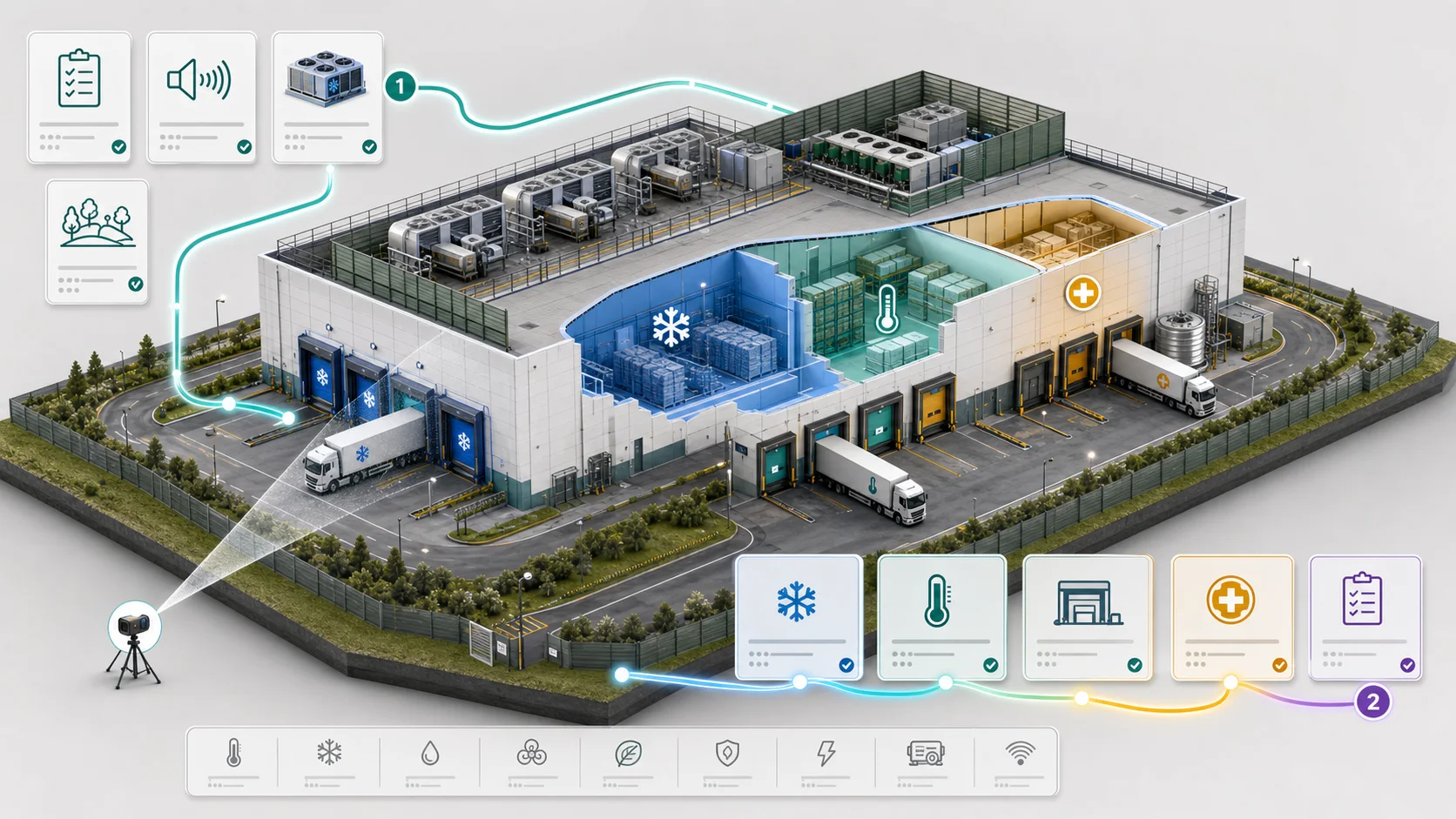
Cold storage evidence has two reads: planning officers test roof plant, acoustic screening, and LVIA visibility; occupiers test dock segregation and chilled, frozen, or controlled-ambient zones.
The planning officer is asking about the plant deck: roof-mounted refrigeration units, condenser arrays, and acoustic screening. These elements trigger noise-assessment conditions and landscape impact queries. In some local authority areas, the plant-screen height requires a separate LVIA exercise because the equipment stack breaks the roofline at a point visible from agreed viewpoints.
The occupier is asking about the temperature zones: which part of the yard is chilled, which is ambient, and whether frozen dock positions are segregated from chilled dock positions. For pharmaceutical cold-chain occupiers, the question extends to whether the MHRA-compliant controlled-ambient zone, 15 to 25 degrees C, is legible as a separate building section rather than a dock-end partitioned bay.
Four exterior markers identify a cold storage warehouse on sight:
Insulated composite cladding panels with a recognisable surface texture and joint pattern.
Roof-mounted refrigeration plant adding bulk, height, and acoustic impact, requiring a plant-screening strategy legible in the planning CGI.
Dock thermal seals and insulated dock doors changing the loading-bay rhythm.
Temperature-zone segregation in the service yard, creating a yard-management read unlike a standard DC yard.
Food-grade cold storage occupiers operating to the BRCGS Global Standard for Storage and Distribution (Issue 4, Section 4.5 on segregation and product protection) carry pre-let checklists in which dock-seal specification appears early. A CGI that shows a generic dock arrangement without thermal seals fails that occupier check before the building is on site.
The occupier temperature range also sets the cladding texture. Ambient-to-chilled facilities, from -2 to +8 degrees C, use standard insulated panels at a wall U-value that reads visually like a standard shed. Frozen facilities, from -18 to -25 degrees C, use thicker panels with a heavier surface profile. That difference is legible in a photoreal CGI if the model is built from the correct specification.
Cold storage facility: refrigerated trailer queue and yard segregation visible without a plan overlay
Cold Storage Pre-Let Visual Evidence
Cold-store CGI must show temperature-zone logic, dock-seal placement, insulated door positions, plant-screen height, and chilled, ambient, and service-yard movements. The standard sequence is base chilled, plant-heavy, and ESG-led.
Insulated cladding: composite panel joint pattern and U-value cladding system visible in close-up
Dock thermal seals: insulated dock doors and dock-seal inflatable collars visible on the loading face
Temperature-zone yard: chilled trailer queue separated from ambient HGV flow, legible without a plan overlay
ESG upgrade potential: PV-ready roof, greener boundary treatment, and office-front upgrade shown in the third position
Production pass: agree two camera positions at brief stage: one for plant-deck impact and landscape screening, and one for dock-face, yard-zone, and thermal-seal legibility. They are not interchangeable.
See cold storage facility CGI services for the three-tier production sequence: base chilled, plant-heavy screened, and ESG-led cold-chain.
Typology 4
Last-Mile Depot Evidence for Urban Logistics Planning
The last-mile depot is the smallest and most politically contested UK warehouse typology. It is typically sub-60,000 sq ft, within a ring road or urban fringe location, and often on a constrained brownfield site that a previous use class has vacated. Operators such as DPD, Evri, DHL Parcel, Amazon Logistics, and grocery rapid-delivery networks have helped push depot demand into more constrained urban-fringe sites.
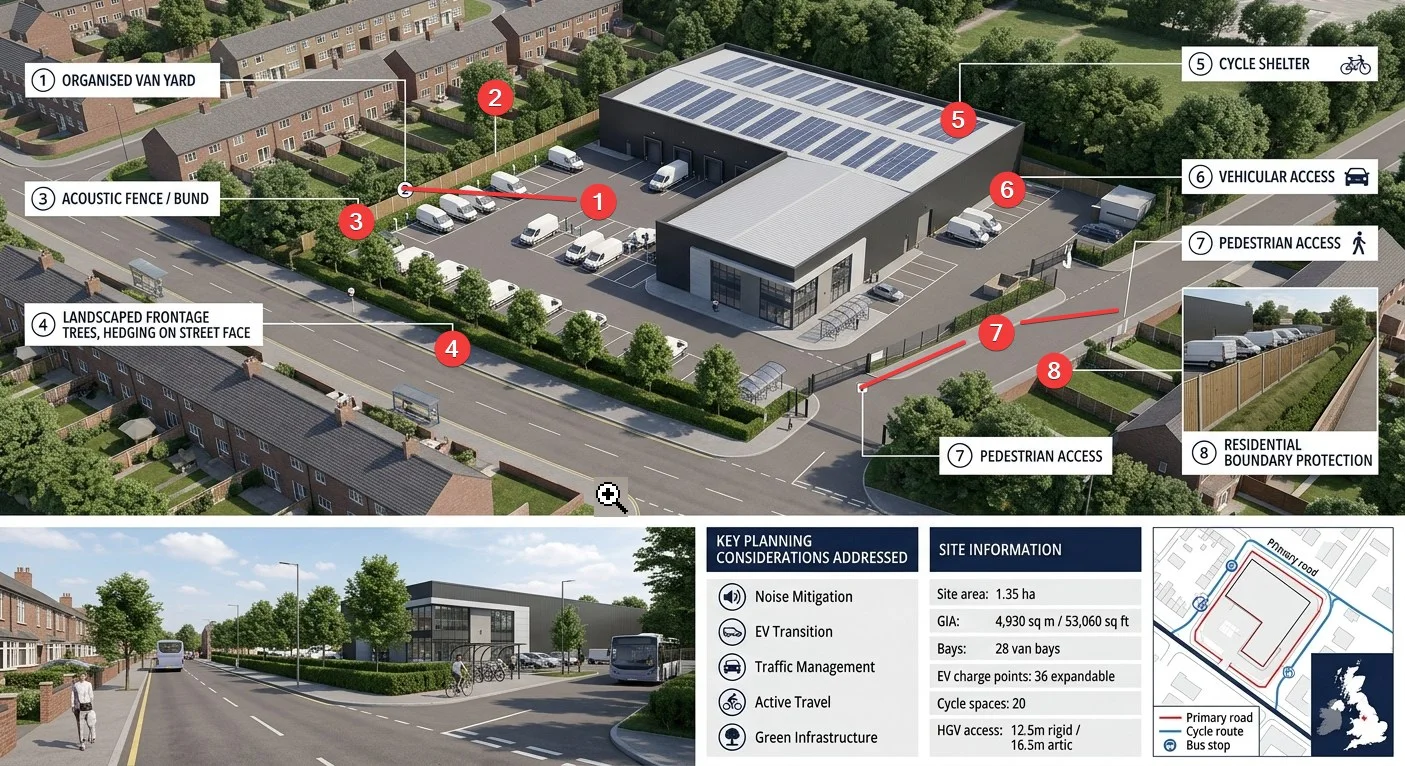
Last-mile depot planning evidence image: organised van yard, acoustic boundary treatment, landscaped frontage, active travel provision, and access control are visible from the street and residential edge.
The planning brief for a last-mile depot is dominated by what the building does to the street, not what the building does inside. An aerial viewpoint showing the roof plan does not discharge this brief. The local authority planning officer, and in urban locations the ward councillor who will observe the committee, wants to see the van yard organised into bays with EV charge points visible, the acoustic fence or bund on the residential-facing boundary, and a street-scene view that shows landscaped frontage, cycle shelter, and pedestrian access.
The building's operational use is not in question. The question is whether the scheme respects the street. The Vehicle Emissions Trading Schemes Order 2023 (SI 2023/1394), in force from 1 January 2024, sets the ZEV sales pathway to 100% zero-emission new cars and vans by 2035. That makes EV charging layout harder to treat as a late fit-out note on last-mile depot briefs.
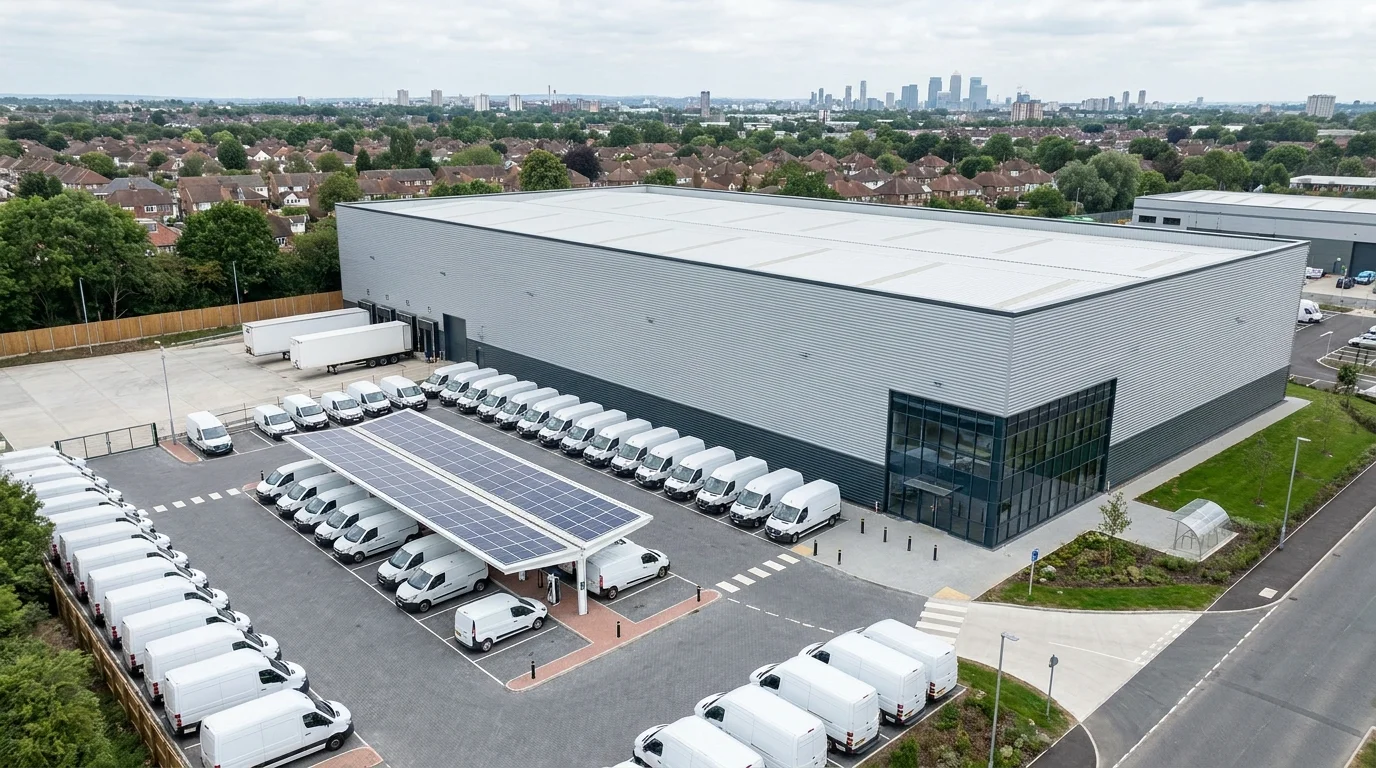
Last-mile depot: organised van yard, EV charging canopy, and street-scene integration in an urban-edge context
Last-Mile Depot Pre-Let Visual Evidence
Last-mile depot CGI must show van yard organisation, EV charging infrastructure, street-scene integration, and noise screening from the relevant public viewpoint.
Van yard: organised van bays with charge points, separated from HGV apron if dual-use
EV infrastructure: charging canopy or ground-mount array visible, number of charge points legible
Street-scene: landscaped frontage, pedestrian access, cycle shelter, and amenity space visible from street level
Noise screening: acoustic fence or bund shown on the residential-facing boundary
Production pass: model the van swept path from the kerb inward, not from the building outward. The street-scene camera is agreed first because it is the frame most likely to appear in the planning committee report.
High-Bay Warehouse Evidence for ASRS and LVIA Review
A high-bay warehouse is a tall automated storage envelope, often 30 to 40 m at ridge height, where ASRS equipment, column grid, dock position, and landscape massing all affect the CGI brief. It is the typology where the planning CGI carries the most risk and often receives the least careful briefing.
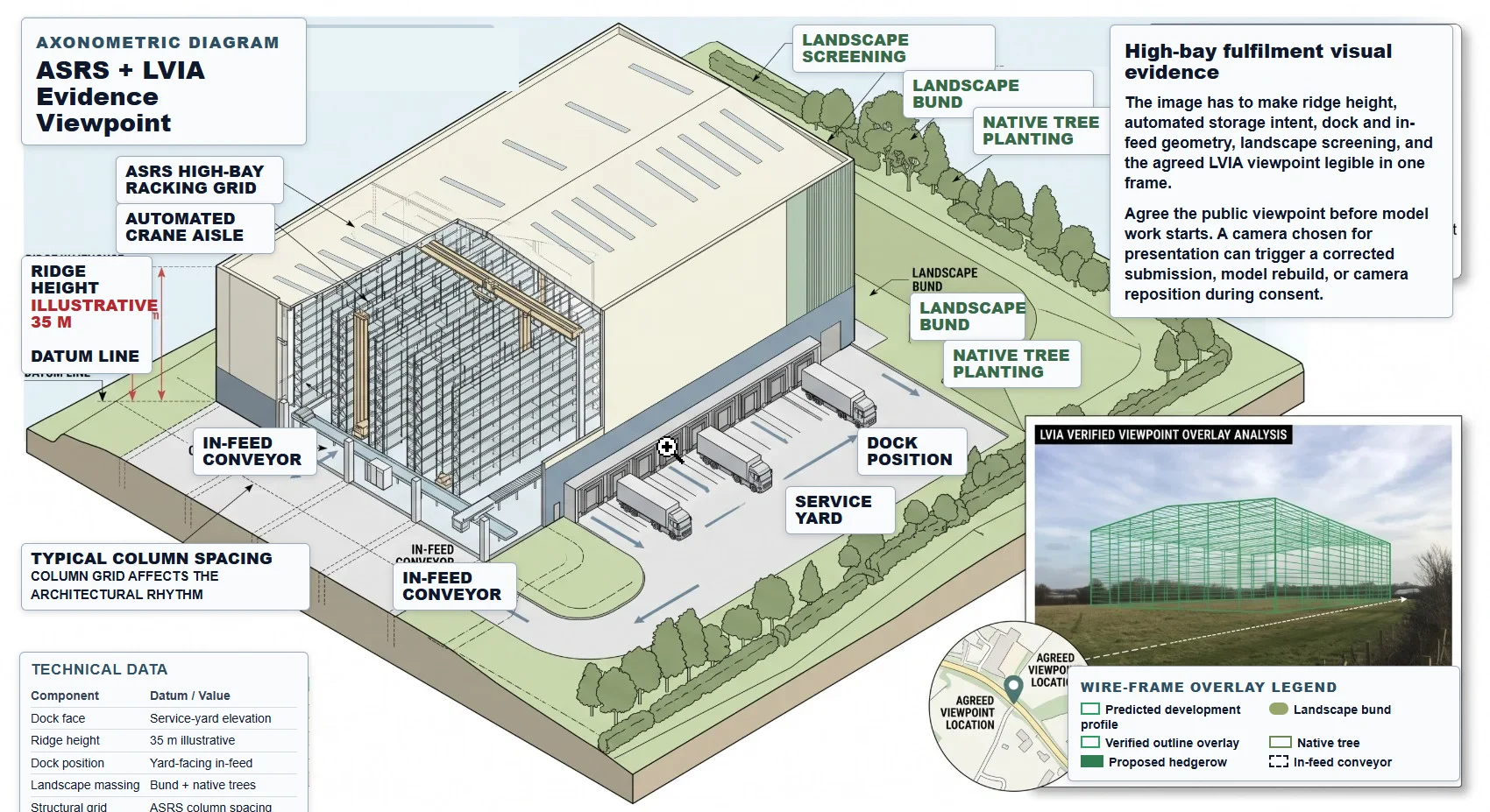
High-bay ASRS evidence image: automated storage grid, ridge height, dock and in-feed geometry, landscape mitigation, and verified LVIA viewpoint overlay are resolved in one planning model.
Ocado customer fulfilment centres show the scale and massing at stake: buildings taller than conventional sheds in their landscape context, modelled in detail for planning submissions that involved agreed LVIA viewpoints and wire-frame overlays on site photography.
The agreed viewpoint is the critical early step for a high-bay planning application. The studio cannot produce the LVIA-grade verified view until the viewpoint is agreed with the local authority landscape officer. Developers who arrive at a pre-application meeting with a CGI from an architect's preferred camera angle, rather than an agreed public viewpoint, can expect a request for a corrected submission. That means a model rebuild or camera reposition, which adds time to the consent programme.
The automation equipment inside the envelope sets the dock position and column grid. ASRS, shuttle systems, mini-load cranes, and goods-to-person robotics each produce a different internal layout. The pre-let CGI must reflect the chosen automation route because an occupier evaluating a scheme for a specific automation vendor reads the elevation for structural grid compatibility before looking at the specification.
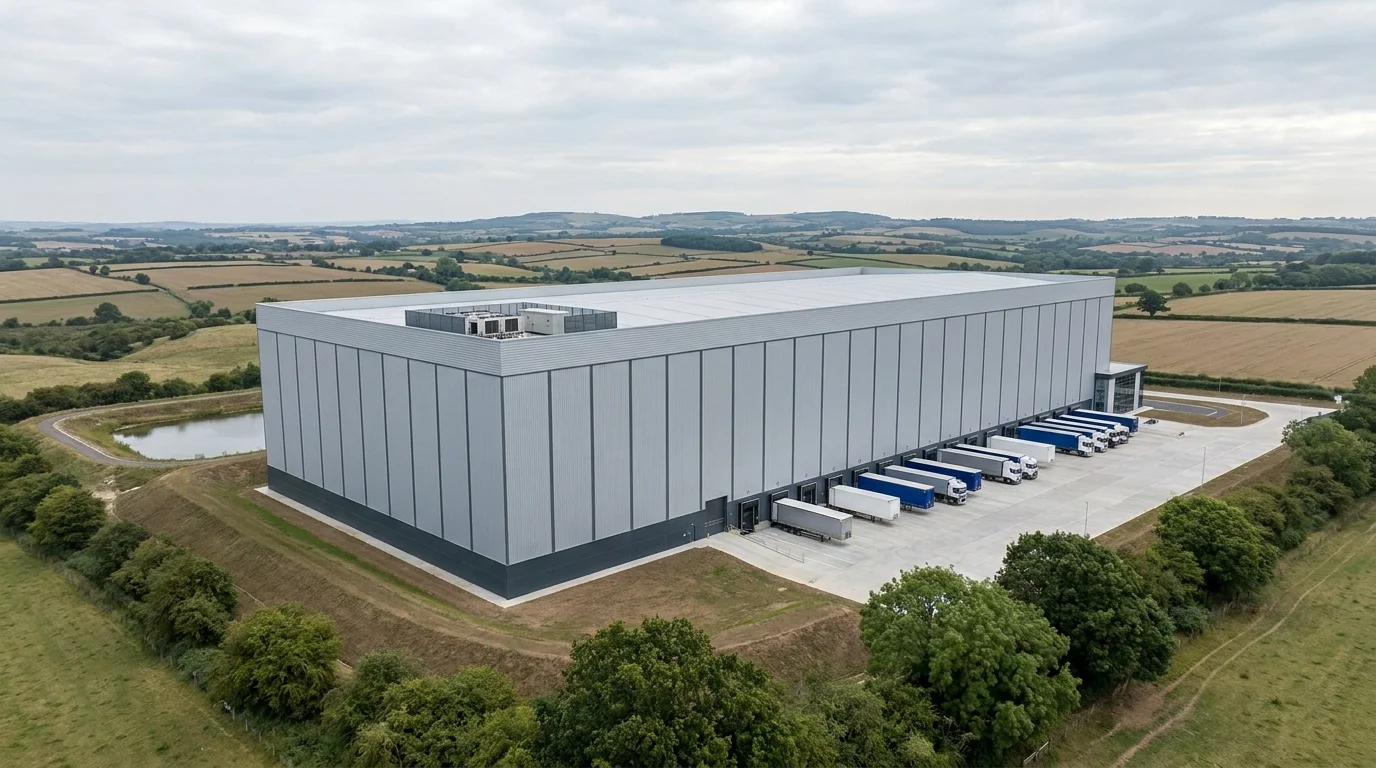
High-bay warehouse: accurate ridge height in landscape context with credible 15-year canopy mitigation
High-Bay Warehouse Pre-Let Visual Evidence
High-bay warehouse CGI must show accurate height in landscape context and signal ASRS design intent, not a later retrofit.
Height: accurate ridge height in the agreed landscape context, no perspective distortion that reduces apparent massing
ASRS signal: narrow-aisle bay spacing, specialist dock positions for automated infeed, shown in elevation
Plant zone: roof-mounted M&E and UPS plant visible, screened to committee standard
Landscape mitigation: tree planting, bunding, or topographic screening shown at 15-year canopy in the planning position
Production pass: agree the LVIA viewpoint before model work starts. Landscape canopy modelling should include a 15-year growth projection where screening is part of the planning case.
See high-bay warehouse CGI services for planning-grade deliverables and case references.
Typology 6
Air Cargo and Hyperscale-Adjacent Logistics Interface Evidence
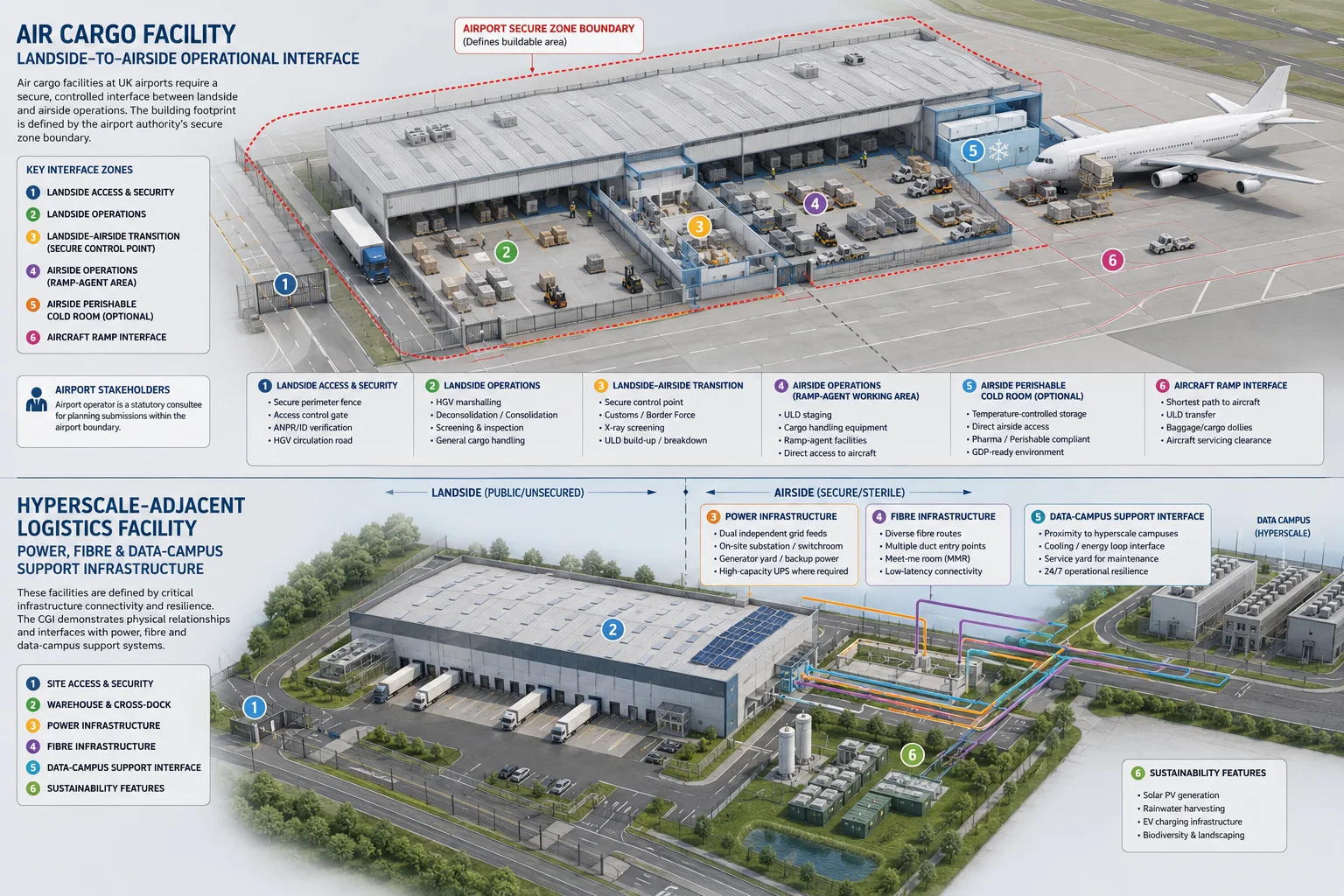
Air cargo and hyperscale-adjacent logistics are specialist warehouse typologies where the CGI must prove operational interface geometry, not just a building that fits the plot. Air cargo is defined by landside-to-airside control; hyperscale-adjacent logistics is defined by power, fibre, and data-campus support infrastructure.
Air cargo facilities at UK airports such as Heathrow, East Midlands, Manchester, and Stansted require the CGI to show the landside-to-airside interface: secure perimeter treatment, ramp-agent working zones, and where applicable, a perishable cold room on the airside face. The building footprint is determined by the airport authority's secure zone boundary, not only by the developer's site plan, and airport-adjacent planning submissions involve the airport operator as a statutory consultee.
Air cargo and hyperscale-adjacent evidence image: secure interfaces, ramp operations, power infrastructure, fibre routes, and data-campus support need to be visible as part of the base CGI brief.
Hyperscale-adjacent logistics has emerged as data centre campus development expands across the Golden Triangle, the Thames Valley, and the central belt of Scotland. These buildings serve logistics and maintenance needs around hyperscale data centre operators: component delivery, hardware refurbishment, and operational supply chain. Stratum produces mission-critical facility CGI for the campus and the supporting logistics envelope.
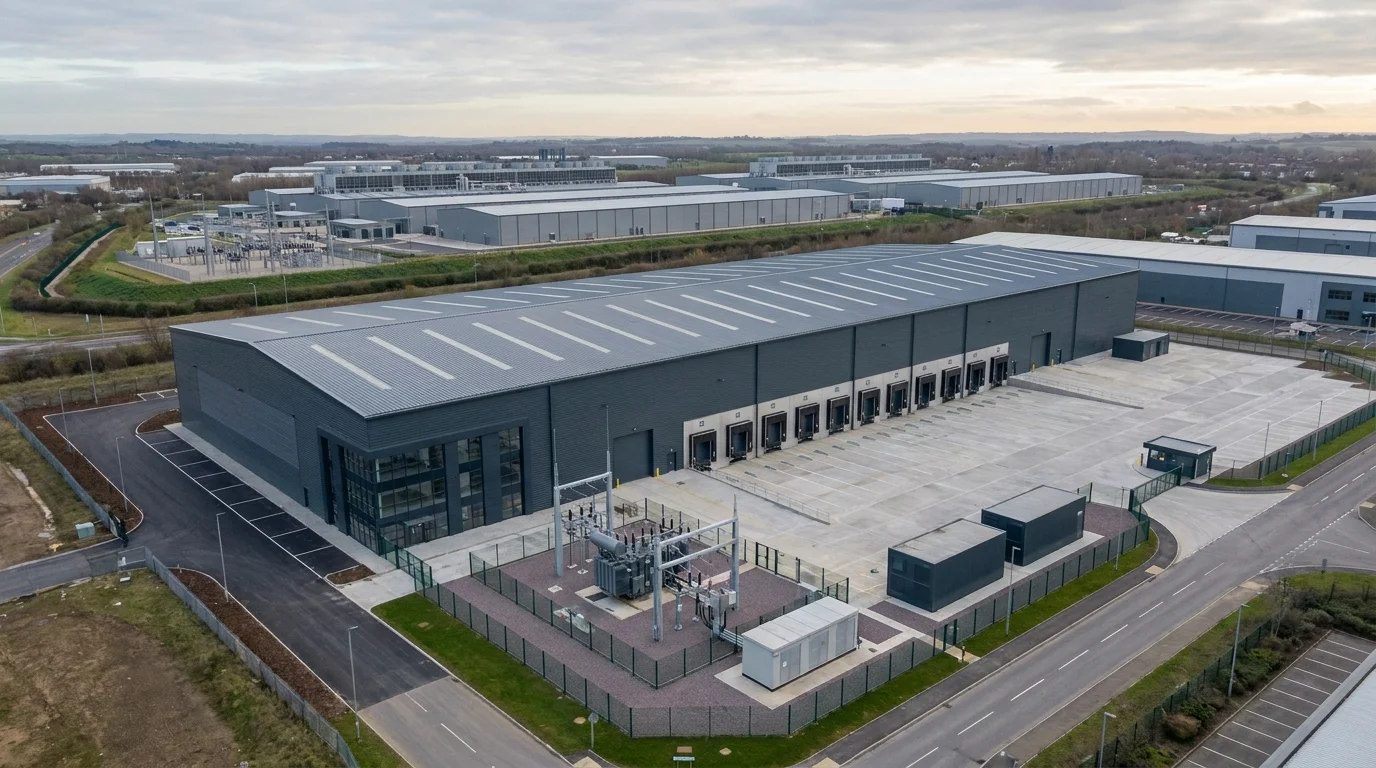
The power infrastructure is the visual differentiator. Primary electrical substation on site, standby generator housing, fibre conduit entry at ground level, and yard security all need to be modelled as part of the base brief. These elements are checked by the operator's facilities team before a build-to-suit commitment, so a conventional shed render with a substation added late does not carry the same technical signal.
Hyperscale-adjacent logistics: dedicated substation, fibre infrastructure, and data-campus context in one frame
Air Cargo and Hyperscale Pre-Let Visual Evidence
Specialist freight CGI must show operational interfaces: airside geometry, secure perimeter treatment, ramp-agent zones, power infrastructure, fibre entry points, and yard security.
Air cargo: landside-to-airside interface, secure perimeter, ramp-agent zone, perishable cold room if applicable
Specialist freight: HMRC bond room, screening area, and high-value cargo dock visible
Hyperscale-adjacent: power substation, fibre conduit entry, standby generator housing, and yard security legible
Production pass: confirm the operational interface geometry with the operator or airport authority before modelling starts, not as an afterthought to the architectural elevations.
See air cargo and specialist freight facility CGI services.
Consent and leasing timeline
Warehouse Visualisation Deliverables Across the Consent and Leasing Timeline
Competitor guides on warehouse typologies often describe what each building is. The timing of warehouse visualisation deliverables matters just as much, because the stage of the consent and leasing programme determines what the studio needs and what resolution of model is appropriate.
Stage 1: Pre-application, typically 3 to 6 months before submission
The pre-application CGI is a massing study, not a photoreal render. Its job is to establish agreed viewpoints with the local authority landscape and planning officers before the formal application is lodged. For high-bay and cold storage schemes, this stage also includes a wire-frame overlay on site photography to establish landscape impact at agreed viewpoints. Budget expectation: 1 to 2 frames at planning-study resolution.
Stage 2: Planning submission
The planning CGI is a photoreal render from the agreed viewpoints. All elements that are material planning considerations must be legible: landscape screening, plant impact, yard geometry, dock arrangement, EV infrastructure, airside interface, or power infrastructure. The planning CGI is produced from the same 3D base model used for leasing, so the base model is built at a higher detail level than a planning-only brief would strictly require. Budget expectation: 3 to 6 frames depending on typology complexity.
Stage 3: Pre-let marketing, concurrent with or immediately after submission
The pre-let hero render is cropped from the same base model as the planning CGI but lit and staged for a leasing audience. For a distribution centre, that usually means a low-level perspective showing dock count and yard depth. For a fulfilment centre, it means a three-quarter elevated perspective showing van and HGV access on separate yard zones. Investor-pack crops are produced from the same session.
Stage 4: Heads of terms and occupier technical brief
Once a named occupier is in conversation, the CGI brief deepens to reflect the occupier's specific requirements. For cold storage, this can mean modelling dock thermal seals to the occupier's seal specification and showing temperature-zone segregation in the yard. For high-bay ASRS, it can mean updating the elevation to reflect the automation vendor's structural grid. This stage is usually one or two revision passes on the base model, not a new production run.
Once planning consent is in hand, the same base model carries through to industrial property marketing: brochure hero, portal carousel, investor pack crops, and trade-press stills. The geometry is fixed at planning. What changes is camera, time of day, signage, and trailer pool. That continuity is what keeps a pre-let campaign image set on-message from RIBA Stage 3 through occupier signature.
Occupier profiles
Warehouse Typology Occupier Mapping
Each typology has a different occupier covenant and CGI requirement. A grocery 3PL evaluating a cold-store build-to-suit needs plant and temperature-zone evidence. A parcel carrier evaluating a last-mile depot needs van-yard and street-scene evidence. An institutional investor reading a distribution centre pack also wants to see covenant-quality cues, not only a dock count.
Distribution centre occupiers
CEVA Logistics, XPO, DHL Supply Chain, Wincanton, Clipper, Sainsbury's, Tesco, general-merchandise importers with pallet throughput over 10,000 pallets per week, and investor-facing schemes where SEGRO, Prologis, or Tritax covenant evidence changes the read of the pack.
Fulfilment hub occupiers
Amazon, Next, ASOS, Ocado, returns-processing operators, parcel network operators, and brands moving to direct-to-consumer with multi-channel despatch.
Cold storage occupiers
Lineage Logistics, Nidum, Yearsley, food-retail 3PLs, pharmaceutical wholesale distributors, fresh-produce importers, and specialist cold-chain operators with MHRA or BRC AA accreditation requirements.
Last-mile depot occupiers
DPD, Evri, DHL Parcel, Amazon Logistics, grocery rapid-delivery operators, and urban EV-fleet 3PLs requiring sub-60,000 sq ft sites within 30 minutes of city-centre postcodes.
The pre-let pack has to picture the named occupier's operation, not a generic shed. A cold-store pack for a food-retail 3PL shows dock thermal seals, temperature-zoned yard movement, and a refrigeration plant deck sized to the occupier's energy load. A last-mile pack for a parcel carrier shows van bay striping at the carrier's count, branded trailer pool, and the late-shift street scene the planning committee will see.
CGI strategy
Where Visual Evidence Carries the Most Planning Risk
The risky typologies are not always the largest buildings. Risk rises where the image set has to prove an operational constraint before a planning officer, leasing agent, or occupier reviewer will trust the scheme.
Typology
Why the image carries risk
First proof point
What fails if missed
Cold storage
Plant deck, acoustic screening, and thermal envelope are visible planning evidence, not background specification.
Roof plant, dock thermal seals, temperature zones.
The render looks like a dry warehouse and weakens both planning and occupier review.
High-bay ASRS
Ridge height, automation grid, and landscape screening have to survive LVIA and technical scrutiny.
Agreed viewpoint, wire-frame overlay, ASRS grid.
The team may need camera correction, model rebuild, or a revised planning image set.
Last-mile depot
The committee reads the street edge, van movement, EV charging, and acoustic boundary before the warehouse form.
Street scene, van yard, charging bays, frontage.
The proposal reads as an unmanaged yard beside homes or local streets.
Hyperscale-adjacent logistics
Power, fibre, security, and service-yard geometry sit in the occupier's technical review.
The image looks like a conventional shed with late-stage infrastructure bolted on.
Pre-let and planning FAQs
UK Warehouse Typology Questions
What are the main warehouse typologies in the UK?
+
The main UK warehouse typologies are distribution centres, fulfilment centres including cross-dock variants, cold storage facilities, last-mile depots, high-bay automated warehouses, and air cargo or hyperscale-adjacent logistics. Each type carries a different occupier profile, planning evidence requirement, and CGI brief.
How does a distribution centre differ from a fulfilment hub?
+
A UK distribution centre moves pallet loads between nodes, prioritising dock count, yard depth, and HGV circulation. A fulfilment centre processes individual orders, prioritising clear internal height, mezzanine potential, van despatch, and cross-dock flow alongside HGV docks. The CGI brief changes because a distribution centre must prove yard discipline, while a fulfilment centre must prove dual throughput across HGV and van streams.
What makes cold storage CGI different for planning?
+
A cold storage warehouse needs insulated composite cladding panels, roof-mounted refrigeration plant, dock thermal seals, and temperature-zone segregation in the yard. Planning CGI must model the plant deck and acoustic screening clearly, while pre-let CGI must make the thermal-seal and temperature-zone logic legible to food-retail, 3PL, or pharma occupiers.
Where does visual evidence carry the most planning risk?
+
Visual evidence carries the most planning risk where the typology changes the consent proof point. Cold stores need plant, acoustic, and thermal-envelope evidence; high-bay schemes need agreed-viewpoint LVIA-grade massing; hyperscale-adjacent logistics needs power and fibre infrastructure; and last-mile depots need street-scene, van access, and EV charging evidence.
What characterises a high specification warehouse in the UK?
+
A high specification UK warehouse, also called Grade A institutional spec, typically combines 12 to 18 metres clear internal height, 50 kN/m² UDL floor loadings, service yards over 50 metres, a full ratio of dock-leveller doors against ground-level shutters, BREEAM Excellent or Outstanding, EPC A, and high-kVA three-phase power for automation, EV charging, and rooftop PV. Every one of those markers is something the pre-let CGI must make legible to the occupier, planning officer, and investor before the building is built.
Related services
Warehouse Visualisation Services by Typology
Each typology has a service page that carries the planning, leasing, and investor deliverables specific to its occupier profile and evidence requirements. The hub page below covers all six on one workflow. The specialist pages drill into the views, signage, and yard logic that the named occupier will check first.
Warehouse and Logistics CGI
All six typologies. Planning, leasing, and investor deliverables from a single production workflow.
Distribution Centre CGI
Big-box planning and pre-let. Yard discipline, dock rhythm, and verified-view options.
Fulfilment Centre CGI
Multi-mode throughput, cross-dock variants, and van-heavy e-commerce despatch.
Data Centre CGI
Hyperscale campuses and power-dense logistics adjacent to data infrastructure.
Industrial Property Marketing
Pre-let campaign image sets, leasing brochures, and occupier-ready portals built from the planning CGI base model.