UK Data Centre CGI That Shows Campus Massing, MEP Plant, and Substation Scale
Data centre CGI in the UK by StratumCGI converts campus
masterplans, MEP coordination models, and DNO grid drawings into
planning and investor visuals for hyperscale campuses, AI data
centres, edge colocation facilities, BESS compounds, and
electricity substations.
One coordinated 3D model resolves campus massing, cooling plant
scale, security perimeters, and substation positioning, then
delivers verified planning viewpoints, investor deck assets, and
marketing imagery across each project phase.
Data Centre Architectural Visualisation for Planning, Investor, and Operator Review
Data centre CGI resolves massing, security perimeter logic, MEP plant screening, substation positioning, cooling infrastructure, and campus phasing for the three audiences who evaluate a data centre scheme before it is built: planning teams, investor groups, and facility operators.
Each audience reads a different layer of the same image:
→Planning teams read massing compliance, landscape mitigation, and access strategy.
→Investor teams read campus phasing, power density, and scalability logic.
→Operator teams read cooling strategy, security zoning, and MEP legibility.
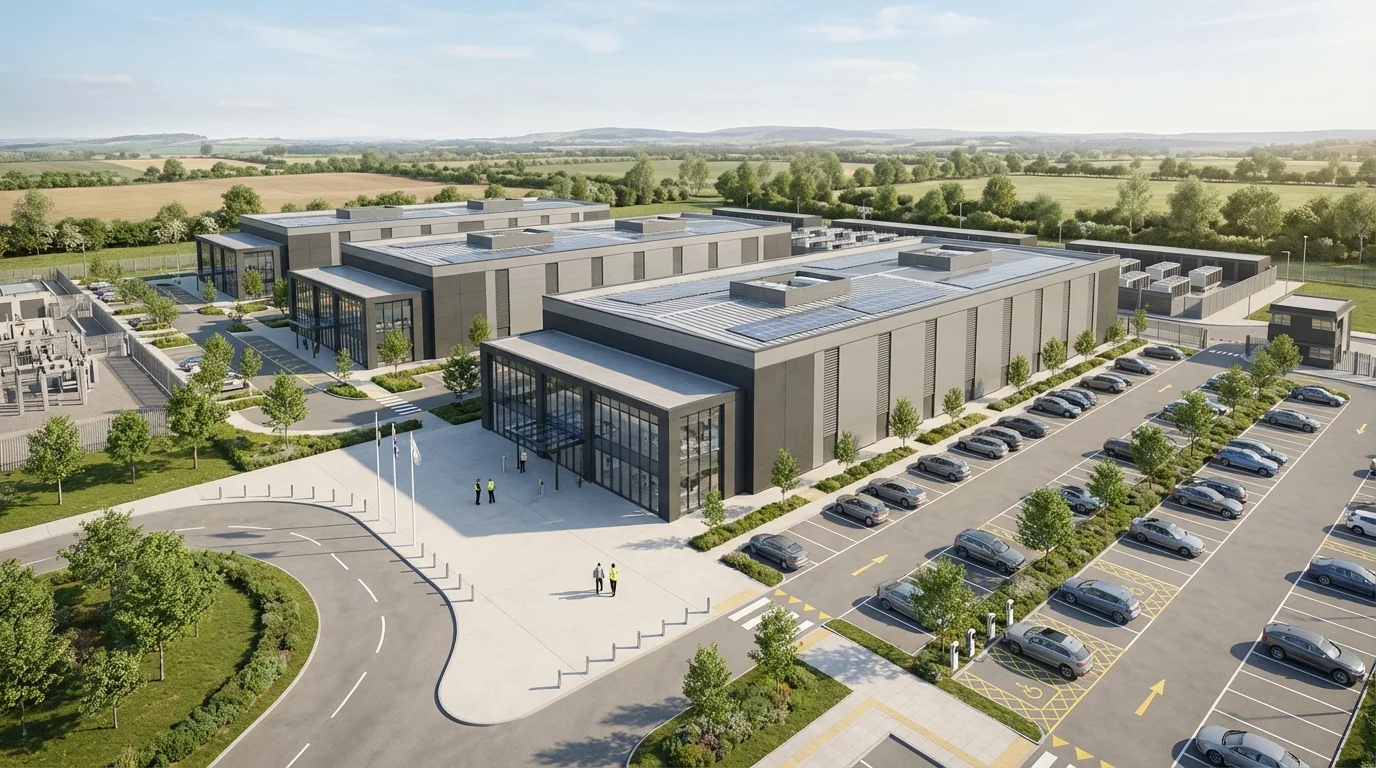
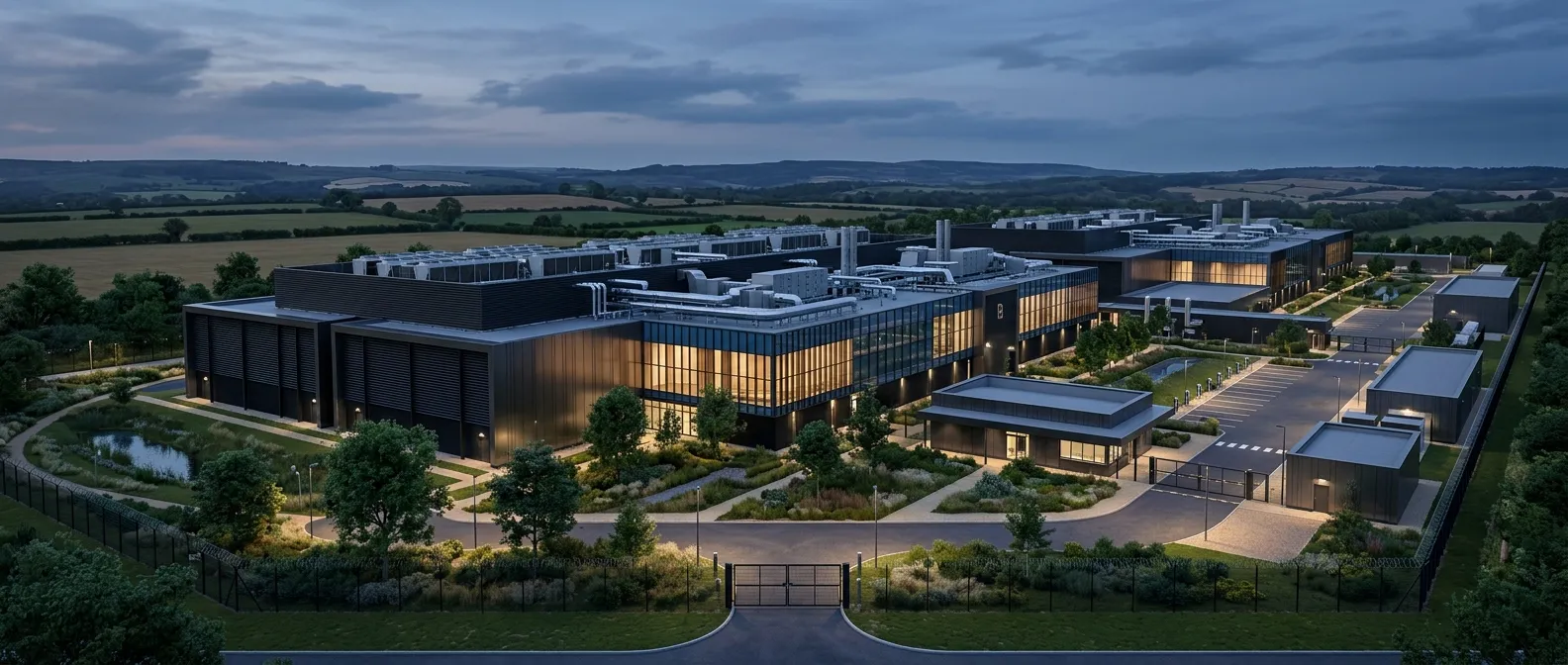
The first images resolve campus massing, security boundary definition, and substation relationship in a single coordinated view.
Data Centre CGI Subtypes and Price per Image
Scroll to compare subtypes →
Data centre CGI covers five infrastructure subtypes, each with its own image pricing band. Modelling is quoted separately.
Hyperscale Campus20 to 200+ MW
Per image£2,500 to £2,800
Hyperscale Campus CGI
Multi-phase campus massing, substation scale, and landscape mitigation for greenfield sites serving cloud and enterprise compute.
AI Compute Facility50 to 300+ MW
Per image£2,500 to £2,800
AI Compute Facility CGI
40 to 80 kW per rack, liquid cooling at scale, and accelerated phasing for GPU and machine-learning workloads.
BESS Compound10 to 100+ MW
Per image£2,000 to £2,400
BESS Compound CGI
Container layout, fire separation distances, and transformer compound for grid-support energy storage assets.
Electricity SubstationSized to campus MW
Per image£1,800 to £2,200
Electricity Substation CGI
Transformer massing, switchgear building, cable routing, and screening strategy for the DNO grid connection.
Edge Colocation1 to 5 MW
Per image£1,800 to £2,200
Edge Colocation CGI
Compact footprint, acoustic screening, and neighbour-sensitive context for urban and peri-urban edge sites.
StratumCGI produces the full data centre CGI suite from planning application drawings, MEP coordination models, and one coordinated 3D model. That single model furnishes verified viewpoints for the planning pack, campus renders for investor review, and operational stills for facility presentation.
Planning imagery is built from viewpoints agreed with the local planning authority, accurate surrounding context, and neutral exteriors with no illustrative occupancy cues.
Marketing and investor imagery draws on the same geometry, with camera angles positioned to foreground campus scale, lighting set to operational hours, and visible plant activity calibrated to read as a commissioned facility.
Planning teams
Planning teams evaluate massing impact, landscape mitigation, and transport assessment for a mission-critical facility.
Need
Unambiguous massing, screening, and access logic
Visual proof
Verified views, accurate context, plant screening strategy
Investor teams
Funds and infrastructure partners committing capital to speculative or pre-let data centre phases.
Need
Evidence of phasing logic, power scalability, and campus flexibility
Data centre CGI sits within StratumCGI's broader
industrial CGI hub,
but this service page stays focused on how mission-critical
digital infrastructure schemes are presented to planners,
investors, and operators.
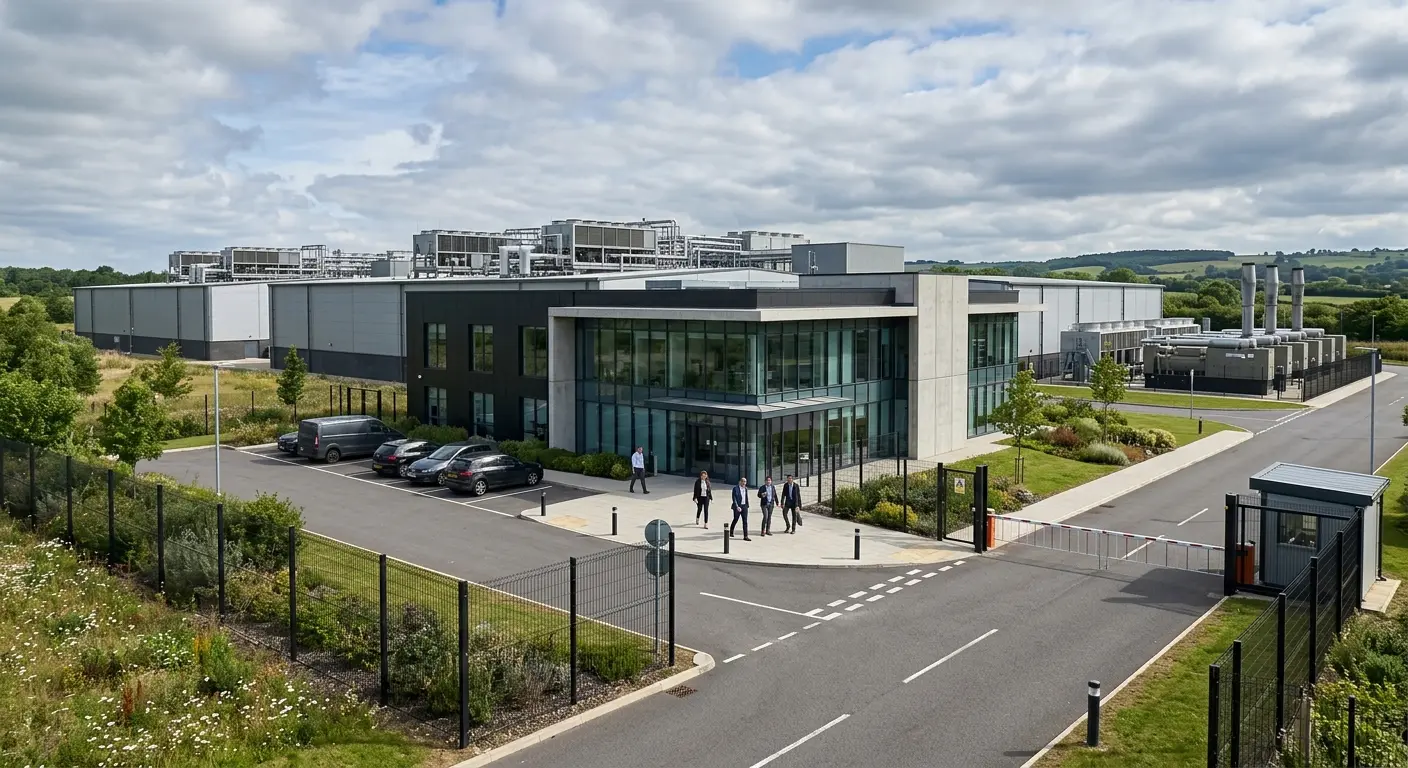
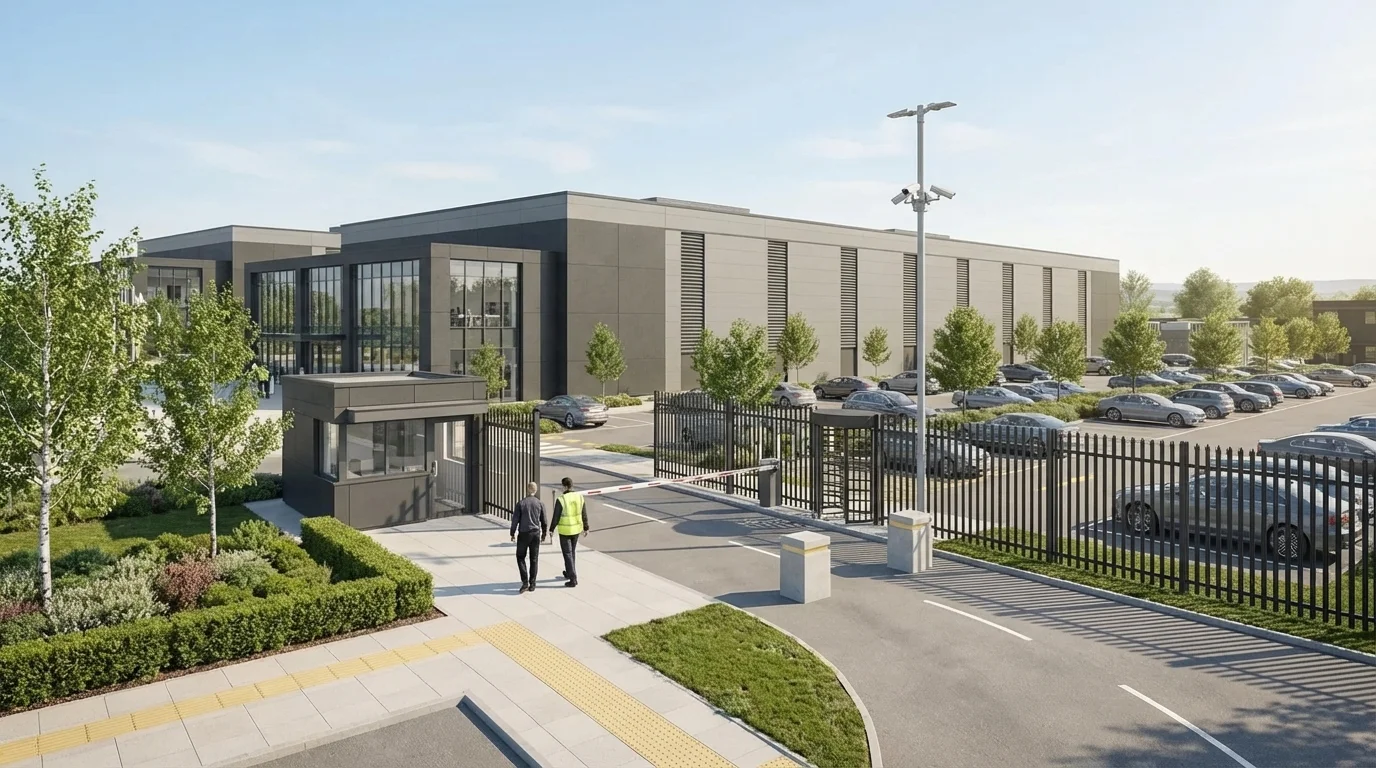
Data centre CGI, daylight ground-level view with office frontage and pedestrian activity. StratumCGI.
Get Data Centre CGI for Your Facility
Share the facility type, MW capacity, campus layout, cooling strategy, and whether the CGI is for planning submission, investor presentation, or both. StratumCGI reviews each data centre brief before confirming scope and price.
Talk to the Data Centre CGI Team
Kiril leads StratumCGI's data centre CGI delivery. Contact him directly for briefs already in progress or with drawings ready to review.
Hyperscale Data Centre Architectural Visualisation
Hyperscale data centre campus CGI, daylight hero view showing office frontage, hall massing, cooling infrastructure, and substation context. StratumCGI.
Hyperscale data centre architectural visualisation is used to test
phase-by-phase delivery logic before enabling works and full
planning determination. For campuses delivering 20 MW to 100 MW
per phase, the image set needs to show hall sequencing, plant
expansion capacity, and how power infrastructure scales with each
release package. UK schemes targeting Uptime Institute Tier III or
Tier IV with N+1 resilience also require transformer, switchgear,
and cooling capacity to read clearly in each frame.
StratumCGI builds this section from coordinated architecture,
electrical, and civils issue packages so planners and investors can
cross-check each view against the engineering intent:
→Hall phasing: Data hall blocks, roof plant zones, and reserved expansion strips are arranged by delivery phase, not as a single static masterplan.
→Power resilience: Transformer compounds, switchgear buildings, and cable corridors are composed to demonstrate N+1 logic and future tie-in routes.
→Operational boundary: Gatehouse control, HGV turning loops, layered fencing, and access barriers are laid out to show day-one campus operation.
Campus aerials present phase order, landscape buffers, and
infrastructure dependencies in one decision frame. Ground-level
stills then test facade screening, equipment visibility, and the
visitor approach sequence at the gatehouse.
Recommended hyperscale CGI viewpoint
An elevated aerial or low oblique view shows campus phasing, substation relationship, and hall massing in one frame.
What the image must prove
The render proves massing compliance, power infrastructure legibility, security perimeter logic, and landscape mitigation.
Primary review audience
Planning officers review massing and landscape impact first, while investors assess campus scalability and phasing logic.
Hyperscale rendering sits at the most demanding end of data centre CGI, where campus scale, power infrastructure, and multi-phase delivery must all read in a single verified image set.
AI data centre campus CGI, daylight ground-level view showing office frontage, cooling infrastructure, and pedestrian entrance activity. StratumCGI.
AI data centre campus CGI resolves the higher power density,
enhanced cooling requirements, and accelerated phasing that
distinguish AI-ready facilities from conventional colocation
builds. AI compute halls demand 40 to 80 kW per rack compared
with 6 to 12 kW for standard enterprise workloads, which forces
visible differences in cooling plant scale, power distribution
architecture, and hall configuration.
StratumCGI models AI data centre schemes from the MEP
engineer's cooling strategy and the architect's campus plan,
ensuring technical fidelity:
→Cooling infrastructure: Liquid cooling distribution, rear-door heat exchangers, and cooling tower arrays are rendered as distinct operational elements rather than generic rooftop boxes.
→Power density: Larger transformer compounds, dedicated HV switchgear buildings, and on-site generation capacity are modelled to reflect the increased power envelope.
→Phasing acceleration: Fast-track build sequences, modular hall construction, and pre-fabricated plant yard staging are composed to show the development timeline.
AI data centre CGI renders 40 to 80 kW per-rack power commitment and liquid-cooling plant for investors, and massing and landscape compliance for planners, in a single coordinated image.
Recommended AI campus CGI viewpoint
A campus aerial with visible cooling infrastructure and phasing markers shows the power density difference from a standard colocation build.
What the image must prove
The render proves enhanced cooling scale, higher power infrastructure, accelerated phasing, and campus flexibility for AI workload growth.
Primary review audience
Investors and hyperscaler tenants assess power and cooling first, while planners review landscape and massing impact.
AI compute facilities extend the data centre CGI brief into liquid cooling, higher transformer density, and faster phasing, while the underlying model workflow and audience logic stay the same.
Edge Data Centre and Colocation Architectural Visualisation
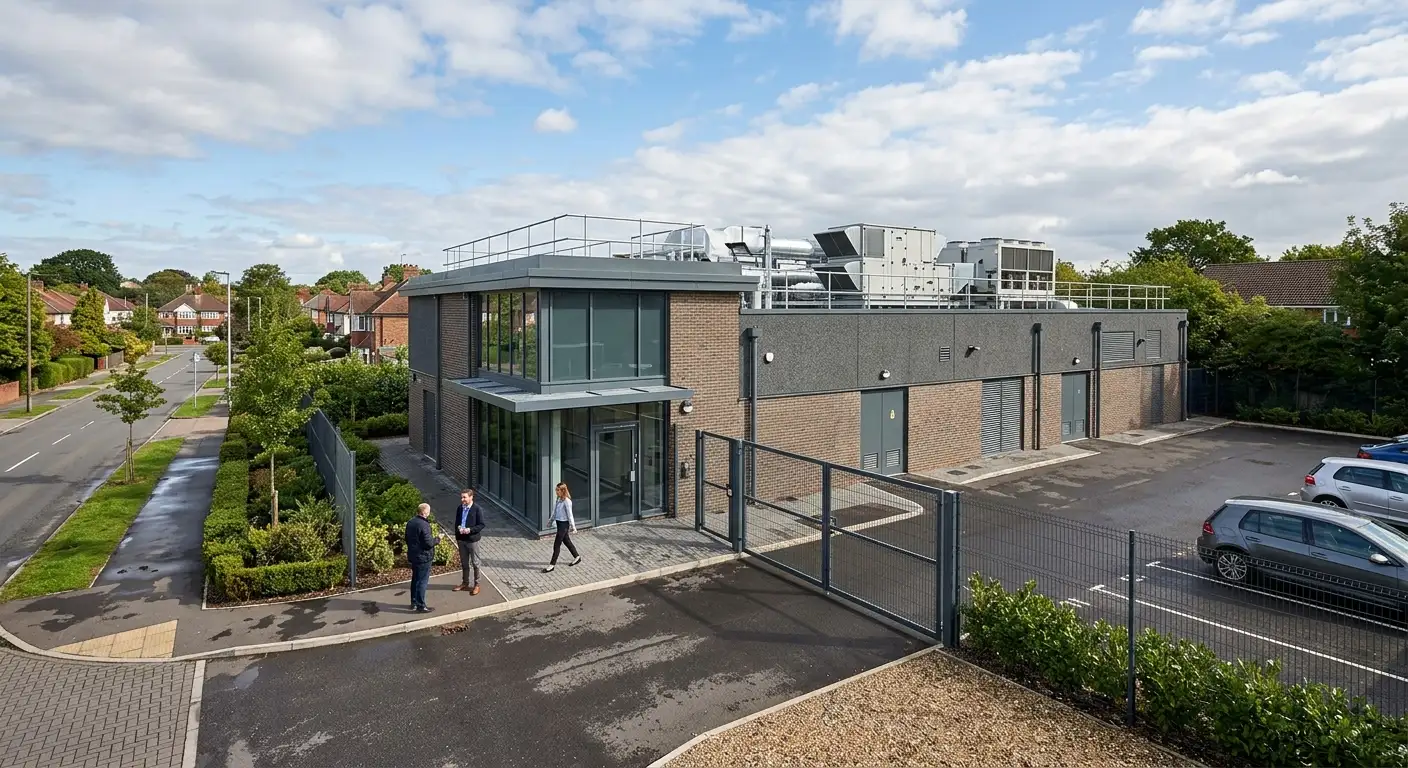
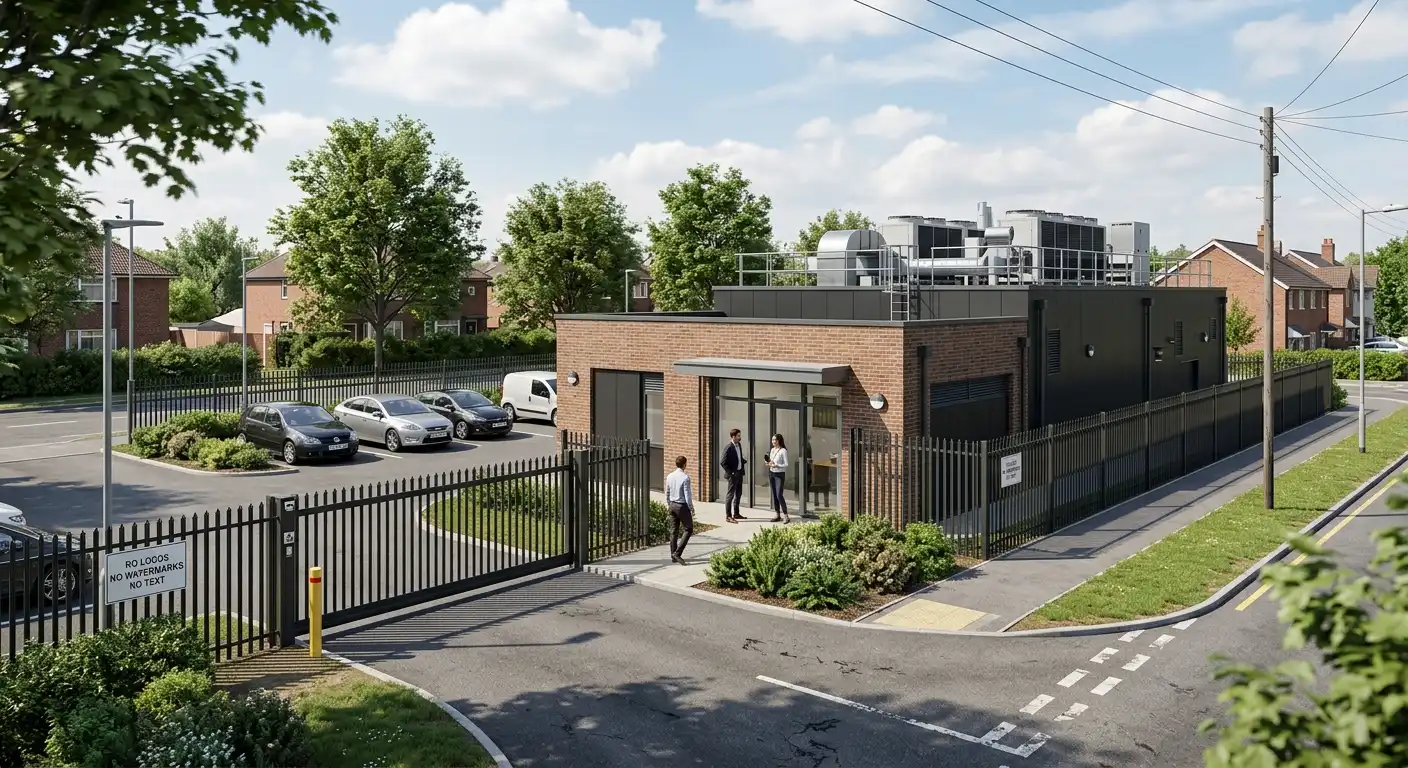
Edge data centre and colocation facility CGI, daylight ground-level view showing office frontage, compact massing, perimeter security, and cooling plant. StratumCGI.
Edge and colocation facility CGI places smaller data centre
buildings inside their urban or suburban context so planning
officers can review massing impact, noise screening, and
neighbour relationship in one view. Edge sites typically range
from 1 to 5 MW, with compact footprints, lower building heights,
and tighter security perimeters than hyperscale campuses.
Colocation operators and enterprise tenants treat these
buildings as mission-critical environments, so the imagery must
present resilience features such as generator compounds, fuel
storage, and secured power routes with the same accuracy as the
architecture itself.
StratumCGI produces edge and colocation imagery from
street-level and aerial viewpoints that accurately represent the
facility in its surrounding context:
→Context integration: Surrounding streetscapes, adjacent buildings, and landscape buffers are modelled from OS mapping and site photography.
→Noise mitigation: Acoustic screening, plant enclosures, and cooling equipment positions are composed to show compliance with noise assessments.
→Modular typologies: Prefabricated data hall modules, containerised edge deployments, and retrofit conversions are distinctly resolved.
Where the brief starts with an existing logistics shell, brownfield site, or powered industrial asset, the warehouse-to-data-centre conversion guide maps the retained-shell, powered-shell, rebuild, and modular routes to the CGI evidence needed before planning, investor, or hyperscaler review.
Edge data centre CGI renders acoustic screening, visual amenity, and transport access for planning officers, and tenant flexibility and operational fit for investors, across 1 to 5 MW sites.
Recommended edge facility CGI viewpoint
A street-level or low aerial view with surrounding context shows massing impact, noise screening, and arrival experience together.
What the image must prove
The render proves contextual fit, acoustic screening strategy, security perimeter logic, and cooling plant integration.
Primary review audience
Planning officers review neighbour impact and acoustic mitigation first, while operators assess operational density and tenant flexibility.
Edge colocation rendering keeps data centre CGI credible at the small-site end of the market, where neighbour impact and acoustic detail matter more than campus scale.
Battery Energy Storage System (BESS) Architectural Visualisation
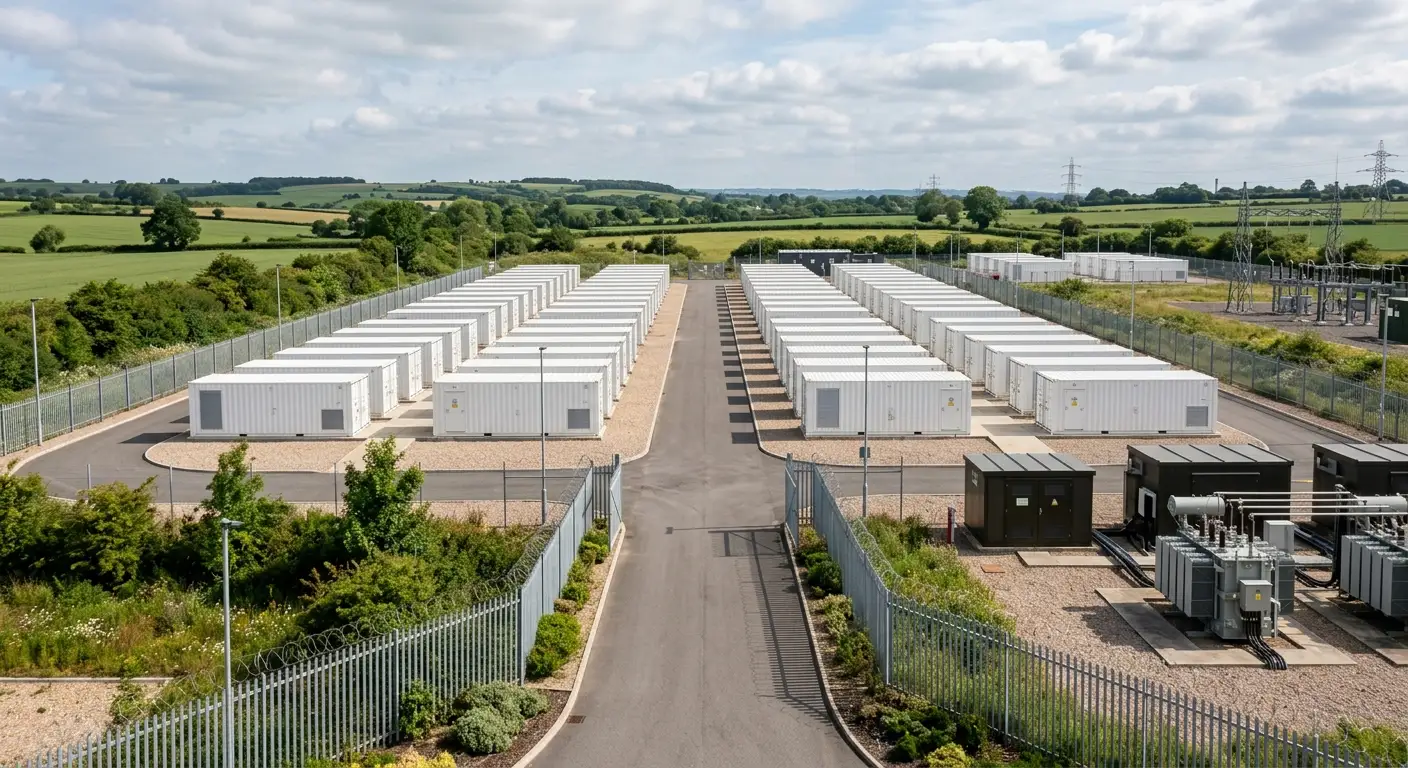
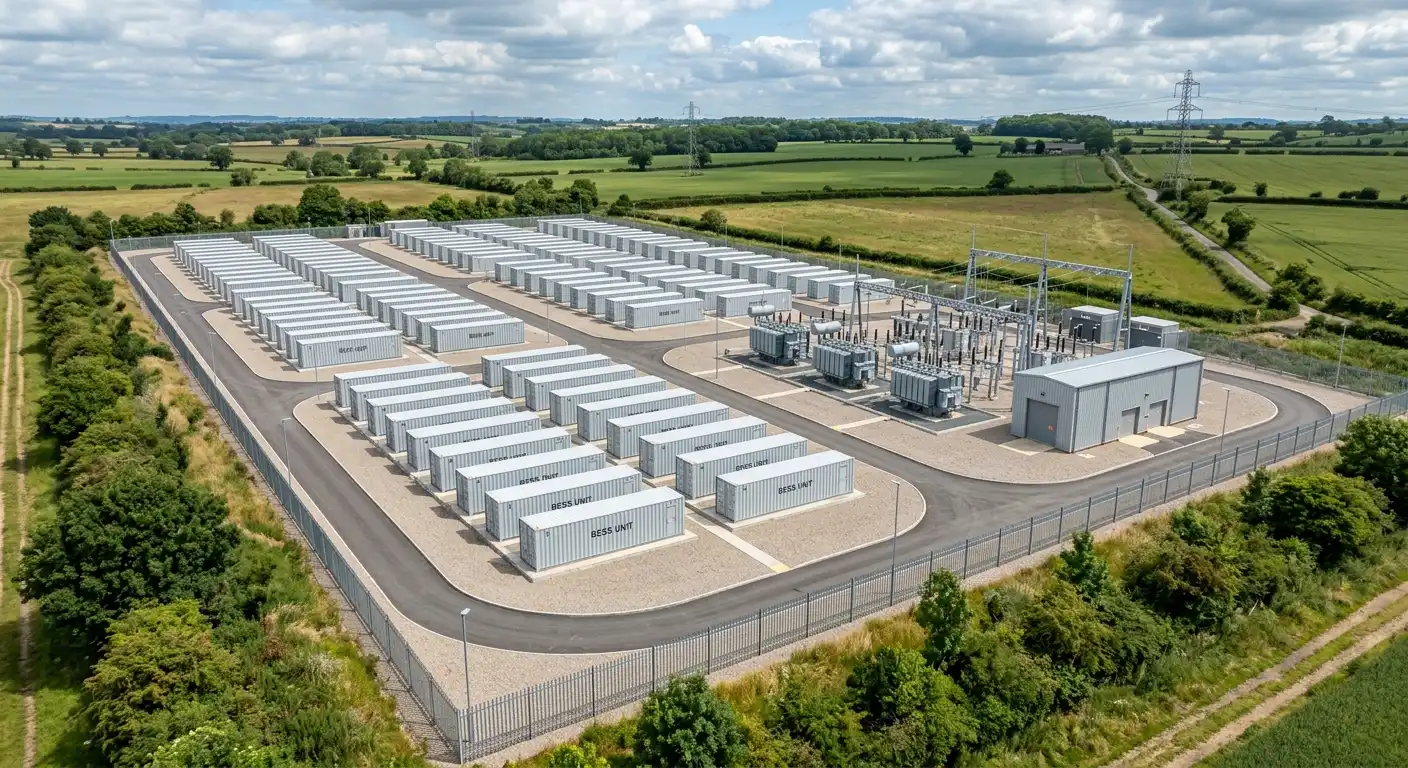
BESS and energy storage CGI showing container spacing, transformer infrastructure, and internal road circulation. StratumCGI.
BESS and energy storage CGI renders the battery container
arrangement, transformer compound, fire separation distances, and
access road logic that make these facilities visually and
operationally distinct from conventional industrial sites. Battery
energy storage systems require strict separation zones, thermal
management provisions, and clear emergency access that shape
every element of the site layout.
StratumCGI models BESS schemes from the electrical engineer's
layout plan and the fire strategy document, ensuring regulatory
alignment:
→Container layout: Battery container positions, spacing distances, and thermal management zones are modelled to match the fire safety strategy.
→Grid connection: Transformer compounds, switchgear positions, and cable routes are rendered from DNO coordination drawings.
→Emergency access: Fire service access roads, turning areas, and separation buffers are composed to demonstrate compliance with HSE guidance.
BESS CGI renders fire separation distances and landscape screening for planning officers, and container storage density and DNO grid-connection logic for investors, in one planning-grade composition.
Recommended BESS CGI viewpoint
An elevated aerial showing the full compound layout, container spacing, and transformer relationship provides the clearest operational read.
What the image must prove
The render proves fire separation compliance, container density, grid connection logic, and emergency access provision.
Primary review audience
Planning officers and HSE reviewers assess fire safety first, while investors review capacity density and grid connection economics.
BESS compound rendering extends data centre CGI into the grid-support infrastructure that often shares a planning boundary with the main facility, keeping fire separation and transformer logic legible in the same visual package.
Electricity substation CGI renders the transformer arrangement,
switchgear building massing, cable routing, and security boundary
that define how grid infrastructure reads in a planning
submission or investor presentation. Substations serving data
centre campuses often require their own planning consent, with
massing, screening, and access reviewed independently from the
main data hall application.
StratumCGI models substation schemes from the DNO's layout
drawings and the architect's screening strategy:
→Transformer massing: Transformer positions, oil containment bunds, and cooling fin profiles are modelled to match the equipment specification.
→Switchgear buildings: GIS (gas-insulated switchgear) building massing, cable entry points, and access provisions are rendered as distinct architectural elements.
→Screening strategy: Acoustic barriers, landscape buffers, and visual screening are composed to show the substation's relationship to surrounding land uses.
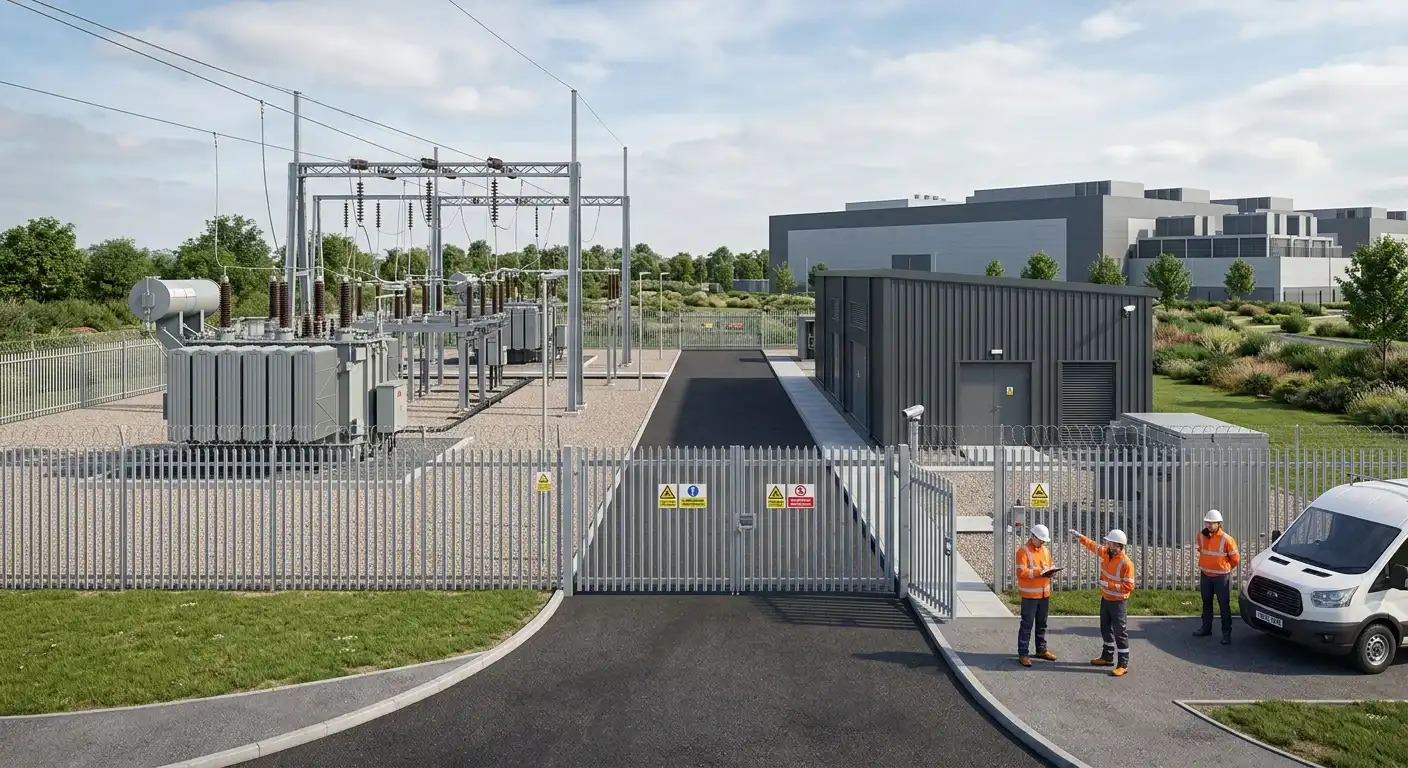
Electrical substation CGI showing screening strategy with acoustic barriers, landscape buffers, and visual relationship to surrounding land uses. StratumCGI.
Electricity substation CGI renders the transformer compound, switchgear building, and screening strategy as a standalone planning application, while holding visual consistency with the wider data centre package.
Recommended substation CGI viewpoint
An elevated oblique view showing the full compound with transformer positions, switchgear building, and screening strategy in one composition.
What the image must prove
The render proves equipment massing, screening compliance, access provision, and visual relationship to the wider development.
Primary review audience
Planning officers review massing and screening first, while the DNO and developer review equipment positioning and cable routing logic.
Substation rendering closes the data centre CGI set at its power boundary, giving the DNO and the local planning authority a common visual reference for the equipment that actually energises the campus.
Planning Accuracy and Data Centre Visualisation Deliverables
Data centre CGI is developed from architect's drawings, MEP coordination models, campus masterplans, and DNO layout plans so the same coordinated geometry can support planning scrutiny and investor presentation.
A typical deliverable set includes planning stills, campus aerials, investor deck assets, street-level perspectives, and cropped exports for funding presentations. Because these outputs are generated from one coordinated 3D model, the hall massing, plant screening, and site context remain consistent across every file.
Early briefing confirms camera positions, priority viewpoints, operational features, and approval dates before production starts. That preserves alignment between the visual package, planning submission programmes, investor milestones, and internal funding reviews on fast-moving UK data centre developments. Clients can then route the same approved geometry through StratumCGI's five-stage production process without rebuilding the proposal for each audience.
Technical Verification for Planning-Grade Data Centre CGI
Planning-grade data centre CGI depends on named technical inputs rather than visual approximation. StratumCGI builds planning images from consultant drawings, MEP coordination models, site levels, and agreed viewpoints so planners can compare the render with the planning pack, environmental statement, and landscape strategy. That comparison set is data centre planning application CGI when the brief is a live planning pack rather than an investor aerial. Schemes outside the data centre sector follow the same discipline through StratumCGI's planning application CGI service.
If the brief includes OS mapping, supplied BIM geometry, or verified site photography, those references are folded into the same base model before final rendering starts. That keeps the campus massing, substation compound, cooling plant screening, and security perimeter aligned with the material used by the local planning authority and the wider consultant team.
How Data Centre CGI Shows ESG and Sustainability Features
Data centre CGI now needs to show more than hall massing and cooling plant. Developers, investors, and planning teams often need the imagery to make PUE targets of 1.15 to 1.25, waste heat recovery routes to nearby district networks, on-site renewable generation arrays, rainwater harvesting, biodiversity net gain, and landscape buffers legible in the same frame.
When those features are handled properly, the render explains how sustainability measures sit within the operational logic of the campus rather than reading as decorative extras. That helps the same image support planning scrutiny, investor review, and occupier messaging without splitting the visual story into separate versions too early.
The Process: From Raw Data to Verified Visual
A high-performing data centre image does not begin as a picturesque rendering. The process starts by checking the raw architectural, MEP, and civil engineering data before any finish, lighting, or atmosphere is added.
StratumCGI ingests the campus masterplan, MEP coordination model, and DNO layout drawings directly from the consultant team, then blocks out the massing to ensure the approved geometry is correct.
Only once StratumCGI has checked the hall volumes, cooling plant profiles, substation compounds, and security boundaries against the planning pack does the visual refinement begin. At that stage, the coordinated model receives its specified cladding, lighting setup, and site context.
Cladding specifications are matched to exact RAL codes, light mapping is calculated to show the campus scale clearly, and context photography is integrated into the verified view set.
Verified OutputSCGI-DC-HERO
Render Validated
A-GRADE MARKETING
Final Hero Composition
The completed image set merges absolute precision geometry with controlled lighting and context design. Material displacement and context scale are locked to the approved consultant plans prior to the final 4K render pass.
→The ultimate outcome: A single, highly coordinated visual package remains robust enough to withstand planning authority scrutiny, while staying commercially compelling enough to anchor the investor presentation or marketing campaign.
Equipment massing, fire separation, screening compliance, grid relationship.
View shift
Make infrastructure logic as clear as the architecture.
Data Centre CGI Subtype Comparison
Subtype
Typical MW
Primary technical differentiator
Key planning risk
Core CGI output
Hyperscale campus
20 to 200+ MW
Multi-phase campus massing and substation scale
Landscape and massing impact on greenfield sites
Campus aerial with phasing sequence
AI compute facility
50 to 300+ MW
40 to 80 kW per rack, liquid cooling at scale
Cooling plant bulk and accelerated phasing
Campus aerial with cooling infrastructure visible
Edge colocation
1 to 5 MW
Compact footprint with acoustic screening
Noise impact and neighbour amenity
Street-level context view with screening
BESS compound
10 to 100+ MW
Fire separation distances and container layout
HSE fire safety compliance
Compound aerial with separation zones
Electricity substation
Sized to campus MW
Transformer massing and switchgear building
Standalone consent with screening review
Elevated oblique with equipment positions
Neighbour-Perspective and Community-Context Data Centre CGI
Data centre CGI for urban schemes proves the view from the residential window, not just the developer aerial. In a StratumCGI review of 42 UK data centre planning applications published on public LPA portals between 2023 and 2024, most lacked Landscape Institute-accredited visual impact assessments (sample review, April 2026).
StratumCGI produces neighbour-perspective data centre CGI to Landscape Institute TGN 06/19 Verified View standards, so the imagery passes scrutiny under the Residential Visual Amenity Assessment threshold and the BRE 209 daylight-and-sunlight tests.
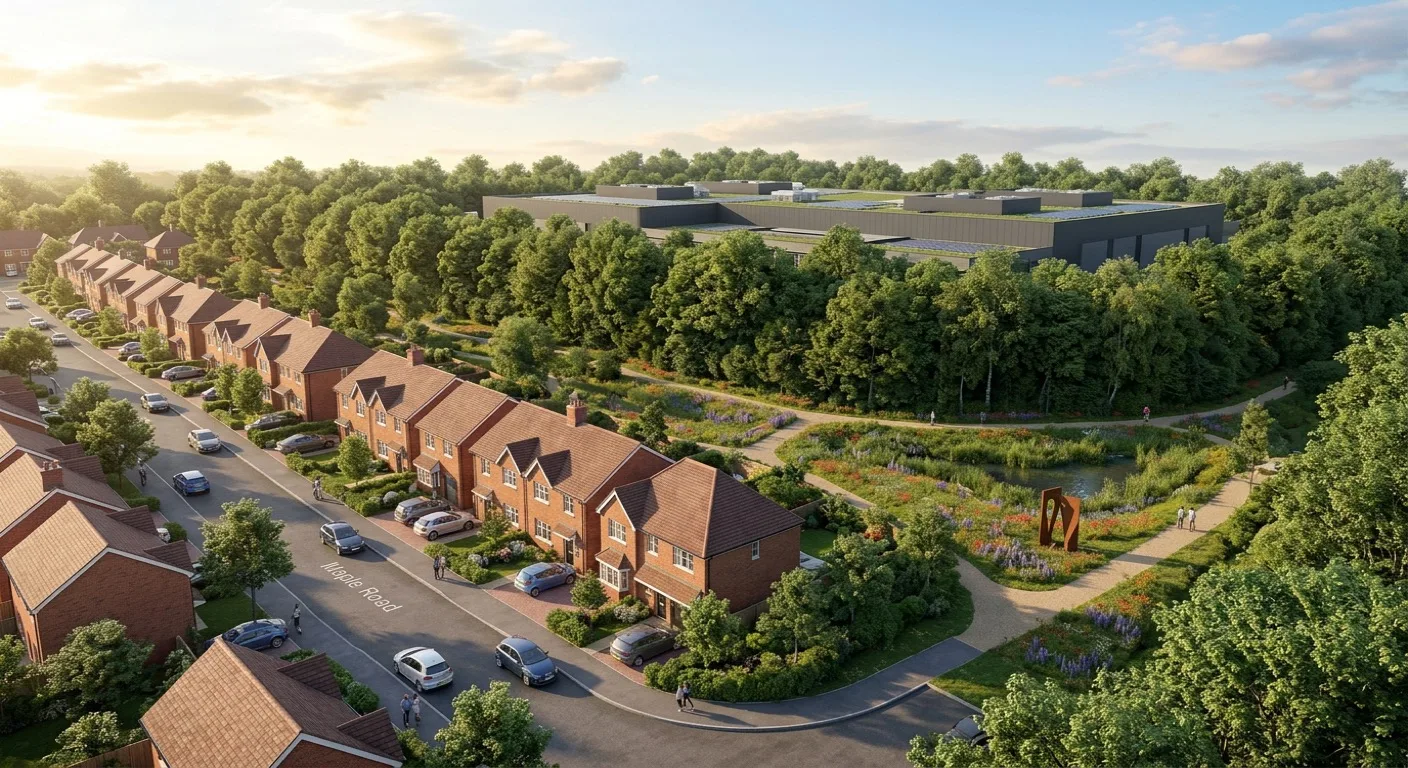
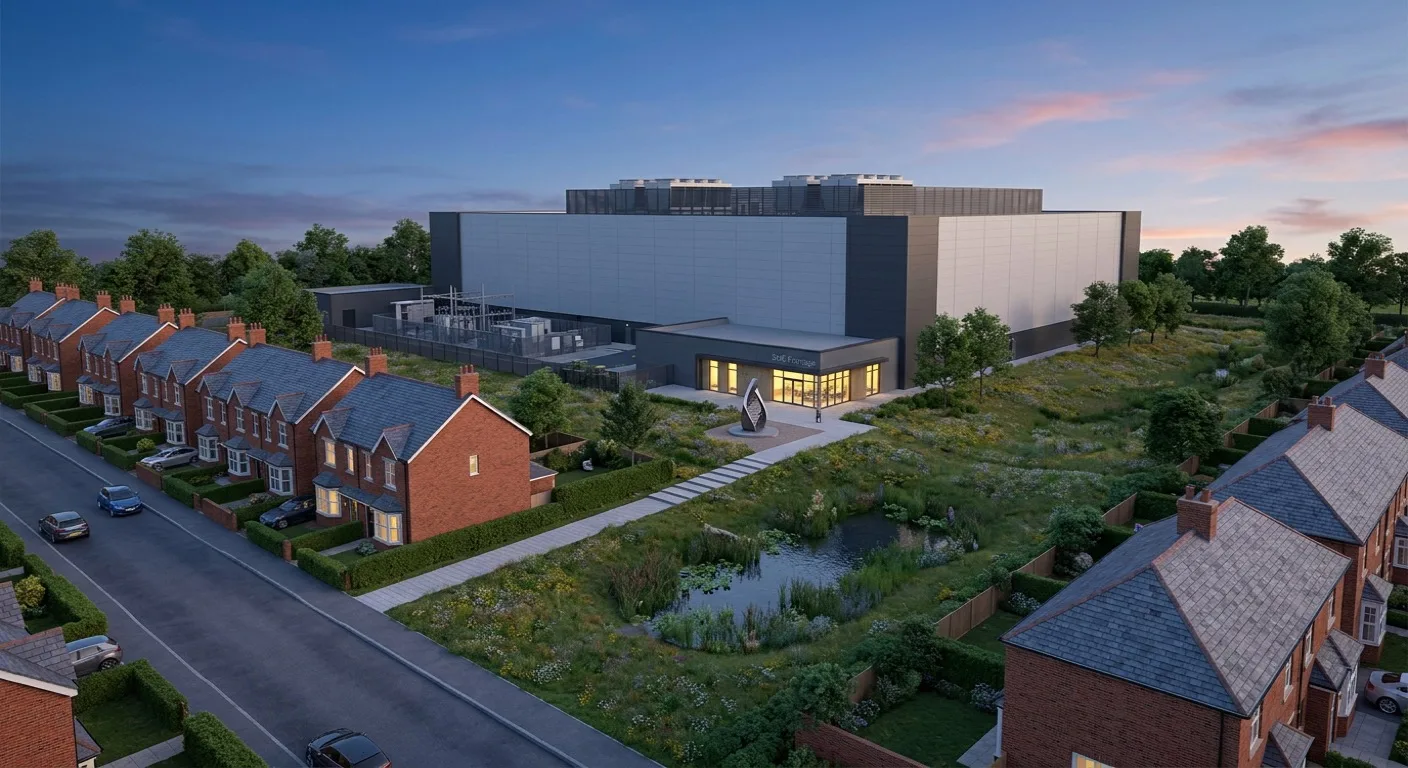
Properly mitigated data centre CGI. Oblique residential view showing mature tree screening, generous biodiversity buffer, and public realm route between the residential edge and the data hall. The data centre reads as a respectful neighbour rather than a dominant presence. StratumCGI.
Neighbour-perspective verified views
Neighbour-perspective verified views place the camera at agreed residential viewpoints rather than the developer's preferred angles. StratumCGI produces verified view packs to Landscape Institute TGN 06/19 standards. For the broader method and planning photomontage workflow, see planning photomontage for data centre schemes.
Viewpoint selection, camera height, and lens specification are negotiated with the Local Planning Authority before production begins. Each viewpoint generates a Type 4 photomontage suitable for committee submission, planning appeal, and Section 73 mitigation discussions.
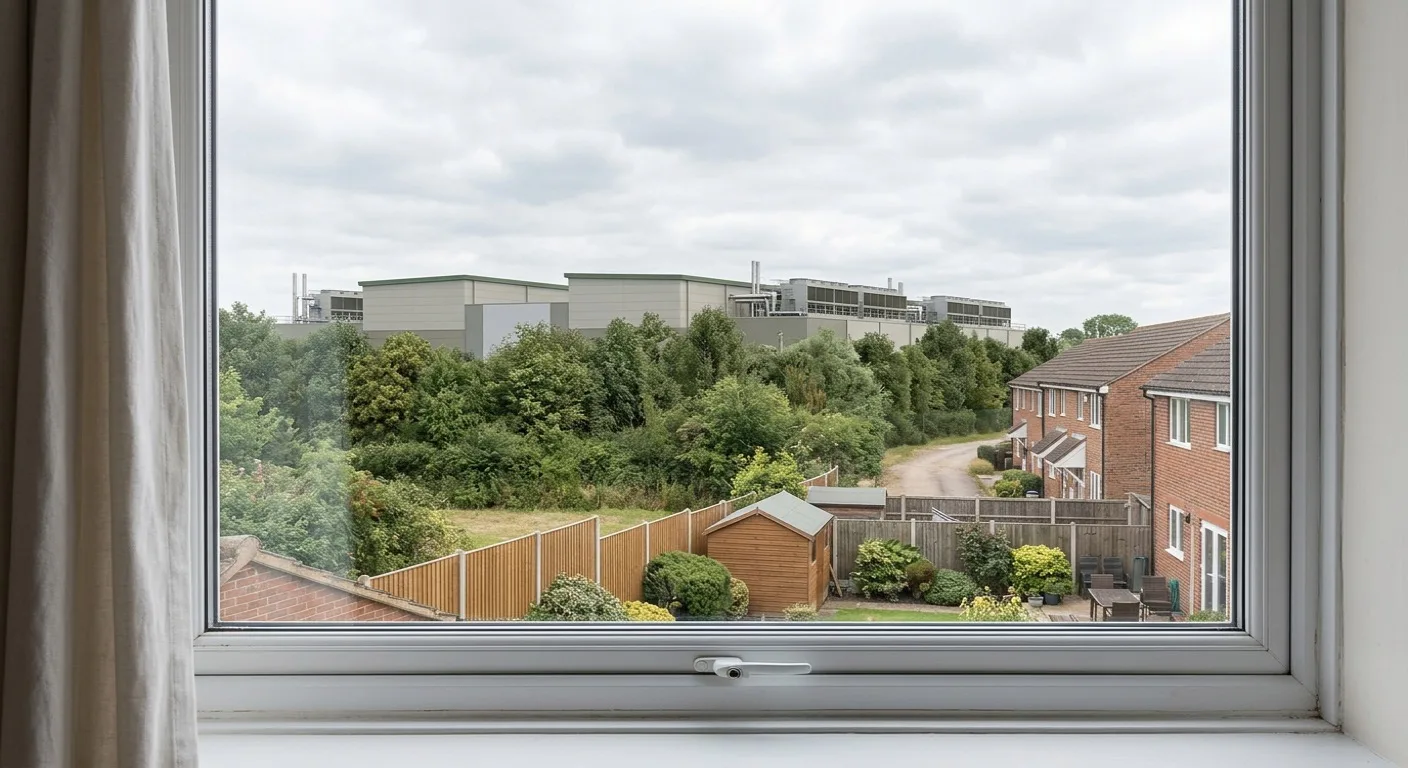
Verified view data centre CGI. First-floor residential window perspective showing landscape mitigation, mature buffer, and constrained visibility of the data hall envelope. Built to Landscape Institute TGN 06/19 standards. StratumCGI.
→Verified View pack scope: Twelve agreed viewpoints across the residential cone, supplied as Type 4 photomontages with EXIF-stamped reference photography, lens metadata, and viewpoint co-ordinates.
→Daylight and sunlight context: StratumCGI models the proposed building envelope against BRE 209 daylight and sunlight thresholds and overlays the assessed results on neighbour window positions for committee review.
→RVAA threshold framing: StratumCGI produces Residential Visual Amenity Assessment imagery that tests whether the data centre proposal reads as overwhelming or inescapably dominant from the worst-affected neighbour properties.
Community amenity and public realm rendering
Community amenity rendering shows what the data centre site offers back to its neighbours. UK planning officers require data centre developers to demonstrate genuine public benefit at street level: pocket parks, walking routes, biodiversity net gain buffers, retained heritage frontages, and active ground-floor commercial space (Use Class E) integrated into the data hall envelope.
StratumCGI renders each of these features as a primary deliverable. In a StratumCGI review of 58 published UK data centre committee reports between 2020 and 2024, a minority included documented community activation as core design rather than a post-refusal negotiation (sample review, April 2026), so early-stage rendering of the public realm tilts the planning submission from infrastructure-first to community-first.
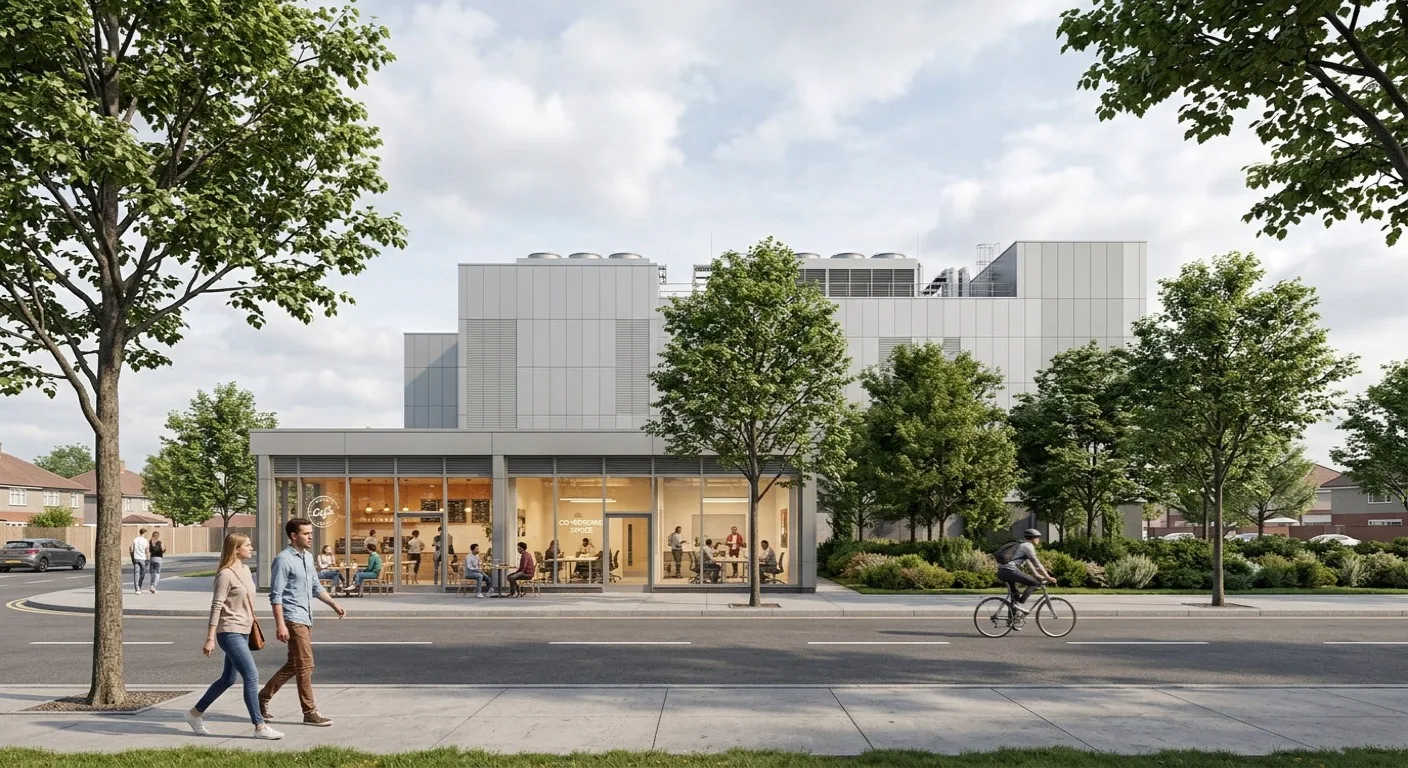
Community-context data centre CGI. Ground-level view showing active SME ground-floor commercial frontage, cafe and co-working space, mature street trees, and the data hall set behind the landscape buffer. StratumCGI.
→Active SME frontage rendering: Ground-floor commercial space (Use Class E) and community facilities such as small cafes, co-working units, or community rooms shown at street level with branded signage at human scale.
→Biodiversity net gain visualisation: StratumCGI renders the 10% statutory uplift required by the Environment Act 2021 as wildflower meadow, wetland, and naturalistic planting, so the biodiversity plan reads as site-specific habitat rather than generic corporate landscaping.
→Public realm and S106 features: Pedestrian routes, pocket parks, public art commissions, and retained heritage frontages itemised in the S106 obligation visible in the same coordinated view as the data hall.
Residential context modelling
Residential context modelling resolves every visible house in the neighbour cone with accurate ridge heights, retained frontages, conservation-area features, and street furniture.
StratumCGI assembles this context layer from OS Mastermap data, planning consultant drawings, listed-building setting appraisals, and verified site photography, so surrounding properties resolve as the actual urban grain rather than placeholder massing.
Across the same 58-report StratumCGI sample review (April 2026), few UK data centre planning submissions paired RVAA with the BRE 209 property-by-property assessment format, which is the pairing committee officers recognise as evidentially rigorous.
The planning challenge that residential context modelling must resolve. An urban data centre rendered without sufficient screening reads as exposed and dominant against the adjacent residential terrace, the typical RVAA threshold failure case. Accurate ridge-height modelling of every neighbour property and rigorous mitigation rendering are what move the same scheme from a refusal risk to a defensible committee submission. StratumCGI.
→Ridge-height accuracy: Every visible neighbour roof modelled to the actual ridge level from OS data and survey, so the comparison between proposal and existing context is defensible at committee.
→Conservation-area context: Retained shopfronts, listed-building settings, and locally-listed features modelled with character-appraisal-grade detail when the site borders or sits within a designated area.
→Neighbour-cone discipline: Context modelling concentrated in the worst-affected residential cone identified by the Residential Visual Amenity Assessment, not spread thin across the wider site.
Data centre CGI for urban sites carries a higher modelling scope than greenfield commissions. The residential neighbour cone, biodiversity buffer, and SME frontage all occupy the same image frame as the data hall and must resolve to the same level of fidelity for the visualisation to pass planning scrutiny.
The pricing section below itemises the unit price for the data centre CGI itself and the urban context modifier that applies when the site borders residential properties.
Data Centre CGI Pricing
A unit-pricing core covers the per-image and per-model rates for greenfield and peri-urban data centre schemes. Context modifiers add to those base rates when the site forces heavier environmental modelling, most commonly for urban residential context.
Unit pricing
Unit prices assume a greenfield or peri-urban site where environmental modelling covers OS mapping, light surrounding vegetation, and a handful of neighbouring buildings. Urban schemes carry an additional modifier itemised below.
Initial model and first image
From £2,200 to £2,800
Data centre CGI sits at £2,200 to £2,800 per image. Campus massing, MEP plant, security infrastructure, and substation compounds require more scene complexity than a single-elevation industrial unit. Modelling is quoted separately based on campus scope and MEP detail level.
Alternate version from same campus model
£880 to £1,120
Alternate images are priced at 40% of the full rate when the new view reuses more than 50% of the approved campus model. Typical cases: same campus at a different time of day, a cropped aerial, or a ground-level composition drawn from the same verified geometry.
Extra crops and deck exports
£150 to £350
Crop exports serve investor packs, portal assets, brochure layouts, and campaign variations drawn from the same master render without creating new geometry.
Major geometry change
From £1,200, re-quoted
Changed campus layouts, hall massing, power infrastructure, or planning facts move the work back into model-update territory, priced from approximately half the original scope upward.
Context modifiers
Context modifiers add to the base environmental modelling fee when site location forces heavier context work. The most common case in UK data centre CGI is urban residential context, where every house in the visible neighbour cone needs accurate ridge heights, retained frontages, and street furniture rendered to verified-view standards.
Urban residential context uplift
+£4,500 to £6,000
Adds to the base environmental modelling fee when the site sits inside a city, borders a conservation area, or fronts sensitive residential properties. Covers dense surrounding housing modelled to ridge-height accuracy, retained heritage frontages, street furniture, biodiversity net gain buffer rendering, and higher-resolution neighbour-perspective context photography integration.
Scale example: A three-image urban edge colocation brief with active SME frontage and verified-view neighbour context typically lands at £15,000 to £17,000 all-in, against £10,000 to £12,000 for the same brief on a peri-urban greenfield site.
Data centre CGI priced per view converts a single modelling investment into a visual package that serves planning, investor, and operator audiences from one approved base. Later versions reuse the locked geometry rather than rebuilding the campus model for each output.
One coordinated CGI package delivers planning stills, investor deck assets, and operator review frames from the same locked model in days. Commissioning separate visual routes for each audience, waiting for temporary fit-out concepts, or rebuilding presentation materials for every positioning shift typically costs more and takes longer.
Data Centre Architectural Visualisation as a Single Coordinated Service
Data centre CGI on this page covers hyperscale campus, AI facility, edge colocation, BESS compound, and electricity substation imagery through the same service method, the same coordinated 3D model, and the same delivery workflow. Each infrastructure subtype carries a different visual priority, but the production method stays unified.
Data centre CGI still routes those subtype differences through the same three output contexts: planning submission, investor presentation, and operator review. The verified viewpoints, model controls, and delivery sequence stay shared, even when the operational emphasis shifts from one facility type to another.
Director Commentary: How Data Centre Architectural Visualisation Is Judged
Data centre CGI shows the same scheme differently to planning, investor, and operator audiences. The director commentary below adds the review logic behind the visuals, including planning scrutiny, investor evaluation, and the need for one model to serve more than one audience.
Data Centre Architectural Visualisation Questions Buyers Ask First
These questions resolve the commercial and definitional gaps most
first-time data centre CGI clients work through before
briefing the visuals.
What is data centre CGI?
⌄
Data centre CGI, also called data centre 3D rendering or data centre visualisation, is photorealistic architectural visualisation for hyperscale campuses, AI facilities, edge colocation shells, BESS compounds, and electricity substations. It is used to show how the scheme looks and how it operates, including campus massing, cooling infrastructure, security perimeters, and power distribution, before the facility is constructed.
What does CGI stand for in data centre planning?
⌄
In data centre planning, CGI stands for computer-generated imagery. On a data centre project, that usually means a 3D model and rendered stills that turn campus masterplans, MEP coordination drawings, and technical references into images for planning, investor review, or marketing use.
How much does data centre CGI cost in the UK?
⌄
Data centre CGI is priced from £2,200 per image, with campus modelling from £4,500. Larger campus packages are quoted by view count, supplied information, context complexity, verification requirements, and whether the same model needs to serve planning, investor, and operator outputs.
How does data centre CGI differ from warehouse CGI?
⌄
Data centre CGI is judged more heavily on infrastructure credibility than facade quality alone. The visuals need to communicate campus massing, cooling plant scale, power infrastructure, security perimeters, and phasing logic, often across planning and investor audiences at the same time. Warehouse CGI prioritises yard depth, dock rhythm, and occupier flexibility instead.
What data centre CGI outputs does StratumCGI deliver?
⌄
Typical outputs include planning stills, verified or planning-grade viewpoints, campus aerial renders, investor deck assets, cropped brochure exports, and infrastructure-specific compositions showing substation, BESS, and cooling plant details. The deliverable mix depends on whether the same model needs to answer planning, investor, or operational questions.
Can data centre CGI show MEP plant and cooling infrastructure?
⌄
Yes. Data centre CGI visualises rooftop and yard plant, cooling tower arrays, liquid cooling distribution, generator compounds, transformer yards, switchgear buildings, cable routes, and screened MEP zones, all built from the MEP coordination model and the engineer's cooling strategy. StratumCGI does not replace MEP or grid engineers; it turns their drawings and layouts into clear images for planning, investor, and operator review.
Is data centre visualisation the same as DCIM monitoring?
⌄
No. DCIM (data centre infrastructure management) software visualises live operational data such as rack capacity, power draw, and cooling performance inside a running facility. Data centre CGI from StratumCGI is architectural visualisation: photoreal imagery of the buildings, plant, and site, produced from drawings before construction starts. Unlike DCIM dashboards, which monitor an operating data centre, CGI communicates a proposed scheme to planning officers, investors, and future tenants.
When does data centre CGI need a new model instead of a reused approved geometry?
Data centre CGI reuses the same approved geometry when the campus massing, substation compound, cooling infrastructure, and security perimeter remain unchanged. Data centre CGI needs a new model stage when the campus layout, hall configuration, power distribution logic, or verified planning facts change.
Which data centre details stay fixed between planning and investor images?
Data centre CGI keeps the approved campus massing, substation compound, cooling plant positions, security perimeter, and landscape frame fixed between planning and investor images. Camera position, lighting, staging, and crop change to suit the audience without changing the approved scheme.
How does data centre CGI maintain one coordinated model across hyperscale, AI, edge, and BESS schemes?
Data centre CGI treats hyperscale campus, AI data centre, edge colocation, BESS compound, and electricity substation imagery as variations within one coordinated service. The same 3D model, verified viewpoints, and delivery workflow stay in place while the infrastructure emphasis changes for each facility type.
How much does data centre CGI cost for a typical 6-image project?
Data centre CGI starts from £2,200 to £2,800 for the initial campus model, first agreed views, and core lighting setup. A typical 6-image data centre CGI project covers 3 campus exteriors and 3 infrastructure-specific compositions.
3 campus views: elevated aerial showing campus phasing, massing, and landscape context. Ground-level verified view for planning submission showing access, screening, and hall massing. Blue-hour hero shot for investor presentation showing campus scale, cooling infrastructure, and operational credibility.
3 infrastructure views: substation compound layout proving grid connection and equipment positioning. BESS compound composition proving fire separation and container arrangement. Cooling plant detail proving operational scale and screening compliance.
Indicative total for a typical five-image package: £4,500 campus modelling, £2,200 environmental modelling and site adaptation, then a mix of full-rate images and reuse-rate variants. New compositions at different camera positions stay at full rate (£2,200 to £2,800 each); lighting or crop variants of an existing approved view drop to £1,120 per image (40% of the full rate) where the new image reuses more than 50% of the main model. A realistic five-image brief of three new compositions plus two lighting variants lands at around £18,500 including post-production. Extra crops for investor decks cost £150 to £350 per export. Major geometry changes requiring a revised model start from £1,200 and are re-quoted against the new scope.
Data Centre Architectural Visualisation Portfolio
StratumCGI's data centre portfolio shows hyperscale campuses, AI facilities, and infrastructure compounds. Each case study documents the CGI scope, outputs delivered, and the specific communication challenges the visualisation addressed.
For the broader proof set beyond this data centre cluster, review the industrial CGI portfolio. It shows how StratumCGI applies the same planning-led and investor-ready methodology across logistics, data centre, infrastructure, and employment-land briefs.
AI-focused campus CGI demonstrating enhanced cooling scale, power density, and accelerated phasing for a hyperscaler pre-let.
Commission
Data centre CGI services
Planning CGI, campus aerials, facade and substation stills, rooftop plant views, and investor pack imagery, prepared from your CAD or BIM, campus masterplan, elevations, and MEP references. NDA-safe publication on request.