StratumCGI helps data centre developers present complex proposals to planning authorities, investors and prospective occupiers. Our architectural visualisations communicate the scale, design and setting of a proposed development. We develop technical drawings into detailed CGI and animation, showing how buildings, infrastructure and landscaping come together. Supporting planning submissions, investment presentations and pre-let marketing. StratumCGI. Your industrial visualisation partner.
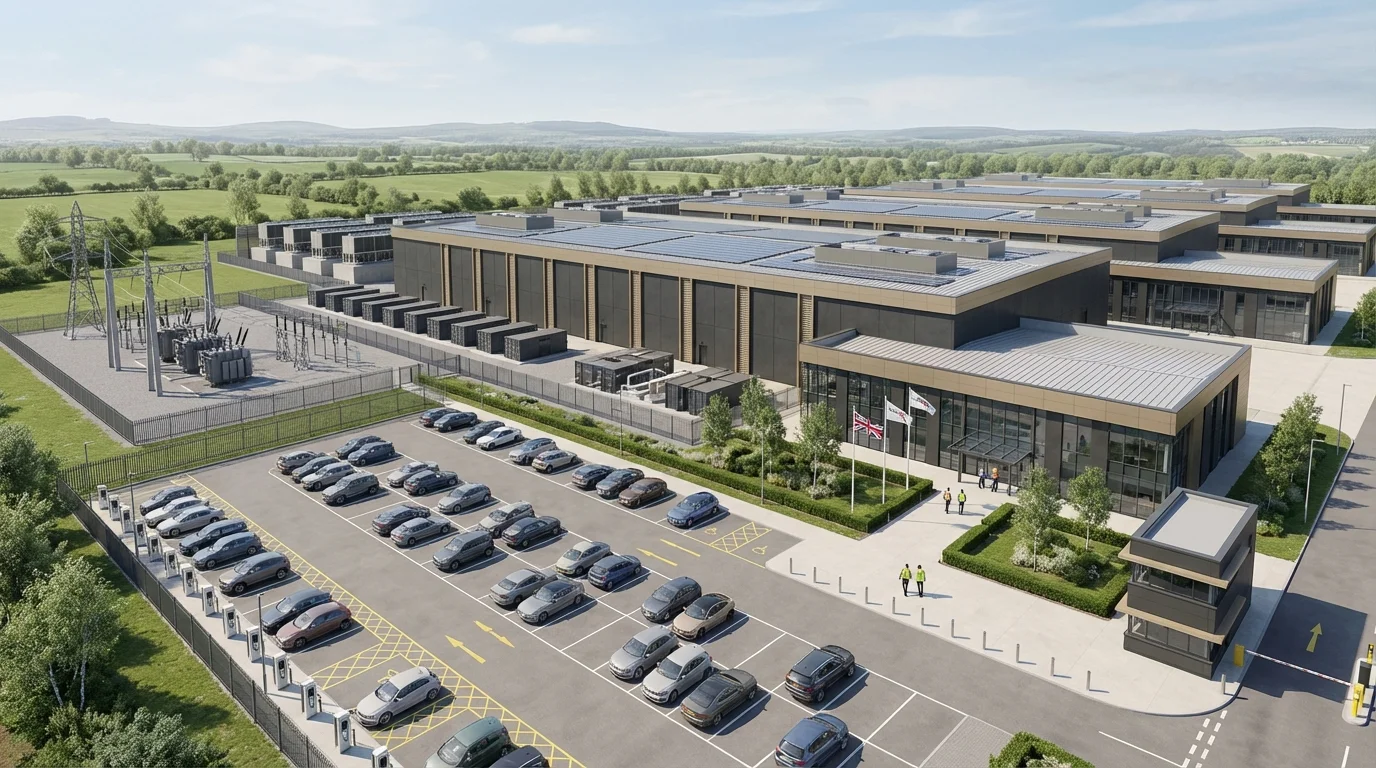
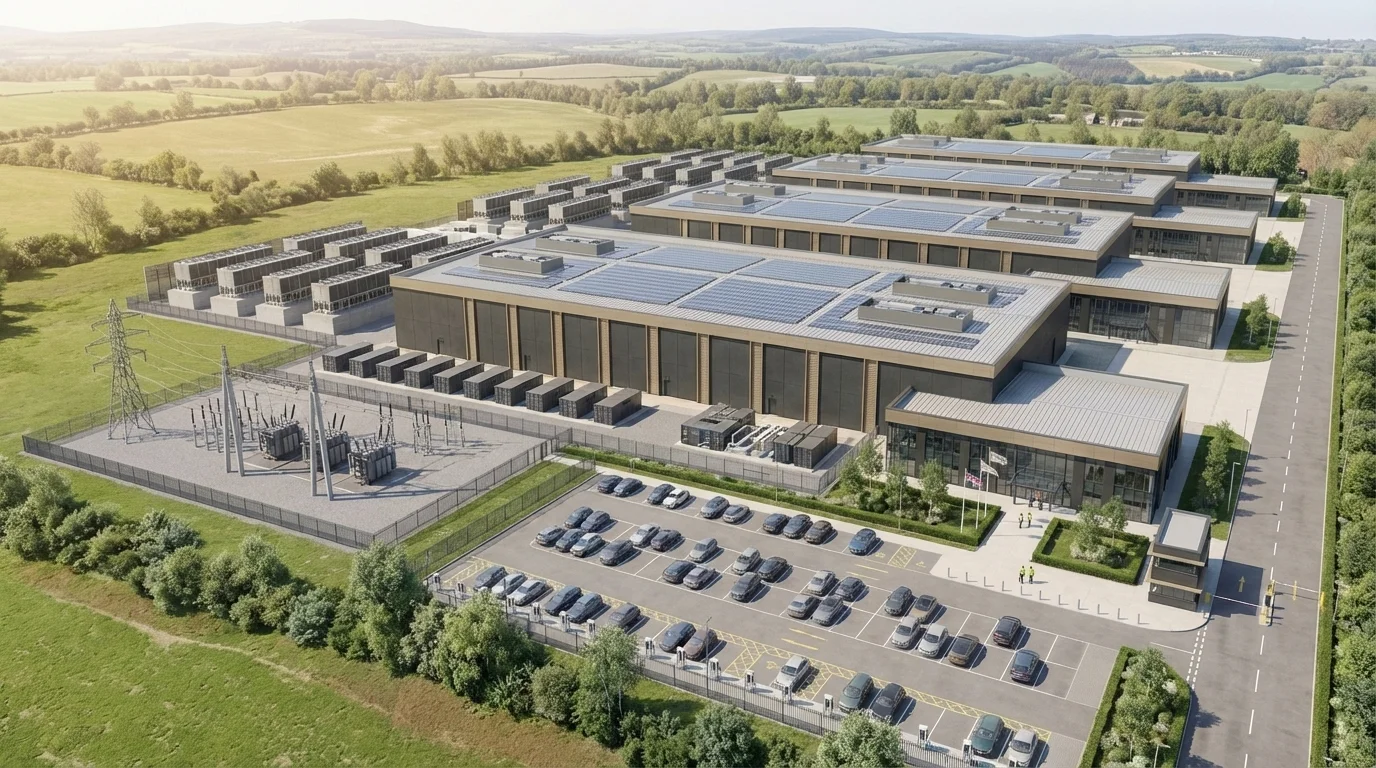
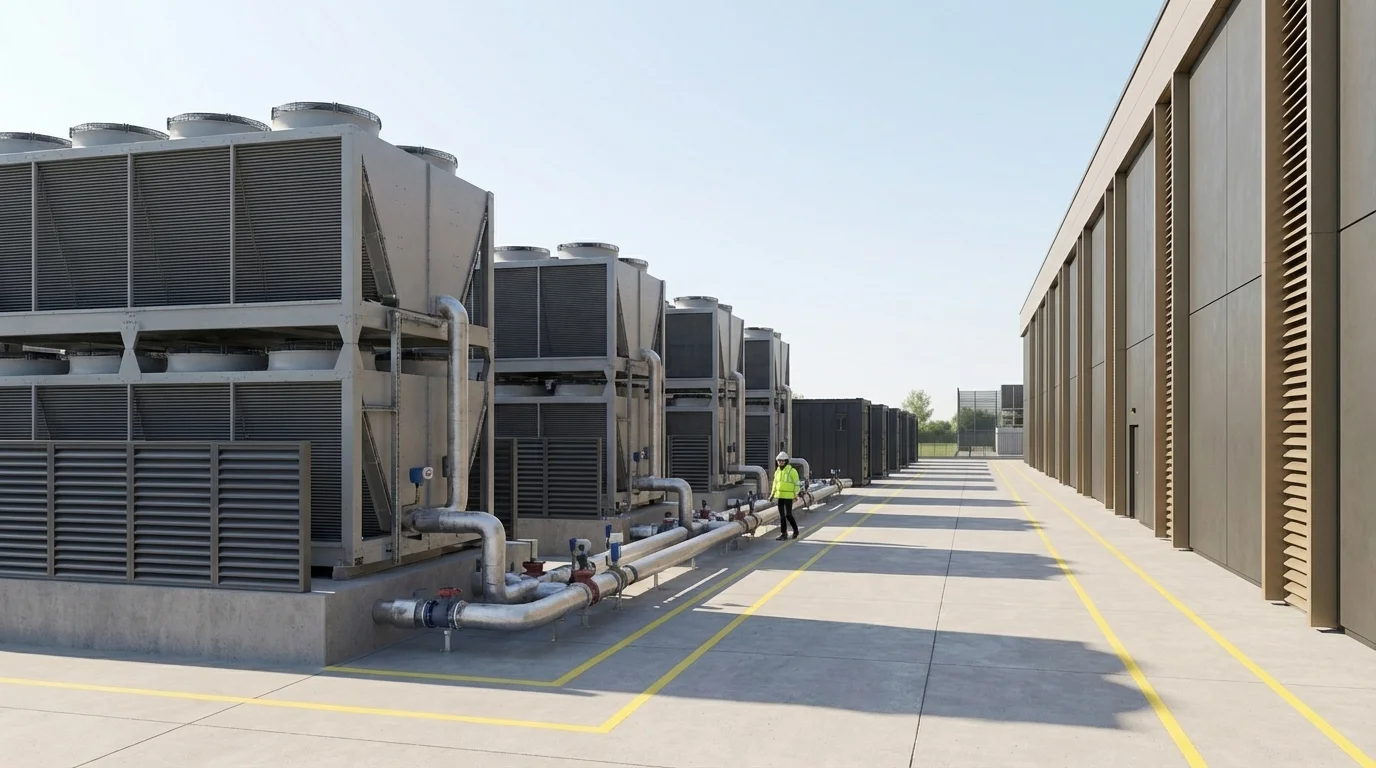
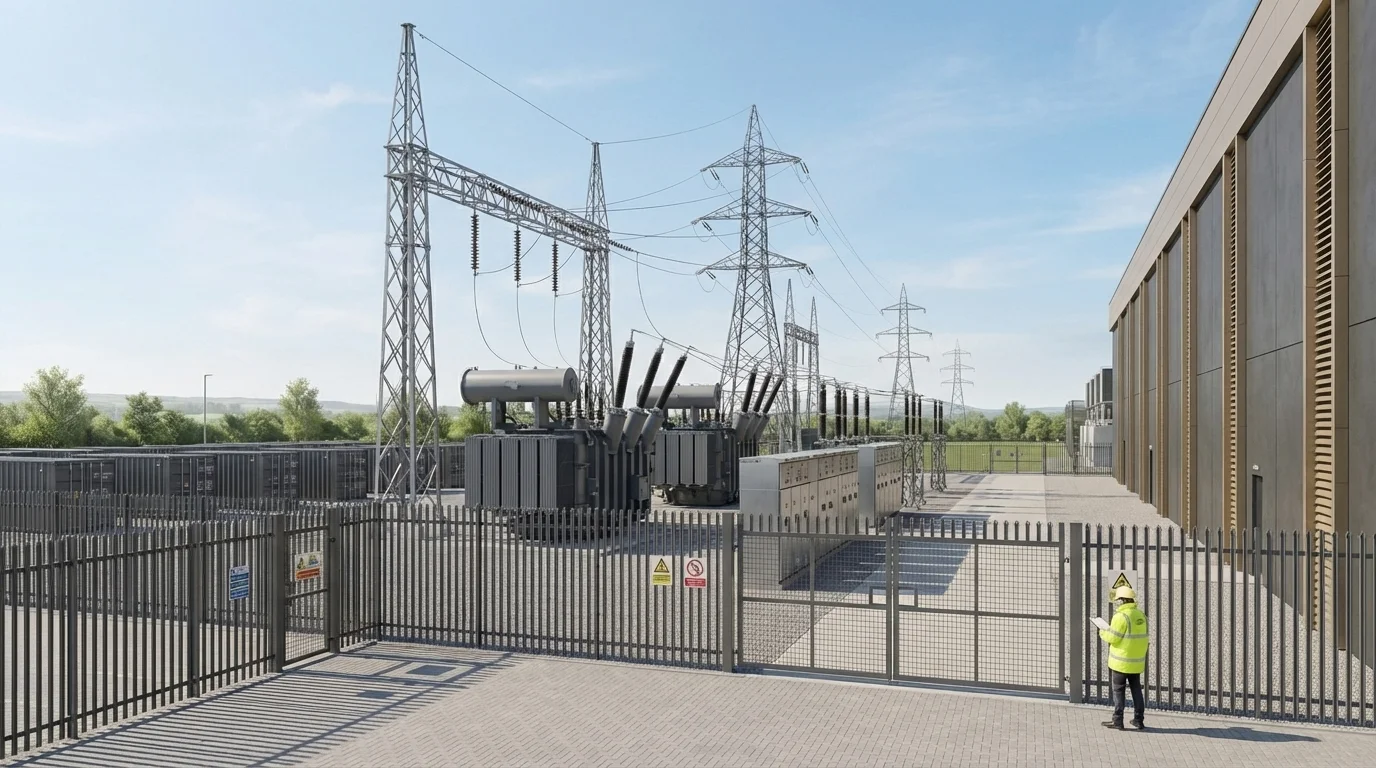
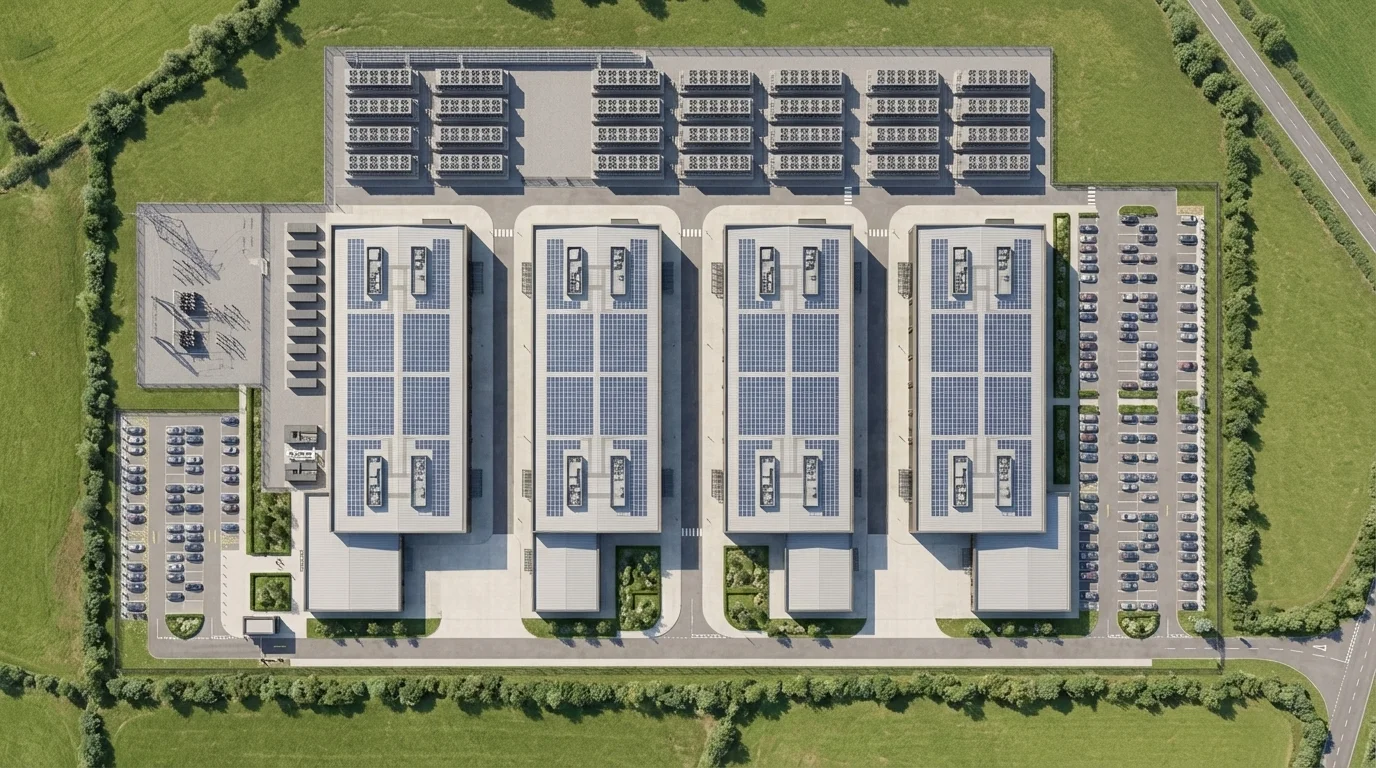
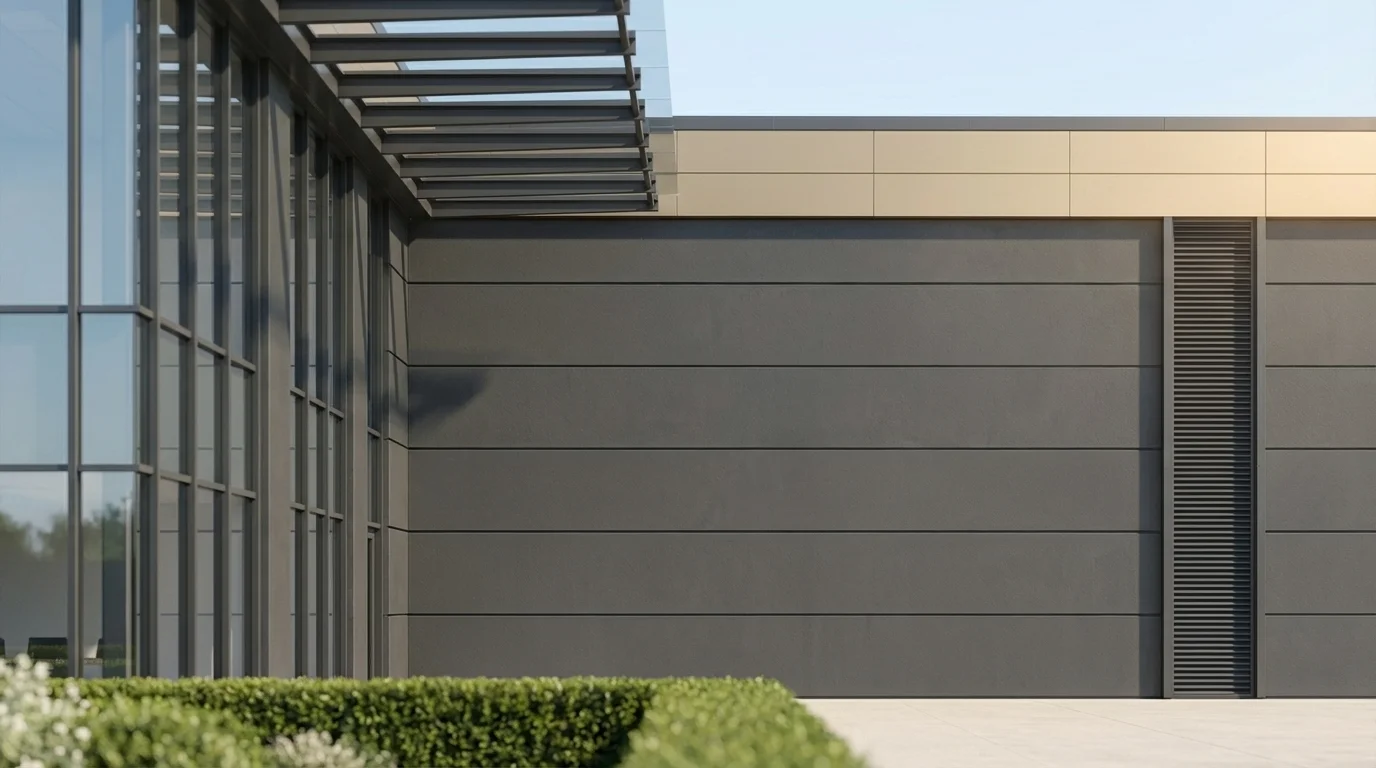
Hero Campus ViewData hall, attached office, and plant yard in one composition under UK overcast light.Aerial ContextDrone-tilt view placing the campus in its North West landscape and infrastructure corridor.Liquid Cooling PlantDry cooler bank arrays, acoustic screens, warm-water manifolds, and backup generator line.HV Substation and BESS CompoundGrid incomer pylons, HV transformers, switchgear, and BESS battery containers.Site MasterplanTop-down orthographic aerial of the hall, plant yard, substation compound, and landscape bunds.Facade Material DetailPrecast panels, aluminium cladding bands, and vertical MEP louvre strips on the hall.
Hyperscale AI campus CGI visualises a purpose-built UK
GPU compute campus from the hall and plant yard to the
aerial site context. Also known
in the market as an AI factory, a GPU compute campus, a
training cluster, a large language model data centre, a
high-density compute facility, or an HPC campus, this
typology is commissioned by hyperscale cloud operators
and AI infrastructure developers, such as Anthropic,
OpenAI, Nvidia, Amazon AWS, Microsoft Azure, Google
DeepMind, Meta AI, Oracle Cloud Infrastructure, xAI,
Mistral AI, CoreWeave, and Lambda, to house GPU
training and inference workloads at national scale. The scheme
typology covers multi-hall campuses with a combined GIA
range of 60,000 to 160,000 square metres across three
to four data halls, 100 to 300 MW of IT load, rack
power densities of 40 to 130 kW per rack, and a
direct-to-chip liquid cooling primary loop backed by a
rear-door heat exchanger secondary loop.
Who commissions this building type
UK hyperscale AI data centre campuses are developed and
occupied by specialist hyperscale developers and AI
infrastructure platforms including Ark Data Centres,
Virtus, Kao Data, Yondr, Vantage, EdgeConneX, Stack
Infrastructure, NorthC, DataVita, Colt DCS, and NTT
Global Data Centers. AI GPU demand on those platforms
is driven by hyperscale cloud and AI occupiers such as
Microsoft Azure, AWS, Google Cloud, Meta, Oracle Cloud
Infrastructure, Nvidia DGX Cloud, CoreWeave, Lambda,
Nebius, G42, and institutional GPU workloads from
foundation model research, financial services, and
defence prime contractors. Build-to-suit is the dominant
delivery route, with signed take-up by a single
hyperscale AI tenant before first concrete is poured.
Why the UK for AI GPU Compute
The UK AI data centre market sits across a small number
of grid-connected clusters where the National Grid has
the headroom to land a 100 to 300 MW connection in a
realistic programme. The North West corridor around
Manchester and Warrington, the Thames Valley around
Slough and Reading, the Scottish Central Belt, and
specific East Midlands and South Wales sites have
emerged as the viable UK locations for purpose-built
GPU compute campuses of this scale (techUK UK Data
Centre Report, CBRE European Data Centre Market Q4
2024, Knight Frank Data Centre Report, DLUHC AI Growth
Zone designation).
Estimated CGI Pricing for a Hyperscale AI Data Centre Campus
Hyperscale AI data centre CGI in the UK typically costs
between £1,800 and £4,200 per final still frame for a
purpose-built GPU compute campus with three to four data
halls, a combined gross internal area between 60,000 and
160,000 square metres, 100 to 300 MW of IT load capacity,
and a direct-to-chip liquid cooling plant, delivered as a
six-frame still set. Underlying costs for 3D modelling,
MEP and liquid cooling compound modelling, HV substation
and BESS compound modelling, material and lighting setup,
post-production, AVR Type 3 verified views, drone survey,
and consultation animation are quoted separately and
listed in the table below. The ranges shown are
StratumCGI's published guide figures for any UK hyperscale
AI compute campus in this typology class, not the
commercial terms paid on the SCGI-003 anonymised
commission.
These are typology ranges, not the price paid on this
specific commission. Commercial terms for SCGI-003 are
withheld under our anonymisation policy. AI data centre
ranges sit above the standard hyperscale baseline because
the liquid cooling loop, the HV substation, the BESS
compound, and the multi-hall campus scale all require
extra modelling depth.
Hyperscale AI Data Centre CGI · Line Items
Final still frame, planning or marketing ready
£1,800 to £4,200 per frame
3D base modelling from the architects' CAD package
£6,500 to £14,500 per campus
Liquid cooling loop, dry cooler bank, and chiller compound modelling
£4,200 to £9,500 per campus
HV substation and BESS compound modelling
£3,200 to £7,400 per campus
Material, lighting, and landscape setup
£1,800 to £3,800 per campus
Post-production and grade pass
£260 to £580 per frame
AVR Type 3 verified view uplift, Landscape Institute TGN 06/19
£600 to £1,200 per view
Drone survey planning and viewpoint capture
£900 to £2,400 per site visit
Consultation flythrough animation, 90 to 120 seconds
£9,500 to £22,000 per animation
Revision rounds beyond the first two
£320 to £680 per frame per round
Planning portal formatting and delivery
Included with planning-spec packages
Typical six-frame AI campus package, all in
£24,000 to £52,000
Range driven by hall count, liquid cooling loop
complexity, HV substation and BESS compound modelling,
number of AVR Type 3 verified views, and whether a
consultation animation is included.
Hall count, rack power density, and HV connection scale
drive where a scheme lands in the range. A three-hall AI
campus at 100 MW sits at the lower end, a four-hall
campus at 300 MW with a 275 kV substation and a large
BESS compound sits at the upper end. For a live
hyperscale AI scheme we quote against the actual view
list, the actual MEP and HV drawings, and the actual
timeline.
Inside the Project: A Conversation with the Director
Industrial architectural visualisation · Hyperscale data centre CGI masterplan · SCGI-003 · StratumCGI
Briefs From the Project Team for the Hyperscale AI Data Centre Campus CGI
A hyperscale data centre CGI commission arrives as a stack
of separate briefs from the developer marketing team, the
investment committee, the letting and leasing agents, the
project architects, and the MEP and landscape engineers.
The five briefs below are the versions StratumCGI
reconciled into a single production pipeline for this
Tier III+ North West campus.
Brief One · Developer Marketing Team
Marketing Team Brief for the Hyperscale Data Centre CGI
Scope: LinkedIn and paid ad crops, investor teaser spreads, website heroes, and press images cut from the rendered frames.
The marketing team briefed a multi-format image set
built around the six rendered frames, cut for the
specific channels the developer publishes into without
retouching between destinations.
The channel list they asked for:
LinkedIn: 1200 x 627 link preview for sponsored posts, 1128 x 191 company page banner, and 1080 x 1080 carousel tiles for organic posts.
Facebook and Instagram paid ads: 1200 x 628 landscape, 1080 x 1080 square, 1080 x 1350 portrait feed, and 1080 x 1920 story and reel.
Website hero and section banners: 1920 x 900 desktop hero, 1200 x 600 tablet hero, and 16:9 mid-page section banner.
Investor teaser spreads: A4 landscape full-bleed at 300 dpi, pre-cropped for the teaser memo template.
Press and trade publication: 2000 x 1333 landscape, 1500 x 2000 portrait, and 400 x 400 thumbnail at 300 dpi.
Brochure and printing: A4 portrait and A3 landscape full-bleed spreads for the developer brochure.
They also asked for the cladding palette to stay
continuous with the developer's existing data centre
portfolio. The anthracite RAL 7016 precast panels, the
mid-grey RAL 7035 aluminium bands, and the anthracite
mullions had to match the other halls in the
developer's live portfolio.
Brief Two · Investment Committee
Investment Committee Brief for the Hyperscale Data Centre CGI
Scope: Aerial and masterplan frames that show the data hall, the plant yard, and the substation compound for the internal investment pack.
The investment committee wanted the straightforward
stuff. Clean aerial and masterplan frames that show the
data hall footprint, the plant yard with chillers and
generators, and the on-site substation compound, so the
MW capacity and PUE numbers in the investment pack line
up with what is actually being delivered.
No cinematic framing. Just imagery that matches the
drawings and supports the spec sheet the committee
circulates with the operator covenant review.
Brief Three · Leasing Agents
Leasing Agents Brief for the Hyperscale Data Centre CGI
Scope: Plant yard and security entrance frames for a hyperscale pre-let pitch, plus multi-aspect crops for agency marketing.
The leasing agents briefed frames built for a
hyperscale pre-let pitch. The plant yard composition
had to show the chiller array and the generator line at
accurate scale, because a hyperscale operator looking
at the image is effectively auditing the MEP before
they even commission a site visit.
The security entrance frame had to show the gatehouse,
the bollards, and the palisade perimeter at human scale
so the operator's security consultants could sign off
the access geometry from the render alone.
Brief Four · Project Architects
Architects Brief for the Hyperscale Data Centre CGI
Scope: Facade material close-ups, MEP louvre detail, and full massing frames for the planning submission and design and access statement.
The architects briefed the technical set. The visual
had to match the CAD package exactly: the data hall
volume, the attached office and operations block, the
vertical MEP louvre strips, the anthracite RAL 7016
precast panels, the RAL 7035 aluminium cladding bands,
the anthracite curtain wall mullions, and the plant
yard geometry all rendered to the same tolerance as the
drawings.
They also briefed the material close-ups for the design
and access statement and the consultation boards for
the public exhibition. The architectural brief is the
one where the CGI has to survive the closest scrutiny,
because any drift between render and drawing is caught
immediately on a planning committee screen.
Brief Five · MEP and Landscape Engineers
MEP and Landscape Engineers Brief for the Hyperscale Data Centre CGI
Scope: Plant yard geometry, substation compound layout, AVR Type 3 verified viewpoint set, and landscape mitigation for the visual impact input.
The MEP consultants and the landscape engineers briefed
the technical plant and the receptor set in parallel.
The MEP consultants defined the chiller cabinet
footprints, the generator enclosure spacing, the fuel
storage compound, and the on-site substation layout at
real-world dimensions. The landscape engineers fixed
the viewpoint matrix, the lighting state, and the
foliage state the imagery needed to render under for a
GLVIA3-aligned visual impact input to the planning
pack.
Between them they briefed the perimeter planting, the
landscape bunds, the hawthorn hedging, and the
cumulative mitigation strategy at the scale a planning
authority expects for a mission-critical scheme. Their
version is the one where both the plant yard and the
landscape read as designed engineering, not decorative
backdrop.
How StratumCGI Answered All Five Briefs in One CGI Set
StratumCGI reconciled the five party briefs into a single
production pipeline that produced one coherent six-frame
still set. Every frame answers at least two of the briefs
at once, and the set as a whole answers all five. The
reconciliation happened in three phases.
We mapped each frame to the briefs it needed to serve.
The hero campus view carries the marketing and leasing
agent briefs. The aerial context and the masterplan
aerial answer the investment committee and the landscape
engineers. The plant yard frame answers the leasing
agents and the MEP consultants. The security entrance
frame answers the leasing agents and the architects. The
facade material detail frame answers the architects and
the marketing team.
Phase 2: Model, material, plant, and lighting setup
We rebuilt the scheme in V-Ray from the architects' CAD
package and the MEP coordination set. The anthracite
RAL 7016 precast panels, the RAL 7035 aluminium cladding
bands, the anthracite mullions, the vertical MEP louvre
strips, the rooftop plant enclosures, the chiller array,
the backup generator line, and the on-site substation
compound were all applied as physical elements. The
lighting was set to the overcast UK reference-day
specified by the landscape engineers for AVR Type 3
delivery.
Phase 3: Frame rendering and iteration
We rendered the hero frame first and locked the camera
and lighting rig. Every subsequent frame was derived from
that master state, which meant the six frames read as
one visit to one scheme. Draft renders went back to the
architects, the MEP consultants, the landscape
engineers, and the marketing team in parallel, and we
iterated through a small number of revision rounds on
chiller spacing, cladding tone, and perimeter planting
density until every brief was signed off.
Final delivery
The final set was delivered in three formats. Planning
portal resolution for the architects and the landscape
engineers. Print-ready resolution for the consultation
boards. Web-sized and social crops for the marketing
team and the leasing agents. A consultation flythrough
animation was quoted but not commissioned on this scheme;
it remains available as an optional extra for buyers who
want one.
UK Data Centre Clusters We Visualise
Hyperscale data centre CGI in the UK covers a small
number of specific regional clusters with the grid
capacity, fibre connectivity, and land availability to
support Tier III+ campuses. StratumCGI produces
industrial architectural visualisation for schemes across
every primary UK data centre market, from Slough in the
south to the North West and the Scottish Central Belt.
The primary UK data centre clusters we visualise include
the Slough and West London Data Centre Market at M4 J5
to J7, the Park Royal and West London cluster, the
Docklands and East London cluster around the Thames
Gateway, the South Mimms and Enfield cluster on the M25,
the Reading and Thames Valley cluster, the Hayes and
Heathrow Airport cluster, the North West cluster around
Manchester, Warrington, and Trafford on the M6 and M62
corridor, the Yorkshire data centre cluster around Leeds
and Doncaster, the Newcastle and Tyneside cluster, the
Scottish Central Belt around Edinburgh and Glasgow, and
the South Wales cluster around Cardiff and Newport for
subsea cable landing stations.
Emerging and secondary clusters we cover include the
Milton Keynes data centre corridor, the Coventry and
Warwick cluster on the M40 and M6, the Midlands data
centre corridor around Birmingham, and the East Anglia
cluster around Cambridge driven by research and science
campus demand.
Every cluster has its own grid capacity profile, its own
planning authority approach, its own fibre route set,
and its own landscape and visual impact context.
StratumCGI matches each hyperscale data centre CGI
commission to the actual cluster context: the right grid
and substation geometry, the right chiller and generator
plant typology, the right security perimeter standard,
and the right material palette for the operator's
global visual identity. If your hyperscale scheme sits
in any of the UK clusters named above, we can render it
for planning submission, operator covenant review, and
hyperscale pre-let marketing.
Hyperscale AI data centre campus aerial views
What a hyperscale AI data centre campus looks like from above
A hyperscale AI data centre campus is read from the air long
before it is read from the ground. Planning consultees,
landscape engineers preparing GLVIA3 visual impact input,
AVR Type 3 verified-view assessors, investment committees
underwriting megawatts per hectare, and hyperscale tenants
auditing the on-site substation and plant yard footprint
all open the same image first: an oblique aerial that shows
the campus sitting in its real cluster context.
That is why we render the typology from above as a
before-and-after photomontage rather than a clean white
plate. The four pairs below cover four UK cluster
archetypes we get briefed on most often: a Midlands
greenfield strategic site on the M40 and M6 corridor,
strategic employment land at a grade-separated motorway
junction, a reclaimed tidal estuary brownfield with grid
substation frontage, and a northern upland reclaimed
quarry plateau beside a clear-water reservoir. Each pair
keeps the sky, the camera, the surrounding infrastructure,
and the lighting state pixel-aligned across both frames so
the campus reads as the only thing that changed.
Pair 1 · Midlands greenfield strategic site
Greenfield strategic land aerial view, hyperscale AI data centre campus before and after build-out
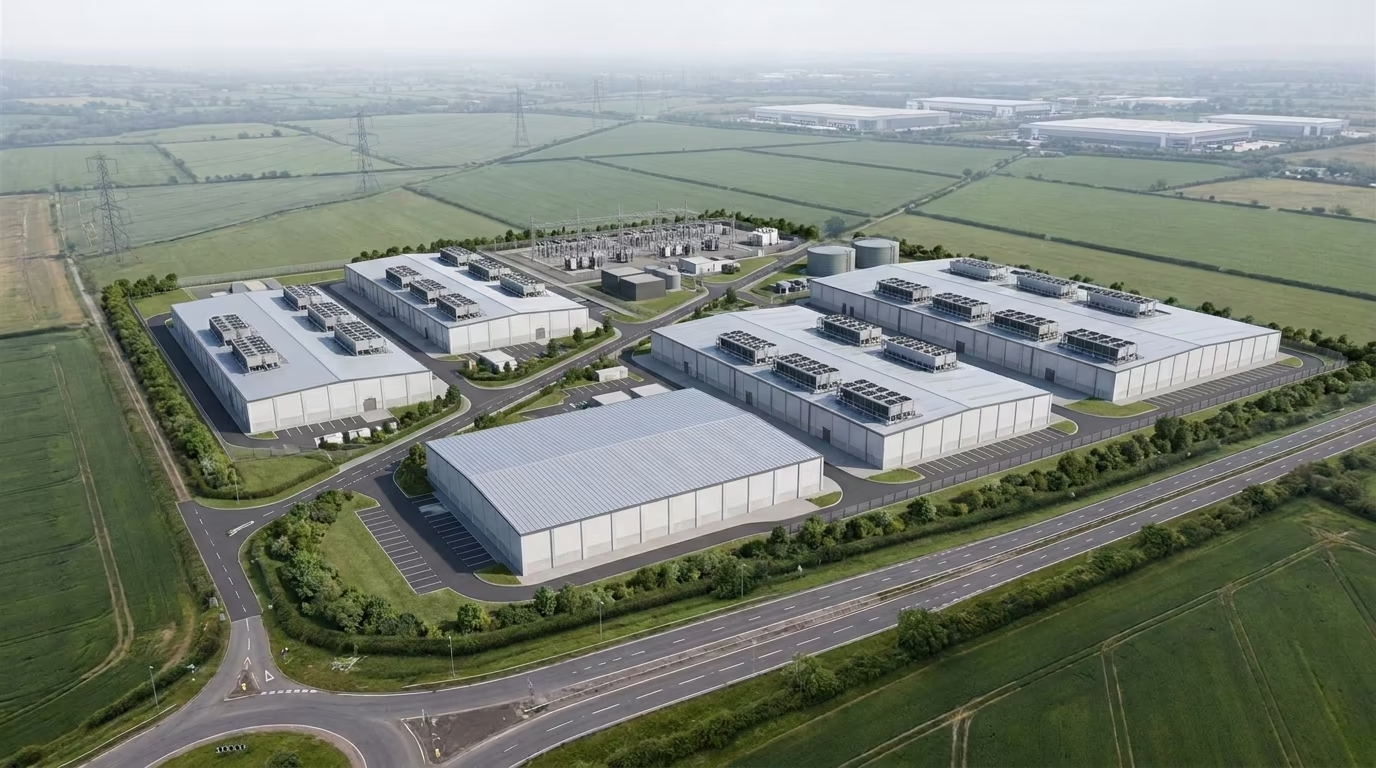
A flat 80-hectare greenfield site on the M40 and M6
corridor with existing dual carriageway access and a
400kV pylon line crossing the north boundary. The
after-frame replaces the central field block with a
multi-hall GPU compute campus, on-site primary
substation, perimeter landscape mitigation, and a new
site access spur off the existing roundabout.
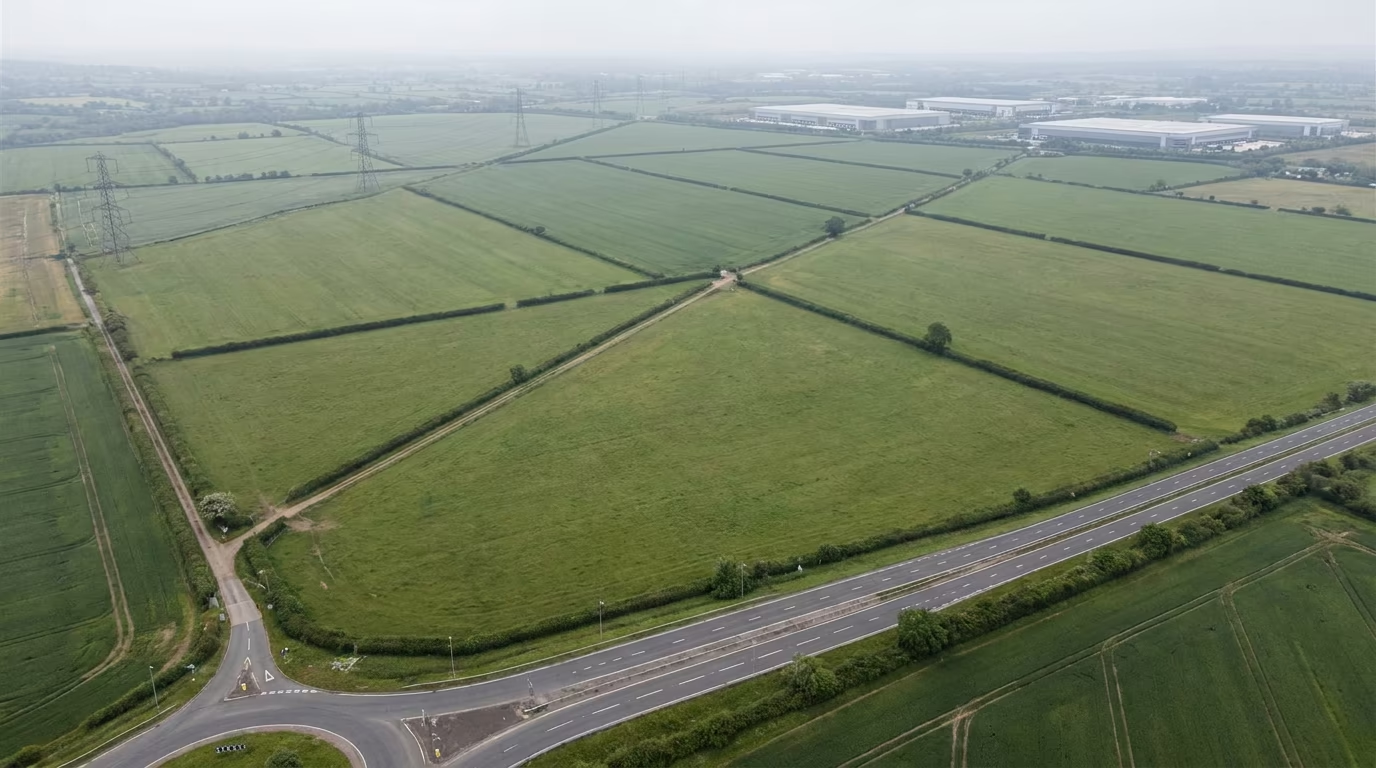
BeforeUK Midlands greenfield site with dual carriageway, 400kV pylons, and distant logistics estate.AfterMulti-hall AI compute campus, on-site substation, and perimeter mitigation on the same plot.
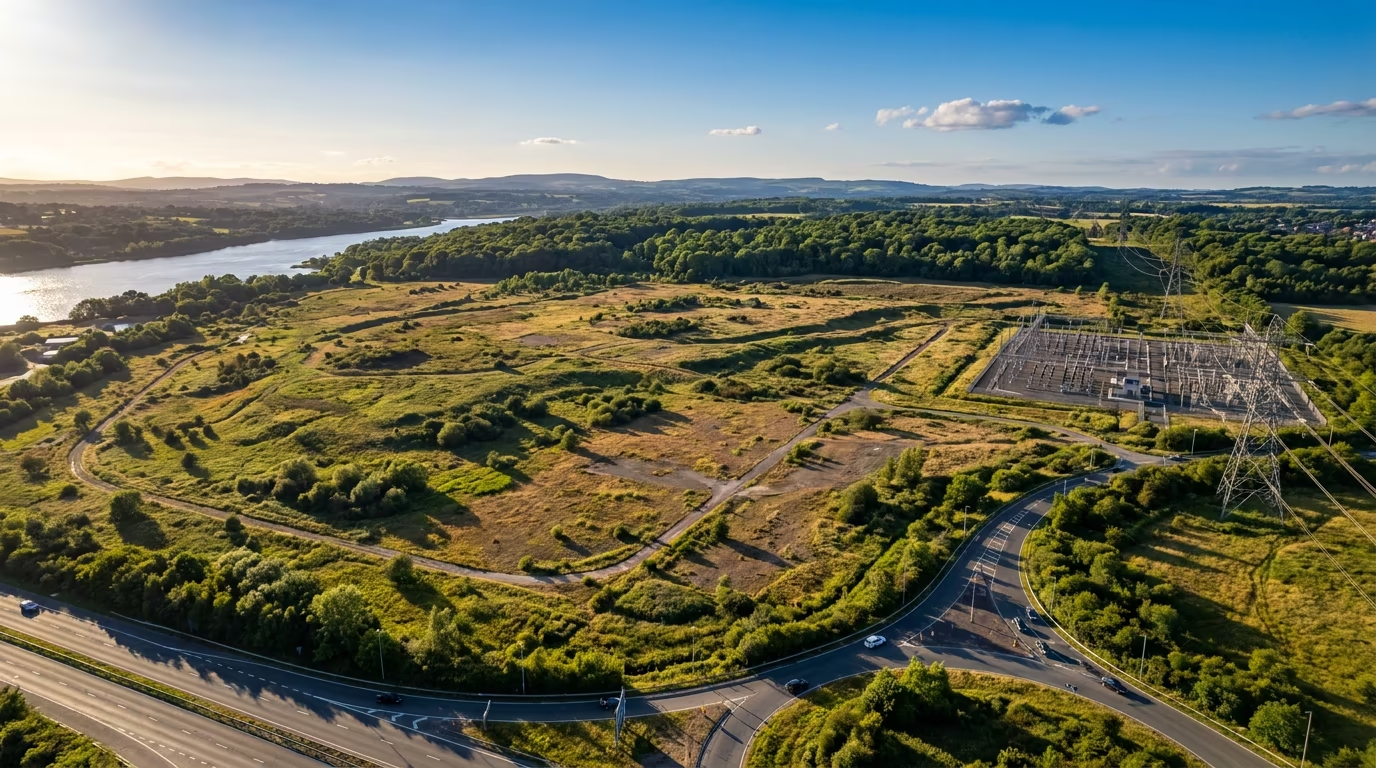
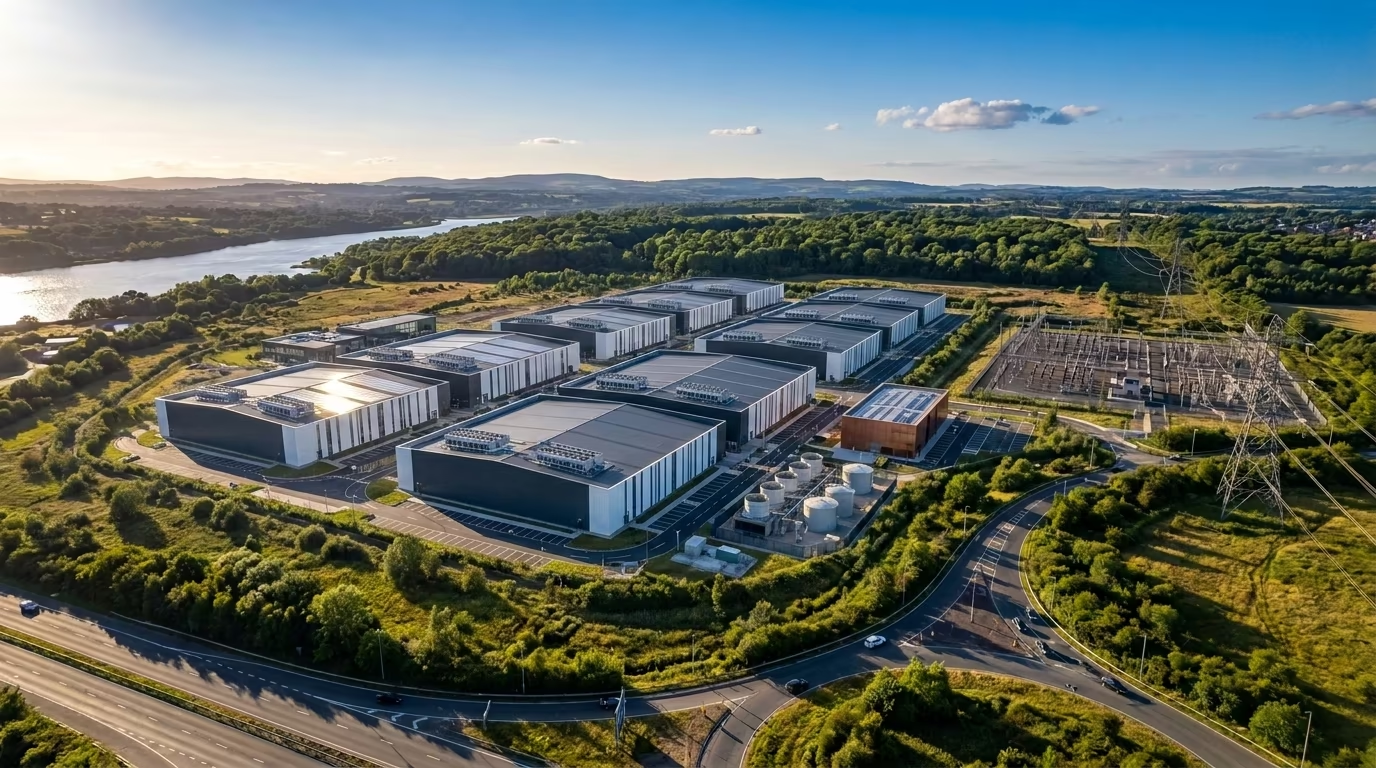
Strategic employment land aerial view, hyperscale AI data centre campus before and after build-out
A 100-hectare brownfield strategic employment site at a
grade-separated motorway junction, framed by an existing
400kV substation, a river or reservoir to the west, and
a mature woodland belt to the north. The after-frame
drops a two-row data hall grid with a copper-clad GPU
compute hall, a dedicated network operations centre,
rooftop solar, and a private substation tied into the
existing pylon line.
BeforeMotorway junction strategic employment site with substation and reservoir frontage.AfterTwo-row data hall grid, copper-clad GPU compute hall, and rooftop solar arrays.
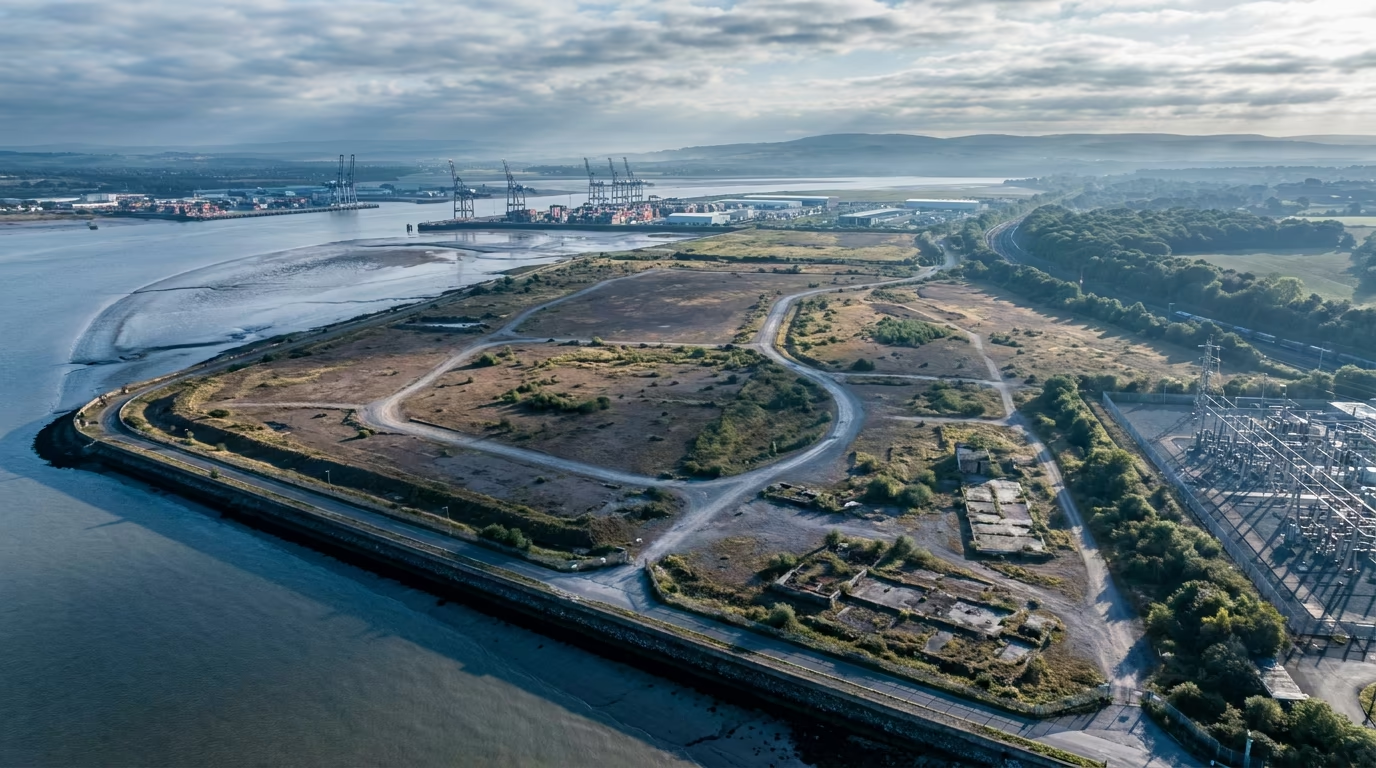
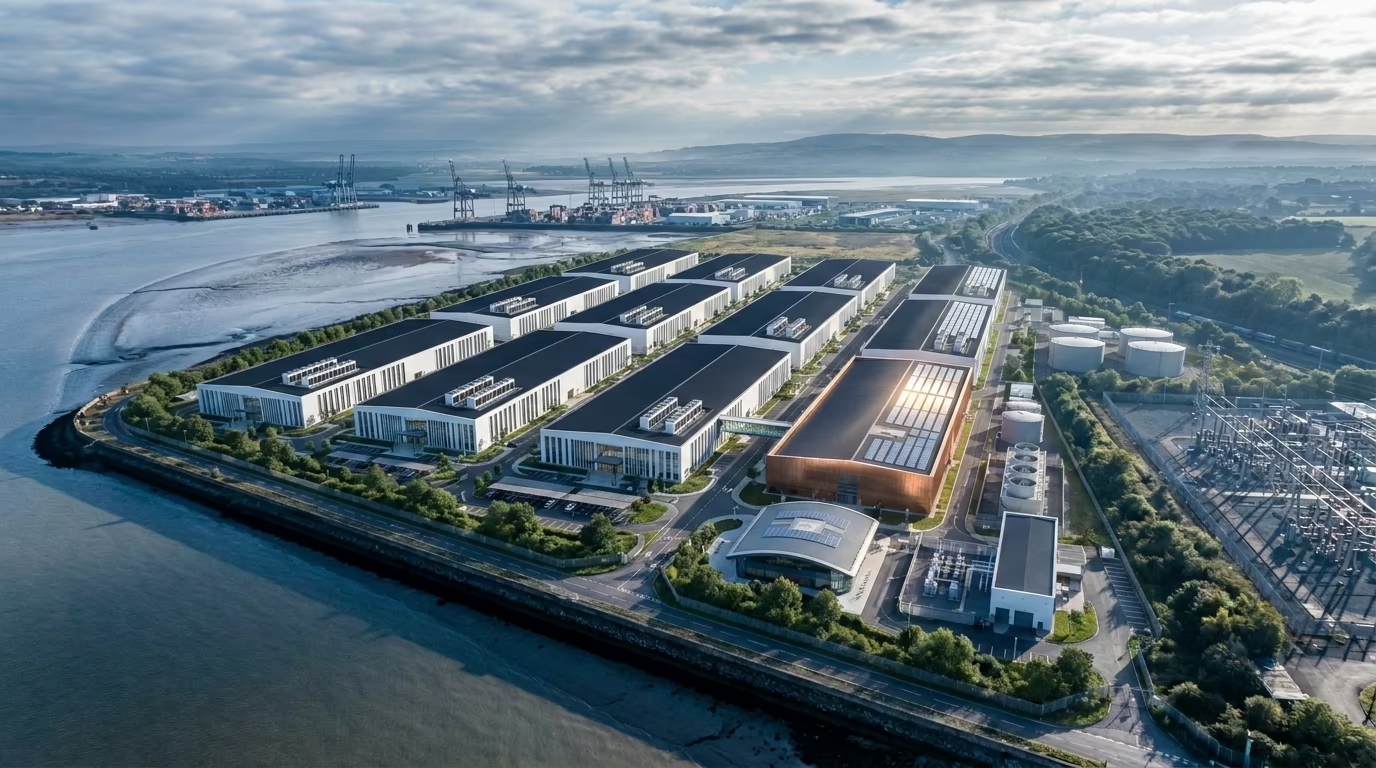
Pair 3 · Reclaimed estuary brownfield
Estuary brownfield aerial view, hyperscale AI data centre campus before and after build-out
A 120-hectare reclaimed tidal estuary brownfield with
sea wall, decommissioned dock cranes, an adjacent 400kV
grid substation, and a freight rail spur. The
after-frame builds out a flagship three-row campus with
a copper-clad GPU compute hall, a glazed network
operations centre, a dedicated waterfront cooling
intake, and a pedestrian skybridge between halls.
BeforeUK tidal estuary brownfield with sea wall, decommissioned cranes, and grid substation.AfterThree-row campus, copper GPU hall, glazed operations centre, and waterfront intake.
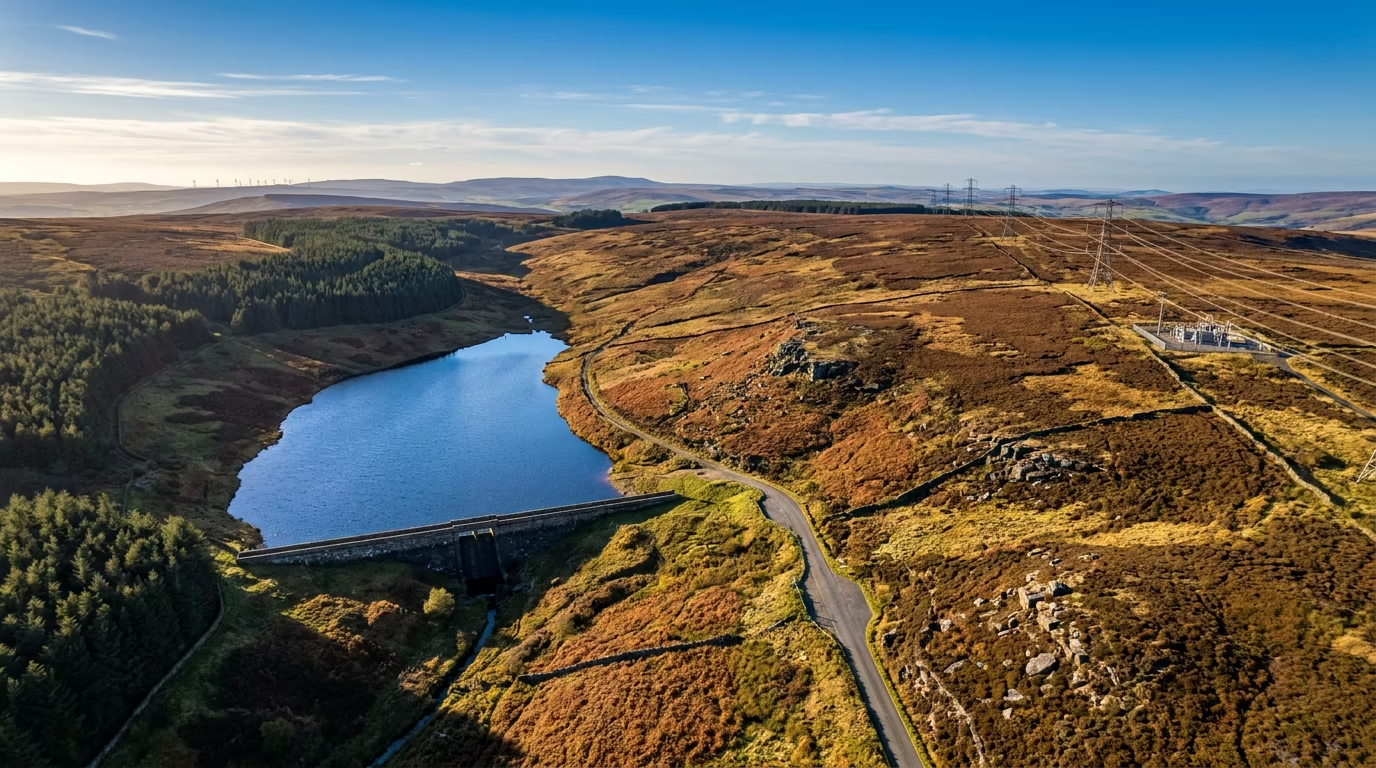
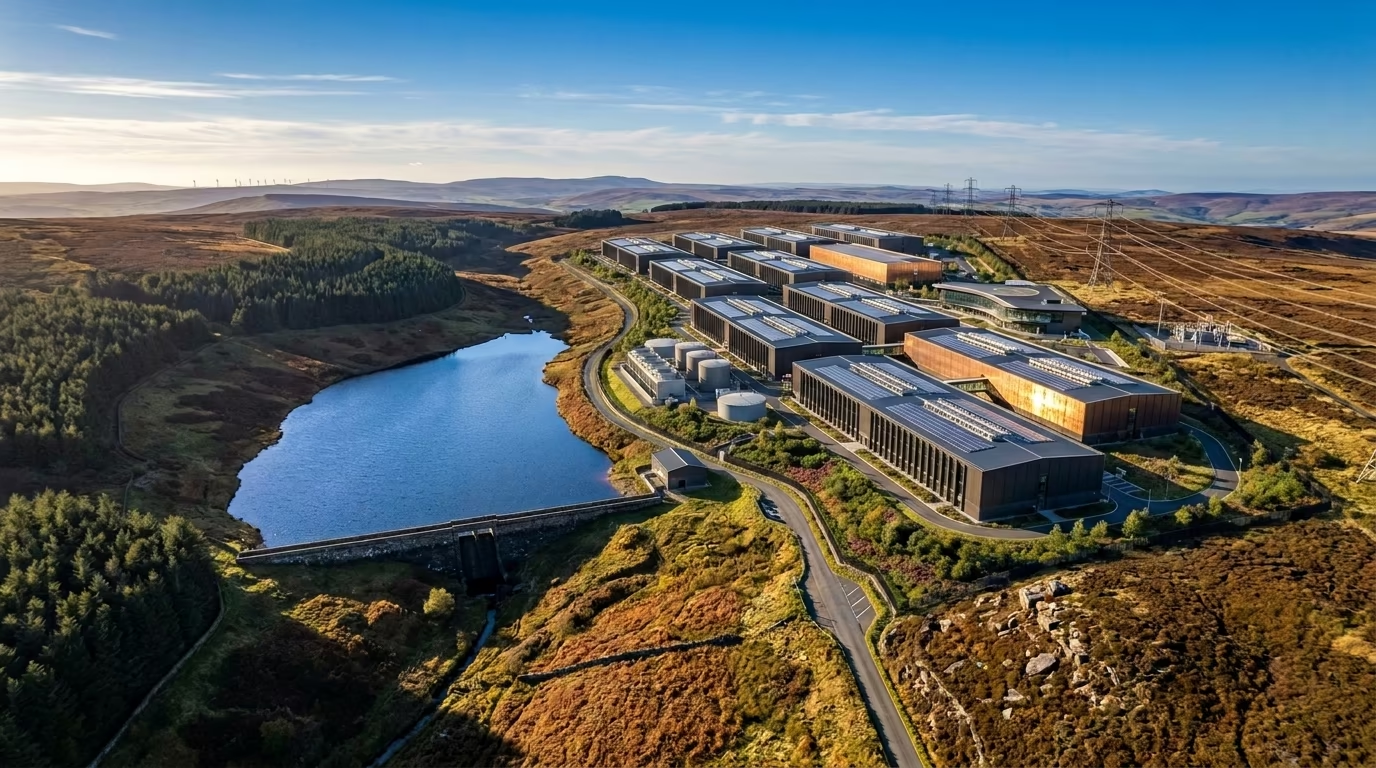
Upland reservoir aerial view, hyperscale AI data centre campus before and after build-out
A 90-hectare reclaimed quarry plateau in the northern
uplands beside a deep clear-water reservoir, with a
conifer plantation belt to the west and a 400kV
transmission corridor on the eastern flank. The
after-frame steps the data halls with the contour in
two terraced rows, integrates a closed-loop liquid
cooling yard against the reservoir backdrop, and ties
into the existing pylon corridor through a compact
gantry.
BeforeNorthern UK reclaimed quarry plateau, clear-water reservoir, conifer belt, 400kV corridor.AfterTerraced data halls stepped to contour, copper GPU hall, closed-loop cooling yard.
Each pair is built as a true photomontage: a base aerial
of the actual site context first, then a single edit pass
that lays the campus typology onto the plate while the
sky, the road geometry, the pylon line, the substation,
and the surrounding land use are held pixel-aligned. That
is how a planning aerial has to read for an LPA, a
landscape consultee, and a hyperscale operator at the same
time.
Industrial architectural visualisation · Hyperscale data centre CGI plant yard · SCGI-003 · StratumCGI
Stage 1
Briefing with architects and MEP consultants, viewpoint list agreed
Stage 2
3D base modelling from CAD and MEP coordination drawings
Stage 3
Plant yard, substation compound, and security perimeter setup
Stage 4
Draft rendering, architect and MEP consultant revision rounds
Stage 5
Final delivery in planning, investor, and marketing formats
Commission
Hyperscale AI data centre CGI
Campus aerials, plant studies, density and access views, planning CGI, and investor pack imagery, prepared from your masterplan, MEP and plant drawings, landscape plan, and viewpoint list. NDA-safe publication on request.
This hyperscale AI campus CGI sits with StratumCGI's wider data centre practice for hyperscale, AI and MEP visualisation.