Distribution centre architectural visualisation by StratumCGI covers UK schemes for pallet-throughput buildings, HGV dock operations, deep service yards, high-bay pallet racking, and single-mode logistics at big-box and multi-unit park scale.
A distribution centre 3D model produces still-image packs in 2 to 4 weeks, and the same approved shell supports planning-neutral, leasing hero, and occupier views without changing the approved geometry.
The image set resolves four operational attributes: HGV dock rhythm, pallet racking height, yard depth and reverse manoeuvre geometry, and neighbour amenity. Each is proved to planning, pre-let, and occupier sign-off standards from one approved 3D model.
Inputs
Structural GA drawings, site plans, transport information, swept-path studies, cladding schedules, and dock-leveller specifications.
Outputs
Planning stills, pre-let hero renders, occupier review views, HGV yard and dock operations, and high-bay interior images.
Lead time
Still-image packs are delivered in 2 to 4 weeks from confirmed brief, with the first approved exterior hero typically ready at the end of week two.
Price basis
Quoted by view count, dock-count complexity, yard scope, racking scope, and whether operating variants reuse the approved 3D model.
A distribution centre brief resolves four operational attributes in the frame: pallet movement through a standard dock rhythm, deep yard geometry that proves 40T HGV reverse manoeuvre arcs, high-bay storage height that confirms pallet racking density, and the yard-to-boundary relationship that answers neighbour amenity questions at planning. These sit alongside the shell and office frontage that a generic warehouse render shows on its own. The difference is what makes the scheme legible as a distribution asset to planning, pre-let, and occupier reviewers.
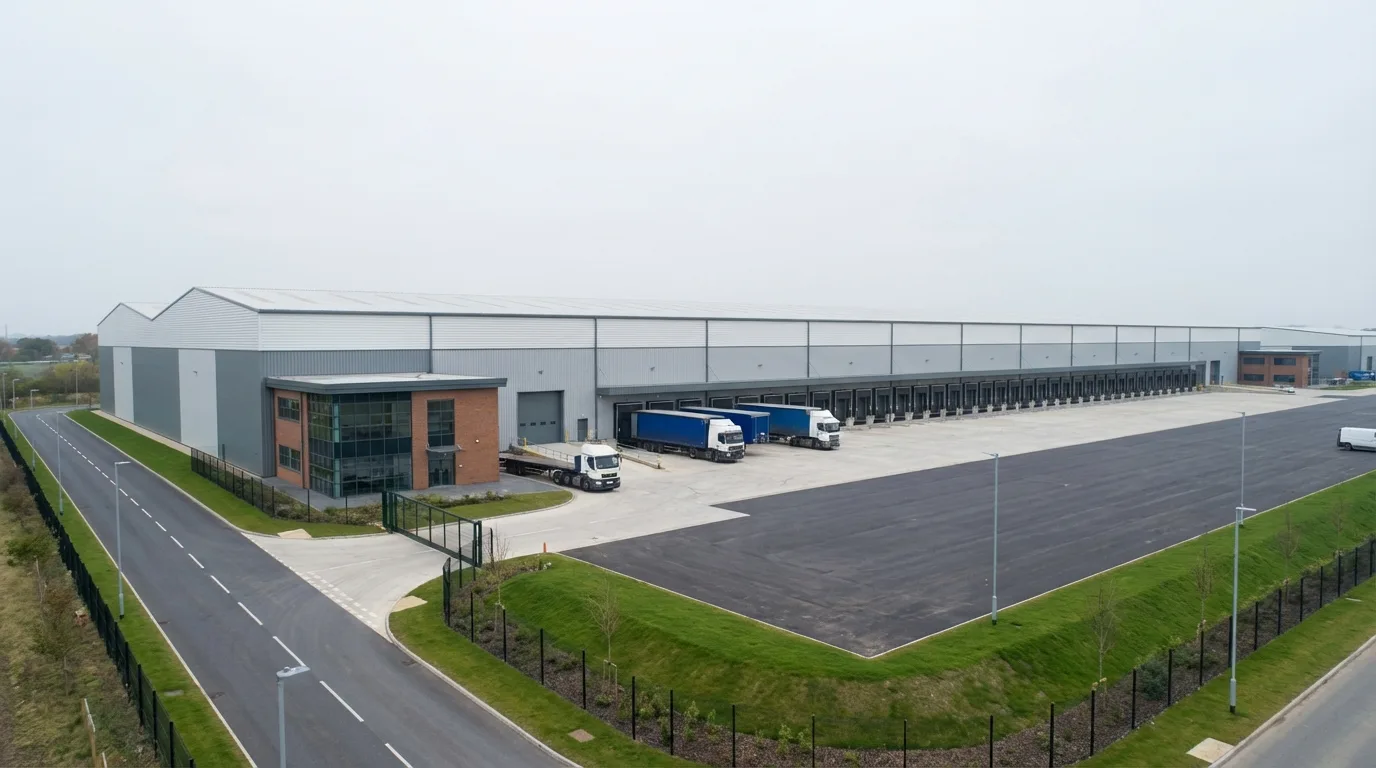
Planning VerifiedEXTERIOR CGI
Proving pallet-throughput geometry before the building is constructed.
Distribution centre CGI prioritises pallet movement, standard dock rhythm, deep yard capacity, and HGV-led single-mode circulation over multi-mode dispatch logic. It sits inside StratumCGI's warehouse and logistics CGI service as the pallet-storage and big-box logistics specialism.
UK distribution centre briefs cluster on the M1/A1 Golden Triangle and along the M6/M62 corridor, at high specification warehouse parks such as Symmetry Park Kettering, Magna Park Milton Keynes, Omega Business Park Warrington, and DP World London Gateway. The dock rhythm, deep service yard, BREEAM Excellent target, and Cat A office grade an occupier expects on the GA tracks the same convention UK industrial architects set on schemes of this class: Stephen George + Partners, Chetwoods Architects, RPS Group, and UMC Architects (No. 1 UK Industrial Architect by Barbour ABI). The CGI brief reads against that convention, not against a generic shed.
→Planning teams read HGV access geometry, yard depth, dock line, and neighbour amenity screening.
→Pre-let agents read operational scale, dock count, frontage quality, and single-mode occupier fit.
→Occupiers and 3PLs read pallet racking density, high-bay clear height, dock rhythm, and HGV queuing logic.
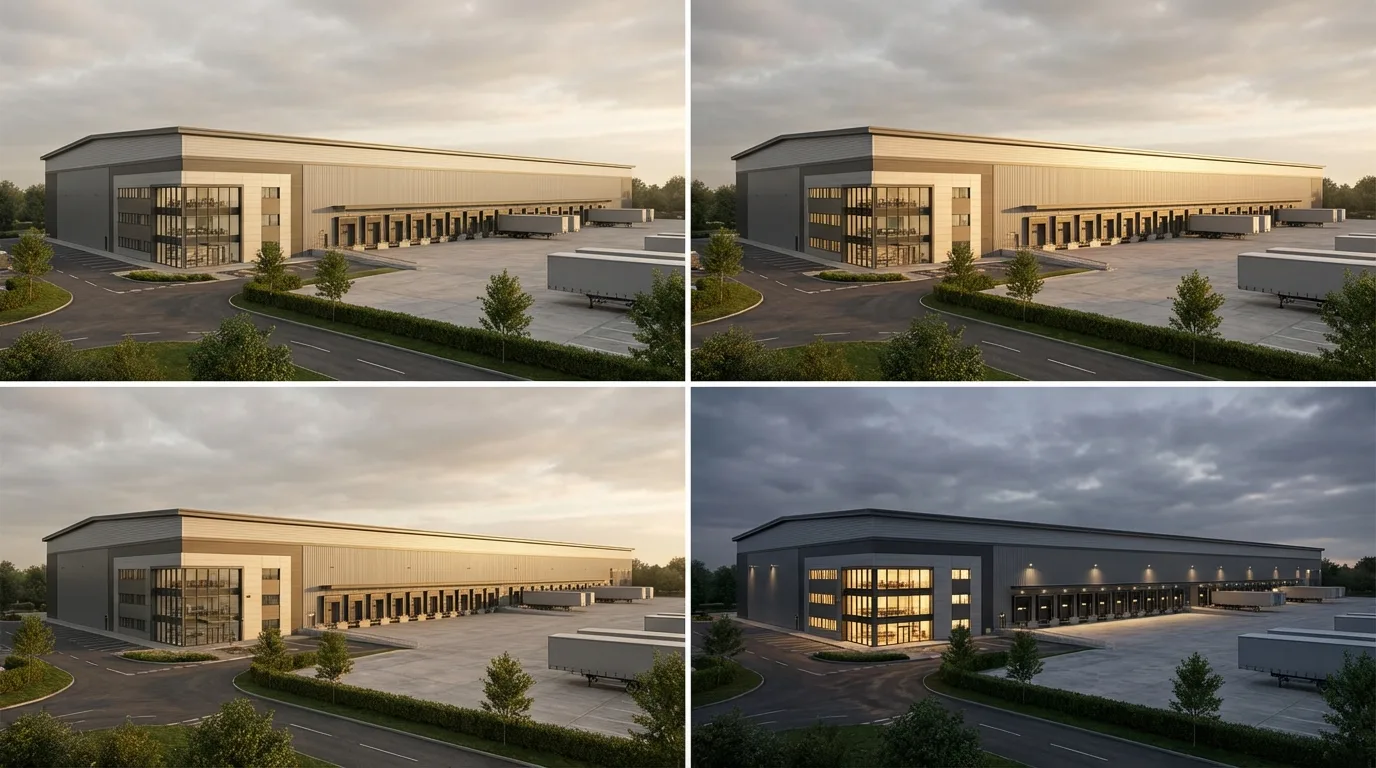
One approved 3D model renders three view contexts from the same locked geometry: planning-neutral verified view, leasing hero, and 24-hour operational read. The difference between them sits in camera position, light, and HGV activity level, not in the building.
Distribution Centre CGI Pricing Example
The indicative five-frame distribution centre package below totals £13,820, built from one coordinated 3D model. That sits inside the warehouse and logistics CGI pricing range of £12,500 to £28,000. The five-frame distribution centre brief can run above the parent range's six-frame lower-anchor figure because dock-count modelling, yard discipline, and HGV swept-path geometry add production days that a generic six-frame exterior pack does not carry. Distribution centre briefs sit towards the lower end of the range when the building is a single-mode pallet shed without specialist kit modelling, and move upward with dock count, yard complexity, racking scope, and occupier-variant depth.
Get Distribution Centre CGI for Your Scheme
Share the building size, dock count, yard depth, racking height, and whether the imagery is for planning, pre-let marketing, occupier review, or a combined proof pack. StratumCGI reviews each distribution centre brief before confirming scope and price.
Talk to the Logistics CGI Team
StratumCGI reviews distribution centre briefs around pallet throughput proof, HGV dock geometry, yard depth, and planning-readiness first. Contact the studio directly if drawings are already issued or the image pack has to support more than one audience.
Planning packs, pre-let sets, occupier reviews, HGV yard and dock operations, and high-bay interior CGI.
Distribution Centre CGI Proves Throughput Before Build
A distribution centre brief covers three operational attributes a planner, occupier, or investor each reviews separately: pallet velocity through the dock line, yard capacity under peak HGV load, and racking density at the confirmed clear height. Each attribute is rendered alongside the external shell that a standard warehouse visualisation covers on its own.
That means dock rhythm, HGV reverse manoeuvre arcs, pallet movement cues, and the relationship between yard depth and the dock face all need to read clearly in the same frame. If those elements stay vague, the render slips back into generic warehouse territory and stops answering the real commercial question.
The commercial stakes are specific. A planning appeal officer reviewing a transport assessment needs to read that 40T HGV turning radii work at the yard depth proposed. A pre-let agent marketing to a 3PL operator needs to show that dock count, EUR pallet flow, and HGV queuing at the gatehouse are credible at occupier capacity. A lender needs to read that the building functions as the building type it claims to be before committing to a forward-fund.
▶
Recommended Distribution Centre CGI Viewpoint Elevated corner and dock-face stills to show yard geometry at system level and human scale.
An elevated corner or low aerial view shows yard depth, dock line, HGV reverse geometry, and estate layout together. Ground-level stills at the dock face prove operational rhythm at human scale.
▶
What the Image Must Prove Throughput logic, circulation, and dock spacing under peak-load conditions.
The render proves pallet-throughput logic, HGV circulation, yard capacity at peak load, dock-leveller spacing at the confirmed floor differential, and single-mode operational credibility.
▶
Primary Review Audience Planning access first, then occupier, 3PL, and investor throughput fit.
Planning officers review HGV access and transport logic first, while occupiers, 3PLs, and investors assess pallet throughput, dock count, racking height, and yard operational fit.
HGV Dock Operations and Tail-Lift Design
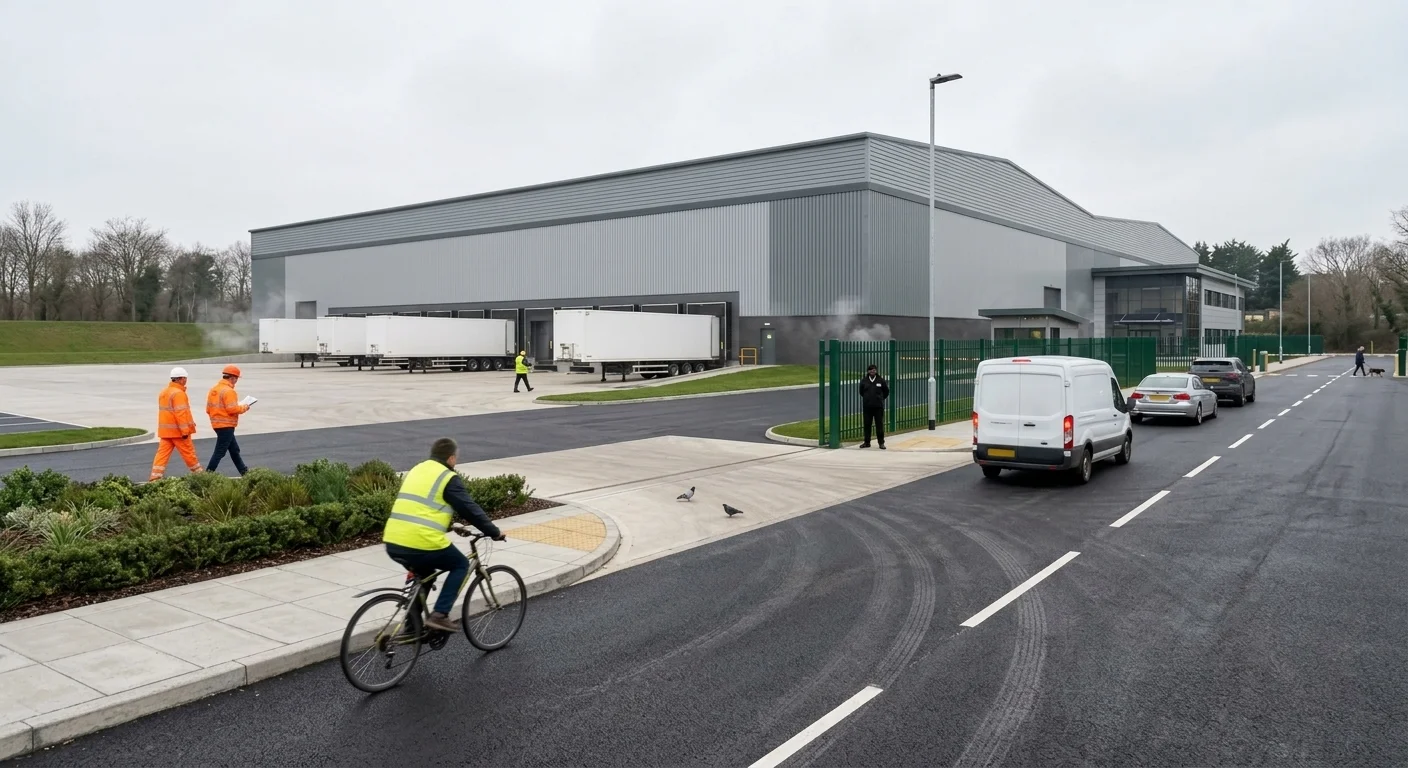
Distribution centre CGI proves the dock line before any steel goes in the ground. A dock face that reads correctly in the render confirms dock-leveller height at the approved floor-to-ground differential, tail-lift clearance at the canopy soffit, and 40T HGV access without tight manoeuvre at the yard mouth.
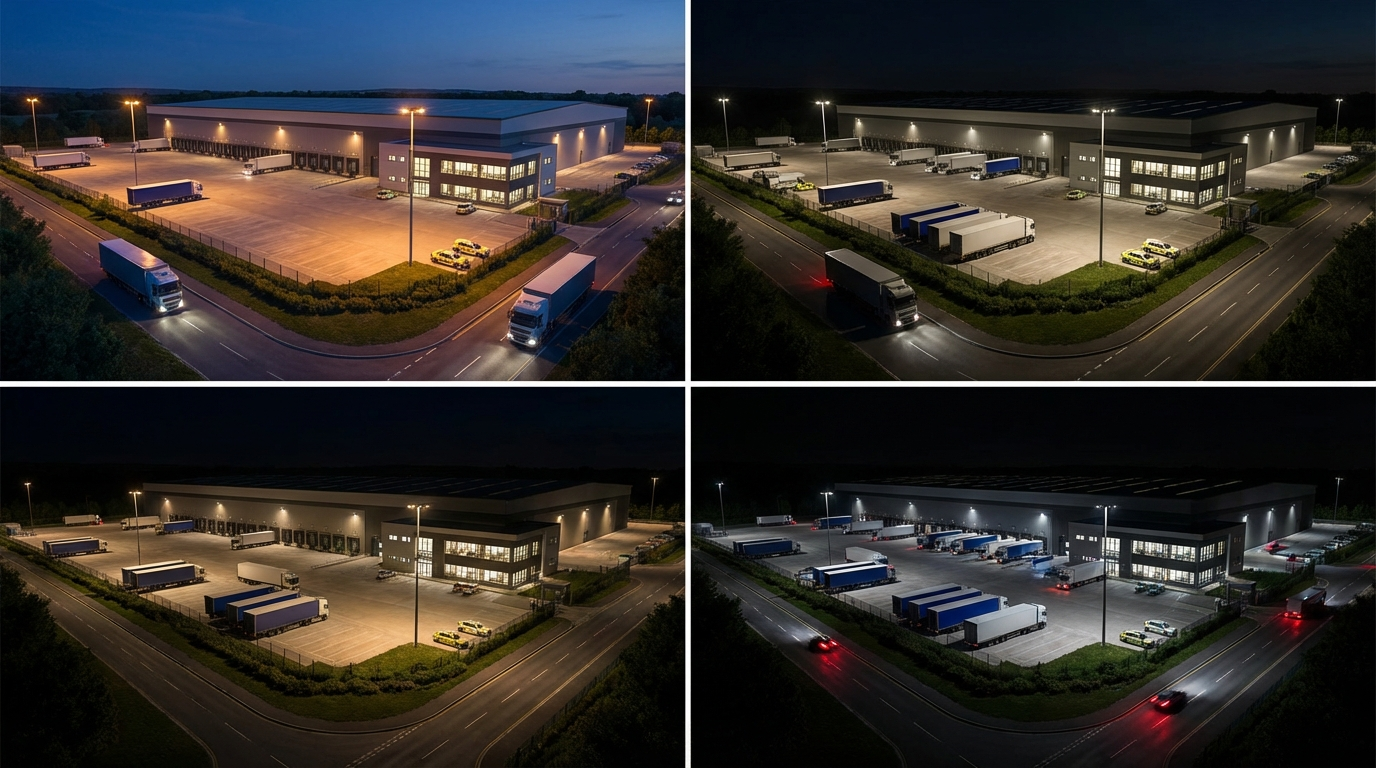
24-Hour Dock RhythmHGV OPERATIONS
Dock operations read for planning, pre-let, and occupier at a single approved geometry.
▶
Dock-Leveller Height and Tail-Lift Clearance Deck differential and canopy-soffit clearance proved for 40T HGV use.
The render positions dock levellers at the confirmed floor-to-ground differential. Tail-lift clearance at the canopy soffit is modelled from the dock specification to prove that a 40T HGV can operate without modification at the approved deck height.
▶
Level-Access vs Dock-Leveller Read Door types separated clearly for flatbed, curtainsider, and trailer use.
Some distribution briefs mix level-access doors for flatbed and curtainsider vehicles with standard dock-leveller positions for trailer delivery. The CGI distinguishes these cleanly so a transport officer can read which vehicle type uses which door without annotation.
▶
Canopy and Dock Shelter Geometry Projection depth and shelter seals shown as operational geometry, not facade graphics.
Canopy projection, dock shelter seals, and the relationship between the building fascia and the dock apron are included at the correct depth so the dock face reads as weather-tight and operationally credible, not as a flat elevation with doors drawn on.
40T HGV turning radii are modelled using 16.5-metre vehicle swept paths. That is the standard UK envelope for a five-axle articulated lorry. The render confirms that the approved yard width accommodates that arc without the vehicle clipping the dock shelter, the building corner, or a parked trailer. That single proof step addresses the most common single objection from highway authorities reviewing a distribution centre planning application.
Dock count is read in the frame as a consistent rhythm. A long dock face on a 200,000 sq ft shed with 30-plus doors needs to read as operationally orderly, not as a wall of identical openings. Trailer positioning, dock shelter colour breaks, and vehicle spacing are controlled in the CGI to communicate dock capacity without making the elevation feel mechanical or repetitive.
Pallet Racking and High-Bay Storage CGI
High-bay pallet racking is the operational core of a distribution centre. A distribution centre interior CGI proves clear height, racking configuration, aisle discipline, and MHE reach geometry before the occupier commits to a floor-slab specification or a fit-out programme. The same 3D model resolves the pallet rack grid, the racking system tier count, and high bay rack storage density in one frame, so the brief reads against build cost without a second visualisation pass.
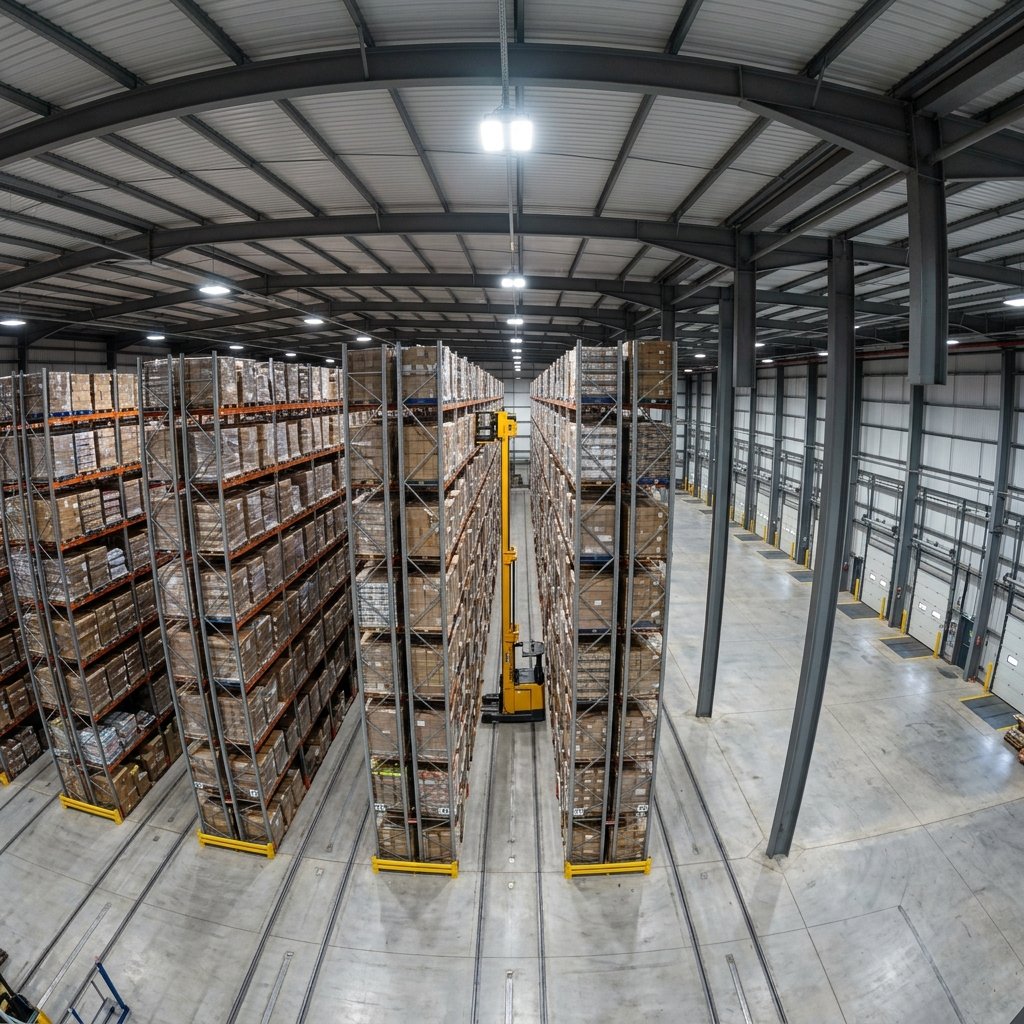
High-Bay VNAINTERIOR CGI
Proving pallet racking density and MHE reach before fit-out begins.
▶
Clear Height and Racking Level Count 12m+ clear height with beam-level counts visible in one frame.
Distribution centre CGI shows 12 metres of clear internal height or above, with pallet racking modelled to the confirmed beam-level count. The haunch height, racking uprights, and roof truss profile read in the same frame so an occupier can check storage density against their pallet count without annotation.
▶
Dexion and Jungheinrich-Style Racking Configurations APR, narrow-aisle, and VNA layouts from confirmed aisle widths.
Wide-aisle APR layouts for counterbalance trucks, narrow-aisle configurations for reach trucks, and VNA aisle layouts for man-up or turret trucks are each rendered from the confirmed aisle-width and grid dimension. EUR pallet geometry is used throughout to keep beam-loading assumptions consistent with the structural floor-slab specification.
▶
MHE Reach Proof and Aisle-End Geometry Clearance and turn circles matched to specified MHE.
Man-up MHE, reach trucks, and turret trucks operate inside the aisle with the correct minimum clearance to the top beam level and to the racking end-frame. Aisle-end turn areas are shown at the correct turning circle to confirm that the floor-slab and the racking grid are consistent with the MHE the occupier has specified.
A distribution centre interior CGI that shows only empty racking misses the single most useful proof for an occupier signing off a pre-let commitment. EUR pallets on every beam level, a reach truck or man-up MHE in the aisle, and the haunch visible above the top beam give the occupier the density read, the MHE fit, and the structural margin in one frame. That is what moves a pre-let conversation from indicative to confirmed.
For distribution centres with automated storage and retrieval systems at the pallet level, the interior brief extends to show ASRS structure, load-handling device geometry, and aisle-transfer vehicles. Those commissions are scoped separately and sit above the standard high-bay racking package.
Yard Logistics, HGV Queuing, Reverse Area, and Neighbour Impact
The service yard is where a distribution centre planning application is most often challenged. A deep yard CGI that reads the correct HGV queuing sequence, reverse manoeuvre arcs, gatehouse position, and boundary screening answers the transport and neighbour amenity questions before the public examination.
Yard Depth 50-80mHGV QUEUING
Proving reverse manoeuvre arcs, trailer queuing, and neighbour screening at one approved geometry.
▶
Deep Yard Geometry at 50 to 80 Metres Service-yard depth proved for reverse arc, trailer row, and through-lane.
A standard distribution centre service yard reads at 50 to 80 metres in depth. That range gives a 16.5-metre articulated trailer safe clearance on the reverse manoeuvre arc onto a dock leveller, a trailer parking row behind the arc, and a through-lane for HGVs queuing from the gatehouse. The CGI makes that spatial logic legible in one frame rather than in a separate swept-path drawing that few planning reviewers read with confidence.
▶
Reverse Manoeuvre Arcs and HGV Queuing 40T arc geometry and queue lanes laid out at approved yard dimensions.
The reverse manoeuvre area shows 40T HGV arc geometry from the confirmed swept-path study. Trailer parking rows, HGV queuing lanes at the gatehouse, and the relationship between inbound and outbound routes are laid out at the approved yard dimensions. That removes ambiguity on whether vehicles conflict under peak operating load, which is the primary highway objection at distribution centre planning hearings.
▶
Gatehouse, Trailer Park, and Traffic Calming Access control and safety details shown in the true plan position.
Security gatehouse position, trailer park capacity behind the dock line, traffic calming at the estate road junction, and CCTV coverage are shown in the correct plan position. These details answer the LPA access and safety questions without requiring a separate site security note at the planning stage.
▶
Screening, Bunds, and Neighbour Amenity Landscape mitigation and boundary sight lines rendered for amenity review.
Landscape bunds, acoustic screening, tree belt depth, and sight lines from the nearest residential boundary are rendered from the landscape strategy. The CGI shows what a neighbouring property would see at ground level and at first-floor window height from the confirmed boundary set-back, which is the proof that an amenity chapter in a planning statement needs but rarely provides as photorealistic evidence.
Single-mode operation is the defining characteristic of a distribution centre yard. One vehicle class, the 40T articulated HGV, runs at high frequency across every dock position. That consistency means dock rhythm, trailer queuing, and yard circulation all need to read as an orderly single-mode system, with one swept path repeated across the dock face. The CGI confirms that discipline before the planning hearing, not after it.
Neighbour amenity evidence is increasingly reviewed at planning by LPAs that have received objections from nearby occupiers before the application is determined. A distribution centre that can show bund height, tree-belt establishment height, and the view from a neighbouring boundary in a photorealistic still is better placed to resolve those objections early than one that relies only on a written amenity assessment.
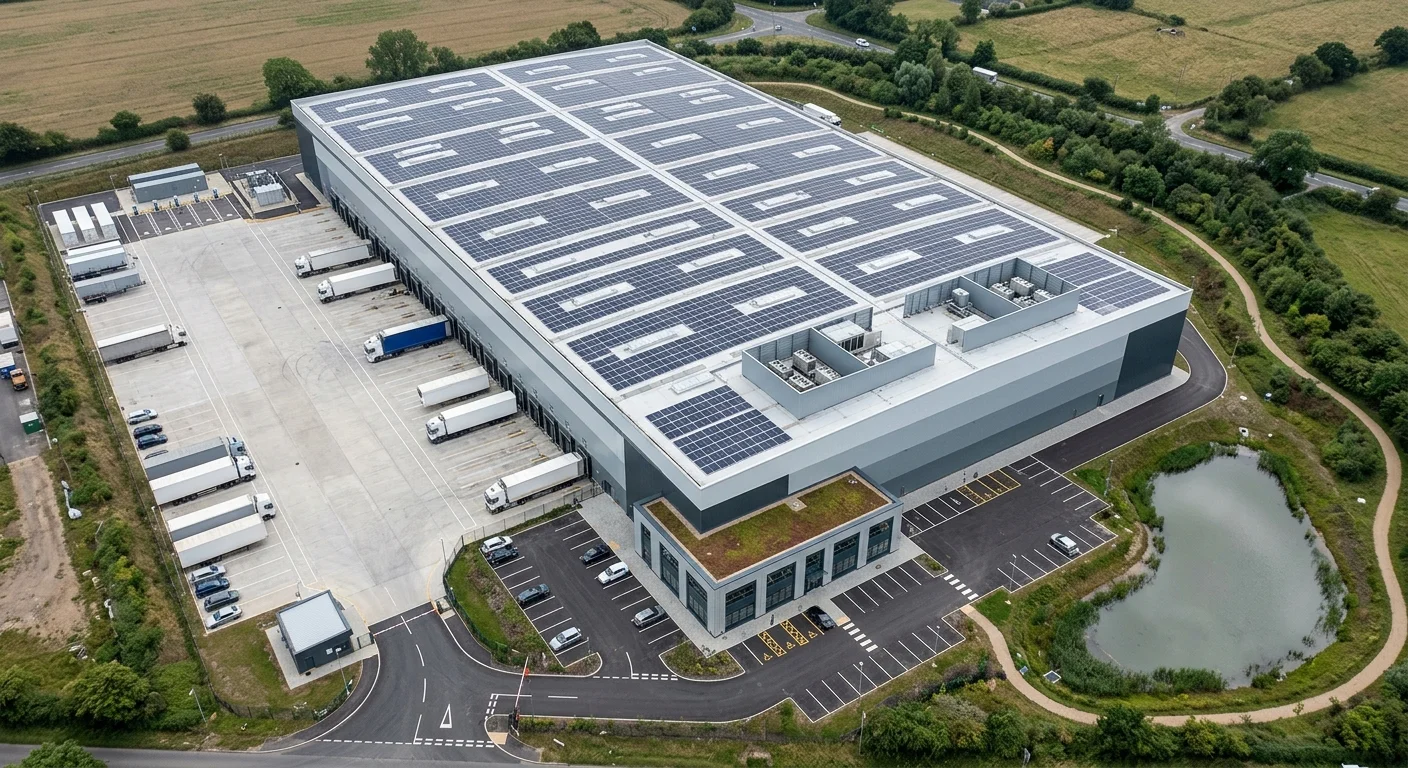
Sustainability kit is now part of the same yard and envelope conversation. LPAs, lenders, and BREEAM assessors expect to see rooftop photovoltaics, electric HGV charging compounds, battery energy storage, attenuation ponds, and green-roof treatments rendered in plan position rather than described in a separate report.
ESG + BREEAMROOFTOP PV · EV HGV · ATTENUATION
Rooftop PV, electric HGV charging, battery storage, and attenuation pond shown in their true plan position for lender, LPA, and BREEAM review.
A sustainability aerial is what connects the operational read of the yard to the environmental read of the scheme. It shows the PV array in relation to plant enclosures and rooflights, the electric HGV charging compound in relation to the standard dock line, and the attenuation pond in relation to the landscape bund, so a reviewer can verify in a single frame that the sustainability strategy sits inside the operational geometry rather than bolted on top of it.
Planning, Pre-Let, and Occupier Image Sets
Distribution centre image sets answer different commercial questions for planning teams, pre-let agents, occupiers, and lenders before the building is delivered. One approved 3D model serves all four audiences from the same locked geometry.
Audience FitPLANNING · PRE-LET · OCCUPIER
One approved shell, three audiences, three proof emphases.
▶
Planning Review Planning-neutral proof of yard depth, dock geometry, and screening.
Yard depth, dock geometry, HGV access, massing, and screening read cleanly in the planning-neutral verified view without overselling occupation. AVR Type 3 methodology confirms the image represents the approved scheme rather than a marketing interpretation of it.
▶
Pre-Let Marketing Frontage quality and dock discipline presented from the same approved geometry.
Frontage quality, dock count, yard discipline, and occupier capex certainty read visibly in the leasing hero. Agent packs and portal listings use the same approved geometry to avoid inconsistency between the planning image and the marketing image.
▶
Occupier Logic Operational proof of pallet density, clear height, and HGV queuing capacity.
Pallet racking density, clear height, dock rhythm, HGV queuing capacity, and EUR pallet flow move to the front of the occupier-review pack. The high-bay interior and yard operations views give the operations team the proof they need to confirm that the building specification matches the logistics brief.
▶
Lender and Board Pack Built-asset credibility for finance review without extra model rebuild.
A forward-fund or development finance submission needs credible images that present the scheme as a built asset, not as a site plan. The leasing hero and occupier-review views serve that audience alongside the planning-neutral view without additional production cost.
StratumCGI keeps the approved shell building fixed while adjusting camera position, lighting, vehicle activity, and staging emphasis to serve each of these audiences. That approach removes the risk of a planner, agent, or occupier seeing a different building in each image, which is a common failure mode on multi-audience distribution centre CGI projects.
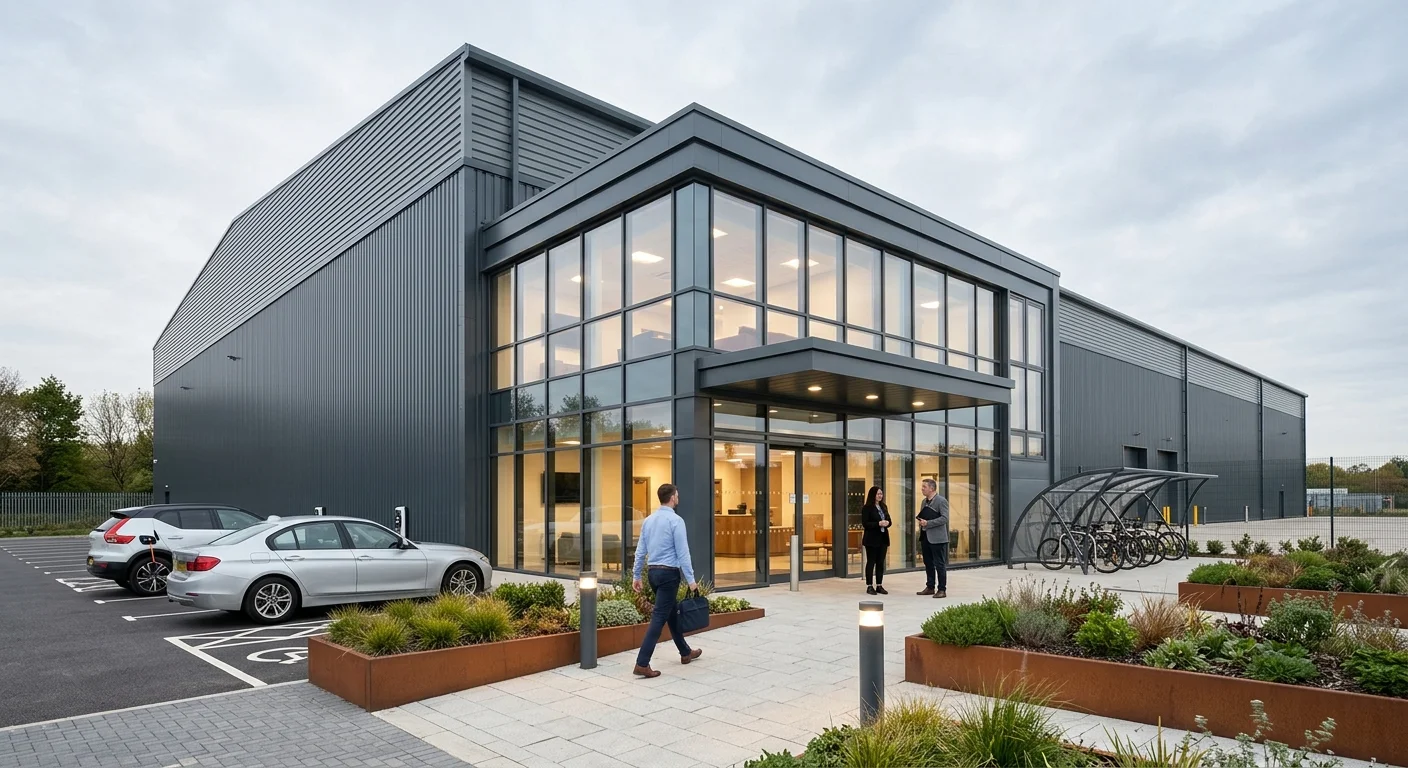
The office frontage hero is the occupier-facing half of the same approved geometry. Where the planning-neutral view foregrounds dock line and yard depth for officer review, the office frontage view foregrounds reception glazing, arrival sequence, and human scale for the agent pack and the occupier fit-out conversation.
Reception glazing, arrival sequence, and human scale from the same approved geometry.
The same 3D model carries the frontage camera position, so the office block, entrance canopy, and glazing module in the leasing hero are the approved ones, not a marketing interpretation. Brochure covers, portal listings, and occupier-board packs all use the same frontage geometry that the LPA has already seen.
Logistics park context and multi-unit distribution CGI
⌄
Multi-unit distribution parks add estate-road hierarchy, phasing logic, and shared infrastructure to the single-unit brief. The CGI extends from one approved shell building to a coordinated park layout, showing gatehouse sequence, internal road grammar, and phase-one versus phase-two occupancy in a single aerial view. That wider context is relevant where an LPA is assessing a strategic employment land allocation rather than a single plot.
A planning photomontage drops the approved distribution centre CGI into a verified street-level photograph of the real site before development. The before frame shows the existing conditions, tired industrial fabric, rusted sheds, and boundary fencing. The after frame shows the same camera position with the approved scheme, dock line, yard depth, and landscape screening composited over the top. That single pairing answers the visual receptor question that LPAs and neighbour groups raise at distribution centre planning applications.
BeforeExisting Site
Before. Existing street-level view of the site, captured at the agreed verified viewpoint.
AfterApproved Scheme
After. Approved distribution centre scheme composited into the same viewpoint, with dock line, yard depth, and landscape screening rendered from the coordinated model.
The camera match between the before and after frame is what separates a planning-grade photomontage from a marketing composite. Four parameters are held identical across both frames.
Verified camera position
Fixed northing, easting, and height recorded at the agreed viewpoint, so the after frame renders from the same point as the before photograph.
Sensor height above ground
Measured to the pavement or survey datum at the viewpoint, so eye-level geometry reads as consistent between the two frames.
Focal length and field of view
Matched to the lens used for the existing photograph, so perspective compression and edge distortion are identical in the composited scheme.
Daylight and weather condition
Sky state, sun angle, and ambient colour temperature are replicated in the render so the composite sits inside the original light rather than floating above it.
Who reads the photomontage pair
→Local Planning Authority: reads the approved envelope against existing context at the agreed viewpoint, for determination reports and officer recommendations.
→Visual impact assessment consultant: reads the landscape mitigation, bund height, and tree-belt establishment against the sensitive receptor baseline.
→Neighbour groups and amenity consultees: read the boundary treatment and massing from the position closest to their own property line.
When the brief requires AVR Type 3 verified view instead of a standard photomontage
⌄
AVR Type 3 verified views carry a stricter evidentiary standard than a planning photomontage. The camera position is captured with a surveyed reference, the accuracy is recorded in a signed statement, and the methodology is prepared to withstand examination at a public inquiry. Where the LPA or an inspector has asked for AVR Type 3, the commission is scoped separately from the standard photomontage frame and carries a verified-view uplift. The uplift reflects the survey control, the accuracy-statement authorship, and the additional QA pass, not a change in the render itself.
Distribution Centre vs Fulfilment and Cross-Dock
A distribution centre CGI brief is a different commission from a fulfilment centre, a cross-dock facility, or a last-mile depot. Using the wrong brief produces imagery that answers the wrong commercial questions and fails with the reviewer the image was built for.
Distribution centre CGI compared with related building types
Building type
Primary CGI proof
Yard and vehicle read
Interior read
Use StratumCGI if
Distribution centre
Pallet movement, dock rhythm, HGV-led single-mode operation
Deep yard 50 to 80m, 40T HGV arcs, trailer queuing
E-commerce or parcel-processing occupier, van-heavy operations, mezzanine fit-out
Cross-dock facility
Dual-sided yard throughput, trailer sequencing across two opposing courts
Two active yard faces, no pallet-storage depth behind the dock line
Short-dwell staging lanes, no racking depth, transfer aisles
Freight consolidation or pallet transshipment brief, in-and-out flow within hours
Last-mile depot
Urban street relationship, neighbour-sensitive vehicle operation, compact footprint
Shallow yard under 40m, mixed van and small HGV, highway frontage prominent
Low-level parcel staging, minimal racking, welfare and driver amenity
Urban edge site, residential neighbour context, courier or final-mile operator
The clearest diagnostic question is: does the building hold goods overnight in deep pallet racking at high bay, or does it move goods through with minimal dwell? If the answer is deep pallet storage and standard dock rhythm with 40T HGVs as the dominant vehicle class, the correct brief is a distribution centre. If the answer is high-frequency parcel movement, mezzanine pick-pack, and van-heavy last-hour dispatch, the correct brief is a fulfilment centre. If the answer is in-and-out within hours across two opposing trailer courts, the brief moves to cross-dock.
For the full subtype comparison across distribution, high-bay, depot, cold storage, and air cargo, see the warehouse and logistics CGI hub.
Distribution Centre CGI Questions Buyers Ask First
Common questions on distribution centre CGI scope, pricing, HGV geometry, pallet racking, and yard operations.
What is distribution centre CGI?
⌄
Distribution centre CGI is photorealistic architectural visualisation for pallet-throughput buildings, HGV dock operations, deep service yards, and high-bay pallet racking. It shows how the scheme looks and how it operates at full HGV load before the building is constructed or occupied.
How much does distribution centre CGI cost in the UK?
⌄
A five-frame distribution centre CGI package at StratumCGI is indicatively priced around £13,700 to £14,500. This includes 3D base modelling, material and lighting setup, a planning-neutral exterior, a leasing hero, a yard and HGV operations view, a high-bay interior, and post-production. The final figure depends on dock count, yard complexity, racking scope, and the number of operating variants reusing the approved model.
What yard depth does a distribution centre CGI need to show?
⌄
A standard distribution centre service yard should read at 50 to 80 metres in depth. That range accommodates a 16.5-metre articulated trailer reversing onto the dock with safe clearance, trailer parking behind the reversing arc, and a through-lane for HGVs queuing at the gatehouse. The CGI must make that depth legible in a single frame for a planning officer reviewing a transport assessment.
What HGV turning radius does StratumCGI model in distribution centre CGI?
⌄
StratumCGI models 40T HGV turning arcs using a 16.5-metre vehicle swept path, which is the standard UK Design Manual for Roads and Bridges swept-path envelope for a five-axle articulated lorry. Reverse manoeuvre arcs onto dock levellers are modelled at the confirmed floor-to-ground differential to prove the dock geometry functions before the building is constructed.
Can one distribution centre model show planning, pre-let, and occupier views?
⌄
Yes. StratumCGI keeps one approved distribution centre 3D model fixed and adjusts camera position, light, and HGV activity level to serve planning review, pre-let marketing, and occupier evaluation from the same locked geometry. That approach avoids geometry inconsistency across a multi-audience pack and keeps operating-variant cost low.
What clear height should a high-bay distribution centre CGI show?
⌄
High-bay distribution centre CGI typically shows 12 metres of clear internal height or greater. That range supports Dexion or Jungheinrich-style pallet racking to six or more levels and narrow-aisle or VNA layouts with reach-truck or man-up MHE access. The CGI should show the racking height relative to the haunch and roof truss so an occupier can read the storage density in the frame.
How does distribution centre CGI support a planning application?
⌄
Distribution centre CGI supports a planning application by providing AVR Type 3 verified views that confirm massing, screening, and access geometry at the planning-neutral read, alongside daylight and outlook stills that prove the scheme against neighbour amenity policy. The images accompany the transport assessment and design and access statement as a visual proof of the approved layout.
What makes distribution centre CGI different from a generic warehouse render?
⌄
A generic warehouse render shows a building shell and a tidy yard. Distribution centre CGI shows the whole single-mode pallet operation: HGV dock rhythm with tail-lift and dock-leveller detail, deep yard reverse manoeuvre arcs, pallet racking height and aisle discipline, trailer parking, gatehouse and HGV queuing, screening bunds, and the neighbour amenity relationship. Each element is modelled from the project drawings, not approximated.
How long does a distribution centre CGI commission take?
⌄
A five-frame distribution centre CGI package at StratumCGI typically takes three to four weeks from confirmed brief to final delivery. The first approved exterior hero is usually ready for review by the end of week two. Operating variants that reuse the approved 3D model are delivered in parallel in weeks three and four.
What inputs does StratumCGI need to start distribution centre CGI?
⌄
StratumCGI starts from structural GA drawings, site plans, and transport information including swept-path studies. Cladding schedules, dock-leveller specs, racking layouts, and a confirmed list of HGV types on site reduce revision rounds and speed up final sign-off.
Which distribution centre details stay fixed between planning and pre-let images?
Distribution centre CGI keeps the approved shell, dock positions, service yard geometry, gatehouse location, access points, and landscape frame fixed between planning and pre-let images. Camera position, lighting, HGV activity level, and trailer staging can change without changing the approved scheme.
What distribution centre details matter most to occupiers and 3PL operators?
Occupiers and 3PL operators focus on dock count, dock-leveller height at the confirmed floor differential, pallet racking density and clear height, EUR pallet fit, MHE aisle geometry, HGV queuing capacity at the gatehouse, and whether the yard depth at 50 to 80 metres supports the intended daily vehicle movement count.
How does distribution centre CGI maintain one coordinated model across planning, pre-let, and occupier reads?
StratumCGI treats planning-neutral verified views, leasing hero renders, and occupier-review stills as staging variants inside one coordinated service. The same 3D model and locked geometry stay in place while the operating read changes for each review context, so no inconsistency can develop across a multi-audience image pack.
Distribution Centre Portfolio
Logistics projects with the closest operational brief to distribution centre CGI, selected for HGV dock rhythm, yard depth, pallet-throughput credibility, and planning-grade scope.
Distribution centre CGI showing dock-face rhythm, deep service yard at regional scale, and planning-neutral verified view for a Central Belt logistics scheme.
Warehouse-led CGI showing dock-face discipline, yard geometry, and office frontage quality for a West Midlands distribution scheme with strong pre-let application.
Multi-unit distribution hub CGI showing estate road hierarchy, HGV circulation, yard discipline, and phased occupancy at a regional logistics belt location.
Big-box logistics park CGI proving estate-scale massing, yard access, service-yard geometry, and occupier-facing frontage quality for a UK Golden Triangle distribution scheme.
For the broader warehouse subtype mix, see the distribution centre CGI section on the warehouse and logistics CGI hub. It shows how distribution, high-bay, fulfilment, depot, cold storage, and air cargo briefs sit inside one coordinated service.
Commission
Distribution centre CGI services
Planning CGI, HGV dock and yard stills, aerial perspectives, pallet-throughput views, and occupier pack imagery, prepared from your CAD or BIM, site plan, elevations, and yard layout. NDA-safe publication on request.