Industrial CGI Process
and Planning Standards

The industrial CGI process is a planning-led methodology covering brief intake, survey alignment, verified-view control, consultant review, and final delivery. StratumCGI uses one coordinated model to support planning-grade CGI, photomontage, and marketing imagery across UK industrial briefs.

  1. Brief & Input Pack: drawings, references, target views, and output scope confirmed
  2. Model & Site Build: 3D massing, site context, infrastructure, and access routes constructed
  3. Draft Views & Composition: camera angles, lighting study, and material tests across 3 to 4 draft frames
  4. Review & Technical Refinement: consolidated review pass covering architecture, planning, and operational detail
  5. Final Delivery & Handover: 8K renders, planning-pack PDF, and multi-format file transfer

A planning-led methodology for creating photorealistic industrial visualisations that satisfy verified-view standards, support consultant review, and carry through to investor and pre-let packs.

Five structured stages. Delivery timelines agreed per project based on view count, scheme complexity, and programme requirements.

250+
Projects Delivered
98%
Planning Success
Agreed
Per Project
ISO 9001
Quality Certified

Planning Standards and Delivery Workflow

StratumCGI handles industrial CGI through one planning-led methodology and five defined production stages, from brief to final handover, typically in 12 to 15 working days. The workflow covers warehouse, data centre campus, and industrial park briefs, with each stage building upon the last to produce planning-grade visualisations calibrated to UK local authority standards.

Unlike general architectural CGI studios that treat industrial schemes as standard elevation renders, StratumCGI structures the workflow around the specific technical and planning demands of logistics infrastructure: correct cladding profiles, loading bay clearances, security perimeters, HGV circulation routes, and verified camera control modelled to reflect actual site operation, not generic convention.

Every project follows the same standards framework before image style and audience pack are agreed.

Planning Standards Before the Five Stages Begin

Planning-grade CGI is not just a rendering style. It is a controlled methodology covering authority requirements, camera logic, survey alignment, consultant review, and output reuse across different audiences. StratumCGI sets those controls before production begins so the same scheme does not have to be rebuilt when the pack moves from planning to leasing or investor review.

The five stages below execute this framework. The standards layer determines what the images must prove, who signs them off, and how one coordinated model supports more than one deliverable type.

Planning-Grade CGI

Planning-grade CGI starts with the authority's view list, scale benchmarks, receptor logic, and submission format. Distance angles, reference objects, and committee-facing use are documented at intake so the image set answers the planning requirement rather than a generic design brief.

Verified Views and Photomontage

Verified views use fixed surveyed camera positions. Photomontage composites the rendered model into a base photograph from the same recorded location. The geometry can then feed standalone marketing stills once the positional constraints of the planning pack are removed.

Survey Alignment and Camera Matching

DWG files and topographic survey information are imported together to build terrain, finished floor levels, and boundary conditions. For surveyed views, focal length, crop factor, and tripod height are matched to the recorded setup so the image can be repeated, checked, and defended.

Consultant Coordination and Review Control

Architect, planning consultant, EIA reviewer, landscape consultant, and client comments are routed through one consolidated review document. That keeps one instruction set moving through Stage 04, instead of letting sequential revisions create conflicting mark-ups and programme delay.

One Model for Planning and Marketing

StratumCGI builds one coordinated 3D shell that can support verified views, photomontages, leasing images, investor crops, and board packs. The building geometry, cladding, yard layout, and landscape model stay consistent while the camera logic, context treatment, and file format change by audience.

Brief StratumCGI on Your Industrial CGI Pack

Share the brief type, site context, stage of the proposal, and whether the pack is for planning submission, leasing, investor review, or a combination. StratumCGI reviews each industrial brief before confirming scope, programme, and price.

Attach up to 3 files. PDF, JPG, PNG, or WEBP. 15 MB total.

Talk to the Studio

StratumCGI's director reviews every industrial CGI brief before confirming scope and price. Contact the studio directly with drawings, briefs in progress, or scheme questions.

Typical lead time
12 to 15 working days

The Five Stages in Detail

Each stage has a defined deliverable, review point, and timeline. The stages below execute the standards framework established at brief stage.

The five-stage workflow applies consistently across warehouse, data centre campus, and industrial park briefs. Each stage builds precision incrementally, from verified inputs at Stage 01 through to final deliverables at Stage 05, with planning compliance checkpoints embedded rather than added retrospectively.

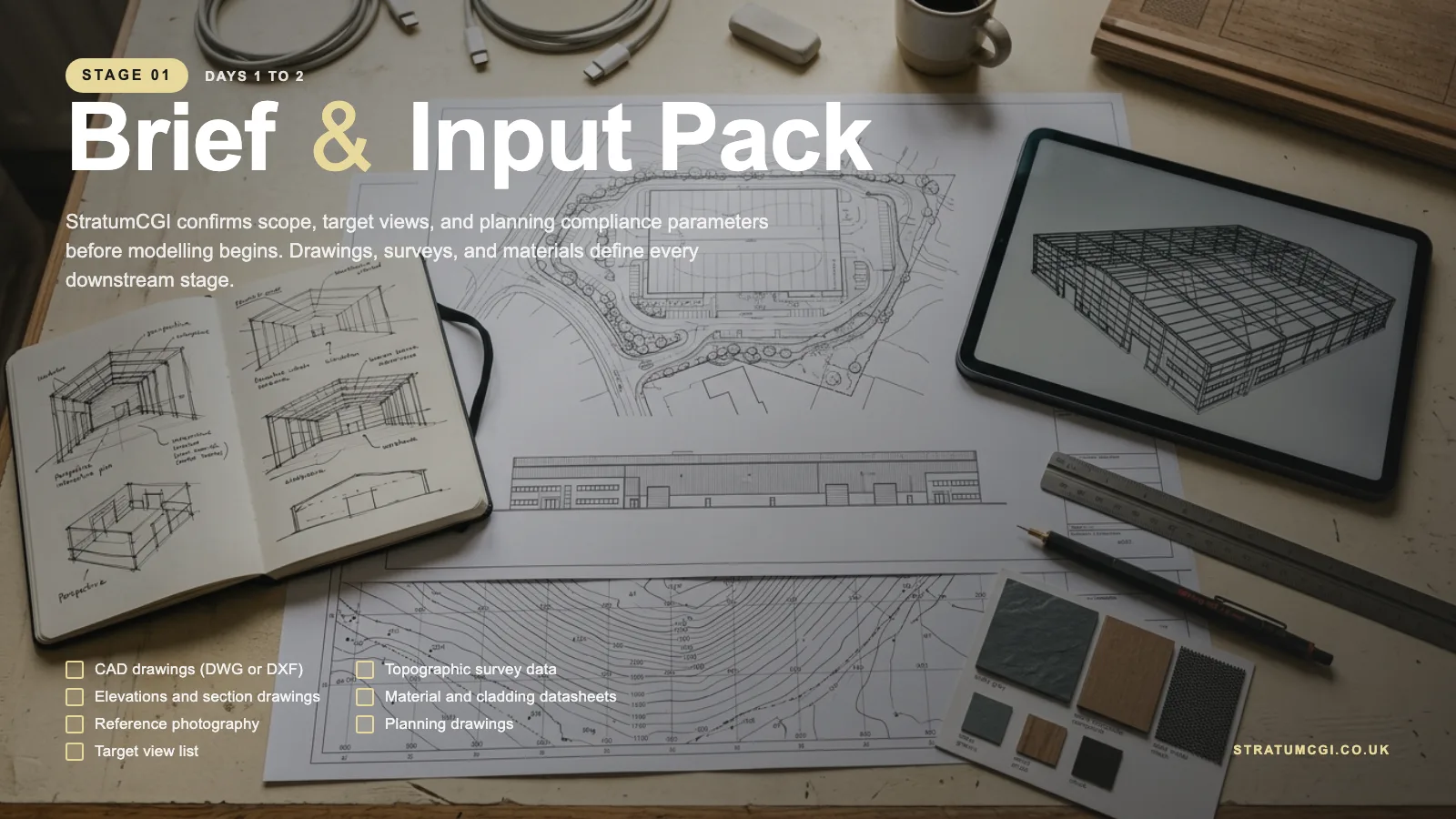
Stage 01 Brief and Input Pack: StratumCGI industrial CGI process intake with CAD drawings, topographic survey, cladding samples and a 3D warehouse wireframe tablet preview
Stage 01 deliverable: a confirmed input pack covering drawings, survey, materials, references, planning context, and a target view list before modelling begins.

Stage 01: Brief & Input Pack

Planning Compliance Intake

Industrial CGI for planning applications must satisfy local authority rules on camera position, distance from proposed facade, and scale calibration against an agreed reference object. StratumCGI records these parameters at brief stage so every subsequent draft view is produced to the correct specification from the outset.

01

Input Checklist

The ideal Stage 01 input pack contains the following technical data to ensure accuracy and planning compliance:

CAD drawings (DWG or DXF format)
Topographic survey data
Elevations and section drawings
Material and cladding datasheets
Reference photography of site
Planning drawings (draft or final)
Target view list and camera positions

StratumCGI can also start from concept sketches or partial drawing sets. The team identifies any gaps during the initial consultation and documents what additional input is needed before Stage 02 begins.

Deliverable Type Options

Confirming which deliverable applies at Stage 01 determines the camera methodology for the entire project. We offer three distinct deliverable types to cover different project needs:

Verified View

A planning-grade image produced to a fixed camera position with documented survey coordinates, used where a planning authority requires a precise, reproducible representation of the proposed building within its setting.

Photomontage

Composites the CGI render into a base photograph taken from a surveyed position, presenting the proposed scheme against a real photographic background for visual impact assessments.

Marketing CGI

A standalone 3D render without photographic compositing, produced to present the scheme to occupiers and investors without the positional constraints of a planning submission.

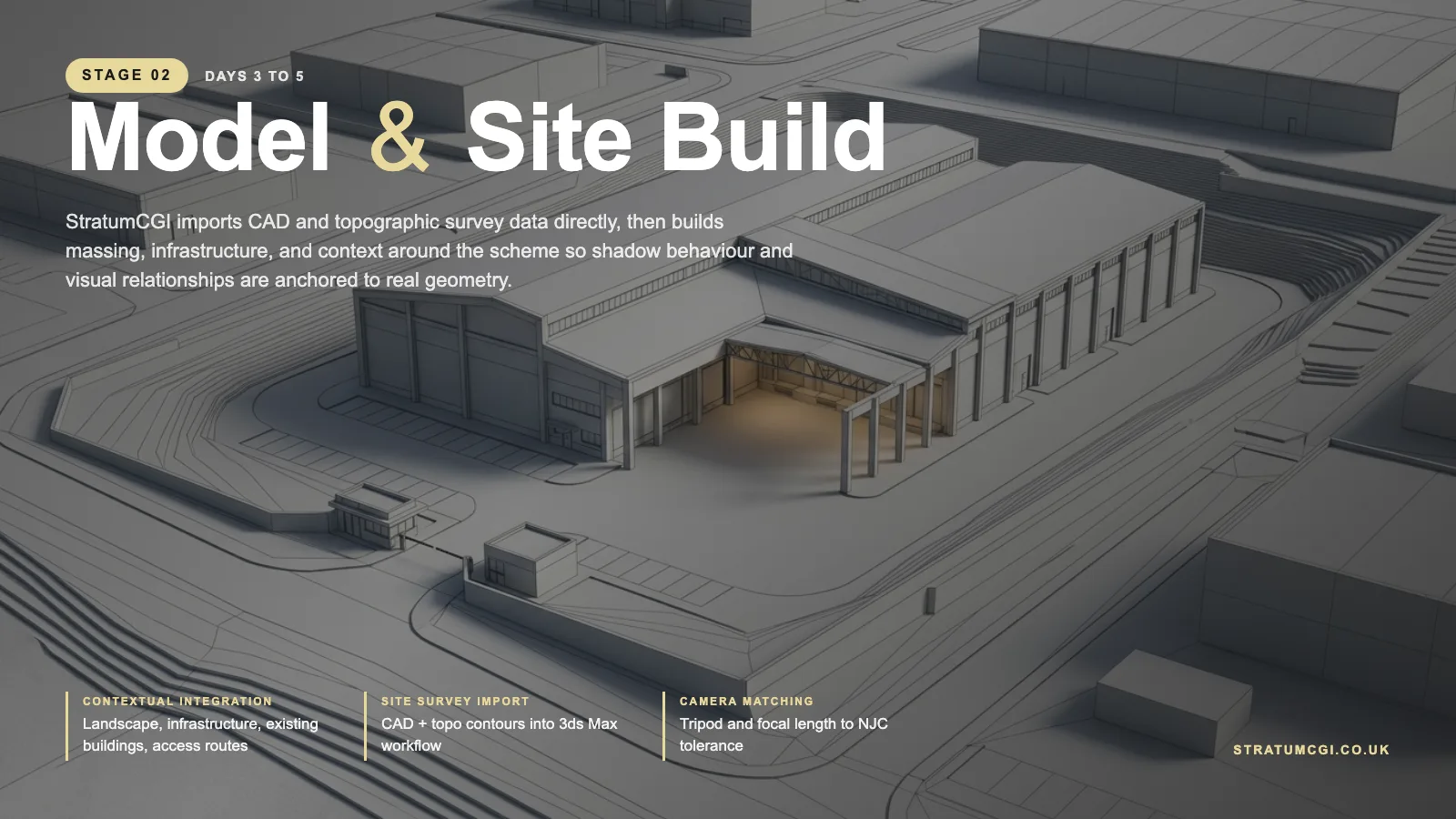
Stage 02 Model and Site Build: StratumCGI 3D massing model of a UK industrial warehouse with contextual landscape, topographic terrain and access routes imported from CAD and survey data
Stage 02 locks the physical geometry that Stage 03 lighting, Stage 04 review, and Stage 05 delivery all inherit: context massing, terrain contours, and camera-matched viewpoints.

Stage 02: Model & Site Build

Contextual Integration

Surrounding buildings, existing vegetation, access roads, site boundaries, and adjacent infrastructure are modelled at Stage 02. For planning-led schemes, accurate context massing determines shadow behaviour and visual relationship to receptors.

Site Survey Import and Camera Matching

CAD data and topographic survey files are imported simultaneously, with terrain geometry built from survey contours. For photomontage briefs, the camera is matched to the physical position: matching focal length, sensor crop factor, and tripod height to within accepted NJC Standards tolerances.

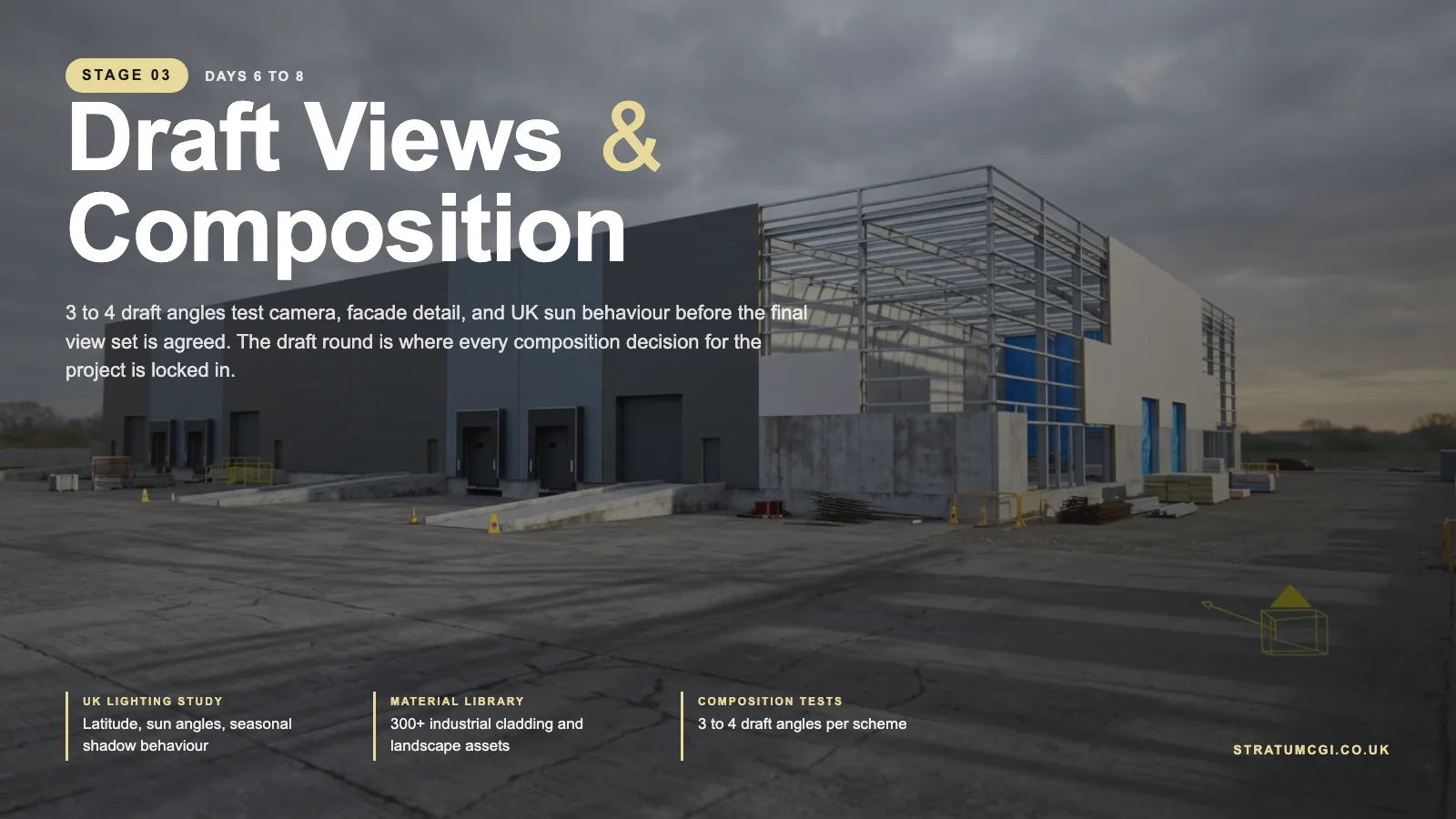
Stage 03 Draft Views and Composition: StratumCGI draft CGI of a UK industrial warehouse testing camera angles, UK lighting behaviour and facade cladding detail before the final view set is agreed
Clients select the final view set from three to four draft angles per project, locking composition decisions before Stage 04 refinement begins.

Stage 03: Draft Views & Composition

UK Lighting Study

We calibrate sun position using the precise latitude and longitude of the site. This determines shadow behaviour for Visual Impact Assessments, showing how the building reads in varying conditions, from mid-summer midday to low winter light.

Asset Library and Material Database

Our library is built from 300+ industrial projects, covering specific cladding systems, standing-seam roofing, and specialist logistics vegetation. Industrial cladding profiles are modelled with correct rib pitch and reflectance values for product-specific accuracy.

Composition Testing

Draft angle tests identify which camera positions best communicate scale and architectural quality. Testing in the rendered environment eliminates surprises later in the programme, ensuring the agreed view set meets all objectives.

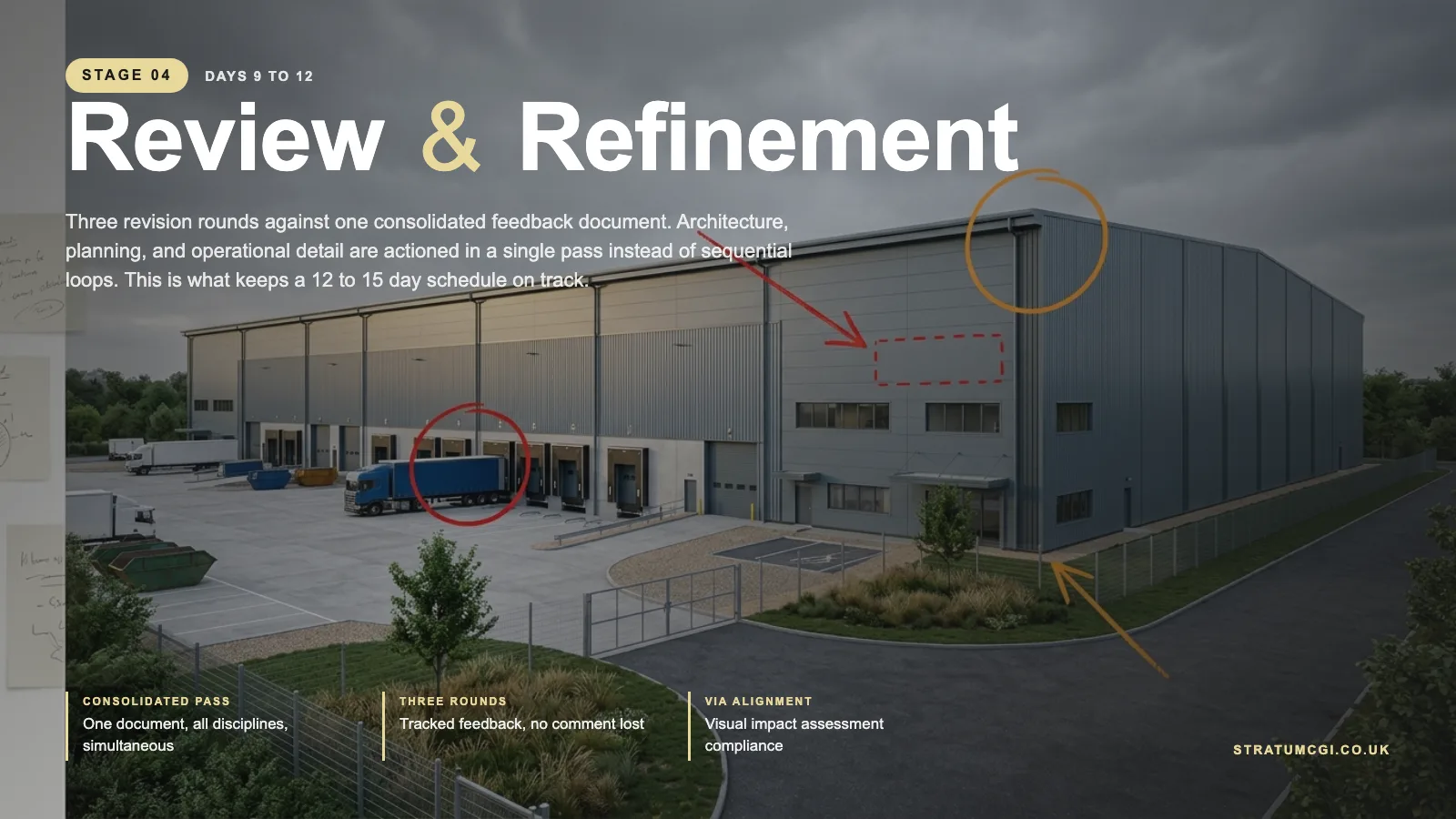
Stage 04 Review and Technical Refinement: StratumCGI annotated industrial warehouse CGI with consolidated review markup on cladding, loading bay, signage and landscape details
Architecture, planning, and operational feedback routes through one consolidated document per revision round, which is why StratumCGI delivers in twelve to fifteen working days instead of three weeks.

Stage 04: Review & Technical Refinement

Consolidated Review Pass

The key to our 12 to 15 day delivery. We route a single document to the client covering architectural quality, planning compliance, and operational accuracy. This prevents sequential revision loops and ensures all stakeholders are aligned.

Visual Impact Assessment Alignment

For schemes requiring an Environmental Impact Assessment, Stage 04 addresses the specific VIA brief directly:

Lighting Match

Ensuring conditions match the season specified in the VIA methodology.

Viewpoint Accuracy

Ensuring receptor viewpoints correspond to agreed assessment points.

Parameter Plans

Representing the scheme at the agreed envelope rather than optimistic intent.

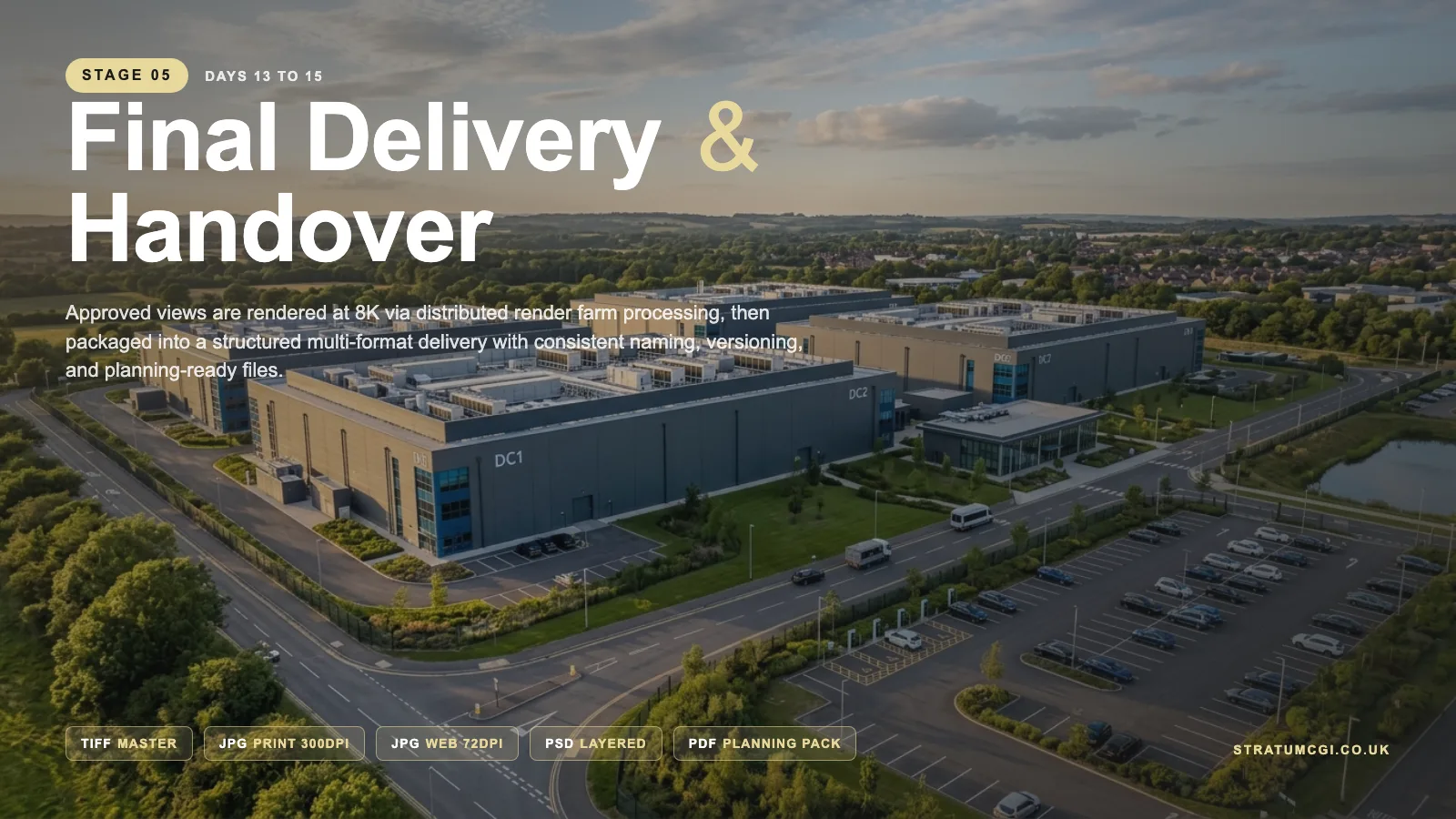
Stage 05 Final Delivery and Handover: StratumCGI hero exterior CGI of a UK hyperscale AI data centre campus delivered at 8K in TIFF, JPG high and web resolution, PSD and planning pack PDF
Final delivery packs are rendered via distributed render farm processing and handed over with consistent file naming, version references, and planning-submission-ready exports.

Stage 05: Final Delivery & Handover

Render Farm

Distributed processing across multiple workstations maintains the 12 to 15 day schedule even at 8K resolution.

Archive Policy

Working scene files and source assets are archived for 24 months, allowing for future revisions without a restart.

Multi-Format Delivery Package

Every Stage 05 delivery pack includes five file formats covering planning submission, print marketing, and digital use so no additional conversion is needed downstream.

TIFF
Uncompressed Master
JPG High-Res
Print-Ready (300dpi)
JPG Web
Optimised (72dpi)
PSD
Layered Composite
PDF
Planning Pack

Software Stack and Quality Assurance

StratumCGI's process is executed using a named software stack, recognised industry standards, and a formal quality management system. The combination determines both the technical quality of outputs and the consistency of delivery across planning, marketing, and investor-facing image packs.

3ds Max with Corona and V-Ray for Stills

Still images are produced in 3ds Max with Corona Renderer and V-Ray as the two primary render engines. Corona handles complex interior and mixed-light scenarios. V-Ray handles exterior photomontage briefs requiring physically accurate sky models.

Both engines produce outputs that satisfy UK planning authority requirements for scale, perspective accuracy, and material representation.

Unreal Engine 5 for Animation and Flythroughs

Real-time animation, site flythrough, and interactive walkthrough briefs are produced in Unreal Engine 5.

The real-time render pipeline allows StratumCGI to produce animation at a frame rate and resolution that would take weeks using traditional offline rendering, making animation viable within standard industrial CGI programme timescales.

NJC Standards Compliance

All planning-grade CGI outputs comply with National Joint Council (NJC) Standards for verified views and visual impact assessments. NJC Standards specify methodology for camera positioning, image verification, and accuracy reporting.

Compliance ensures the CGI pack is acceptable to planning inspectors and independent VIA reviewers without requiring supplementary technical justification.

ISO 9001 Quality Certification

StratumCGI operates under an ISO 9001 certified quality management system. ISO 9001 certification covers the review and approval workflow across all five stages, the file handover protocol, and the revision tracking system.

For developers and planning consultants managing multiple concurrent submissions, ISO 9001 certification provides a measurable quality assurance basis that a generic CGI studio cannot offer.

Consultant Coordination and Client Communication

StratumCGI maintains transparent communication throughout the process, with structured checkpoints at every stage and a consolidated review round. Every client receives a named project contact, a stage-by-stage schedule confirmed at brief, and a single consolidated feedback document at Stage 04 that routes comments from architects, planning consultants, environmental reviewers, and client-side decision makers simultaneously.

01

Brief Confirmation

We confirm the technical brief before modelling begins, ensuring scope, views, and deliverables are aligned before any work starts.

02

Initial Render Review

First renders are shared for approval before proceeding, giving you the opportunity to confirm materials, scale, and context before detailed refinement begins.

03

Three Revision Rounds

Three structured revision stages allow for adjustments to landscaping, vehicles, materials, and lighting. Revisions are tracked and actioned systematically.

04

Final Approval and Delivery

Final renders are delivered in agreed formats, with full file packages including working files, hi-res exports, and format specifications for your planning submission.

The Industrial CGI Process by Brief Type

The five-stage methodology applies consistently across all industrial project types. The input requirements and Stage 03 lighting complexity vary by brief type as follows.

AI Data Centre Campus

AI data centre campus briefs require modelling of security perimeters, HV switchgear compounds, external cooling plant, and access control zones alongside the main building envelope.

Stage 03 lighting studies for data centre campus schemes address security lighting levels visible in the CGI. Planning officers increasingly note security lighting in design and access statement assessments for hyperscale sites.

AI data centre campus CGI case study (SCGI-003)

Warehouse and Distribution

Warehouse and distribution briefs cover single-unit and multi-unit logistics park schemes. The Stage 02 model build includes HGV circulation routes, loading bay dock levellers, gatehouse, and yard lighting columns.

Material accuracy across insulated panel cladding systems is the primary Stage 03 focus. Planning officers and occupiers both use the CGI to assess facade appearance at full site scale. Golden Triangle big-box warehouse CGI case study (SCGI-001)

Industrial Park and Masterplan

Industrial park and masterplan briefs require an aerial or elevated camera position to communicate the full site layout, plot configuration, and landscape framework.

Stage 02 for these schemes models multiple building types, shared infrastructure, and the landscape treatment plan simultaneously.

The Stage 03 composition work identifies which camera altitude and angle communicates the masterplan's place-making quality to a planning committee. strategic employment land masterplan CGI case study (SCGI-010)

Planning-Led Development

Planning-led briefs prioritise NJC Standards compliance, verified view methodology, and Visual Impact Assessment alignment over marketing presentation.

Stage 01 for planning-led schemes documents the planning authority's specific requirements before modelling begins.

The Stage 04 consolidated review pass routes feedback from the architect, planning consultant, and EIA consultant in a single document, preventing the sequential revision loop that extends planning-submission programmes.

Why Industrial Developments Need Architectural Visualisation

Architectural visualisation for industrial developments serves three functions that a drawn elevation or a physical model cannot replicate at planning, investment, and pre-let stages.

Planning Compliance and Committee Confidence

Planning committees assessing large industrial schemes rely on CGI to understand how a building relates to its landscape setting, what its facade materials look like at full scale, and how it will read from identified residential and public receptors.

A drawn elevation presents a building in isolation. A planning-grade CGI produced to NJC Standards places it within the actual landscape context at a documented camera position, giving committee members a verifiable representation they can reference against the site visit.

Local authorities across England now routinely require verified view CGI as part of the planning application pack for schemes above a certain floor area threshold: making architectural visualisation a compliance requirement rather than a discretionary addition.

Investor and Occupier Confidence Before Construction

Industrial developers presenting schemes to institutional investors and potential occupiers at pre-planning or pre-let stage use CGI to communicate design quality, operational capability, and site character before a single foundation is poured.

A photorealistic CGI showing the correct cladding specification, loading bay configuration, and landscape treatment converts a parameter plan into a credible development proposition. Occupiers assessing multiple competing sites make location decisions partly on the quality of the visualisation material presented: a low-quality render signals low design ambition.

Risk Reduction Before Construction Commitment

The five-stage CGI process identifies design coordination issues, material selection conflicts, and site layout problems before construction tender.

A loading bay clearance that reads acceptably on a DWG section can appear visually undersized in a CGI produced at correct scale: the CGI surfaces the issue at a stage when the design team can resolve it without abortive construction cost.

The CGI review process, structured around Stage 04 consolidated feedback, routes architectural, planning, and operational observations simultaneously, catching cross-discipline conflicts that sequential drawing reviews miss.
Timing, Payments, and Delivery

Each of the five stages carries a specific payment trigger, a defined client commitment, and a defined deliverable. The schedule below sets out what moves at each stage so planning teams, finance teams, and procurement teams see the same picture. Full commercial terms are set out in the Terms and Conditions, clause 3.

Stage Payment trigger Client commitment Deliverable
01 Brief
Days 1-2
Stage 1 invoice on quotation acceptance. 50% (≤£10k) or 40% (>£10k). Work commences on cleared funds or authorised purchase order. Signed quotation, site plans, elevations, references, NDA where applicable, within 2 working days. Project reference (SCGI-NNN), kickoff note confirming scope, views, verification level.
02 Model and site build
Days 3-5
No new invoice on standard split. On the 40/30/30 staged split, model approval triggers the Stage 2 invoice (30%). Written approval of model framing within 48 hours. Late feedback shifts the programme day for day. Draft 3D model screenshot, site massing, view-angle markup PDF for approval.
03 Draft views
Days 6-8
None directly. Stage 2 invoice processing in parallel for staged clients. Consolidated written feedback on draft views. Verbal comments not binding unless confirmed in writing. Watermarked draft renders on review platform, client-reference and render-date stamped.
04 Review and refinement
Days 9-12
None new. Overdue Stage 1 or Stage 2 invoices beyond 7 days trigger the right of suspension under clause 3.8. Final consolidated feedback by day 10 to hold the 15-day schedule. Three revision rounds included as standard. Revised watermarked drafts, visual impact compliance check, final review PDF.
05 Final delivery and handover
Days 13-15
Final invoice issued on client approval of the final draft, in accordance with clause 3.11.6. 50% standard split or 30% staged split. Due 30 days. Written approval of the final draft. Payment in cleared funds prior to release of production masters. TIFF masters, JPG print 300 DPI, JPG web 72 DPI, PSD layered where agreed, PDF planning pack. Structured naming and versioning.

Payment schedule at a glance

  • Standard commissions (≤£10,000): 50% on commencement, 50% on approval of the final draft.
  • Larger commissions (>£10,000 or >6 weeks): 40% on commencement, 30% on model approval, 30% on approval of the final draft.
  • Payment period: 30 days from the date of each invoice, by electronic bank transfer.
  • Extended corporate terms (45, 60, 90 days): available by prior written agreement, subject to a finance uplift disclosed on the quotation.

Schedule risks and how they are priced

  • Late client input. Each working day of delay in supplying site plans, references, or written approval shifts the programme day for day. No cost where the delay is under two working days; beyond that, day-rate applies for held programme slots.
  • Scope change after model approval. Treated as a change order under clause 4. Additional views, major geometry revisions, or altered planning schemes are quoted before execution.
  • Revisions beyond the included rounds. Three consolidated rounds are included as standard. Further rounds are charged at the applicable day rate or per view.
  • Overdue invoices. Work is suspended at day 7 past due under clause 3.8, until the position is cleared.

What the commencement deposit secures

The Stage 1 payment is a non-refundable commencement deposit. It reserves the studio's programme slot, any named freelance resource, render-farm capacity, and preparatory work against the scheme. On cancellation, the deposit is retained in full under clause 3.6, without prejudice to further sums due for work carried out up to the cancellation date.

Corporate accounts payable

For clients operating purchase order systems, supplier portals, or extended payment terms, the studio requires a valid purchase order in advance of commencement and a written agreement on any period beyond 30 days. The mechanism in clause 3.11.6 permits the final invoice to be issued on approval of the final draft so that the client's accounts payable period runs in parallel with, rather than after, delivery. Full detail is set out in clause 3.11.

Industrial CGI Process FAQ

Common questions about how StratumCGI manages the five-stage industrial CGI process, revisions, sign-off, planning file preparation, and output reuse across different audiences.

How many review rounds are included?

Three structured revision rounds are included as standard across all industrial CGI packages. Each round is tracked against a consolidated feedback document:

  • Round one: initial material, lighting, and composition comments
  • Round two: detailed architectural and planning accuracy
  • Round three: final finish quality before approval

Additional revision rounds beyond three are available and quoted on a time basis.

What happens if drawings change mid-project?

Drawing changes received before Stage 02 modelling is complete are incorporated without programme impact. Changes received during Stage 03 or Stage 04 are assessed against the scope agreed at Stage 01 brief.

Minor changes: elevation changes, material substitutions, and landscaping updates within the agreed view set: are accommodated within the standard revision rounds. Significant scope changes, such as a revised massing volume or a different building footprint, are quoted as a variation so the client can assess programme and cost impact before approving.

Can you work from concept sketches?

Yes. StratumCGI produces industrial CGI from concept sketches, outline floor plans, and massing diagrams where full CAD drawings are not yet available.

Stage 01 for sketch-stage briefs documents the design assumptions StratumCGI will model from, with the client confirming those assumptions before Stage 02 begins. This is common for pre-planning marketing CGI and feasibility visuals produced before the planning drawing set is complete.

Who signs off each stage?

Each stage requires a named sign-off from the client before StratumCGI proceeds:

  • Stage 01: confirms the brief, input pack, deliverables, and programme
  • Stage 02: confirms the massing model and site context
  • Stage 03: confirms draft view selection before final finish
  • Stage 04: confirms each revision round
  • Stage 05: confirms final render quality before full resolution output

Sign-off is recorded in writing, either by email or through the project management portal.

Do you handle planning submission files?

Yes. StratumCGI prepares planning submission file packages as part of the Stage 05 delivery. Planning submission packages include the full resolution TIFF master, a web-optimised JPG for the online submission portal, a planning-pack PDF formatted to the local authority's document specification, and a methodology statement covering camera position, NJC Standards compliance, and image verification. StratumCGI coordinates directly with the planning consultant's team on file naming and submission format requirements so the CGI pack is ready to upload on the day it is delivered.

Can one model support planning and marketing images?

Yes. StratumCGI builds one coordinated model so the scheme geometry, cladding, yard layout, and landscape treatment remain consistent across planning and marketing outputs.

For planning, the image set follows verified-view or photomontage controls, with fixed camera logic and reporting requirements. For leasing, investor, or board use, the same model can be rendered from freer camera positions with different crops, staffing, vehicles, and presentation emphasis. That avoids rebuilding the scheme from scratch and keeps every audience looking at the same underlying project.

Looking for a quick summary of the StratumCGI process? The homepage provides a concise overview of all five stages with the key timeline and deliverable for each.

View the Process Summary on the Homepage

Ready to Start Your Project?

Whether you are planning a logistics hub, data centre, or industrial development, our proven five-stage process delivers planning-grade CGI on a timeline agreed to match your programme.

Arrange a Consultation