30-70%
on-site demand met
PV offset visualisation
Annual operational demand met on site. Typical 30 to 50% from rooftop arrays, rising to 60 to 70% on schemes with battery storage.
Warehouse and Logistics CGI Studio
StratumCGI is a UK architectural visualisation studio producing planning-grade CGI for B8 warehouse and logistics development briefs, helping developers, landlords, agents, investors, and occupiers review the building before it is built. A single verified 3D model underpins every rendering: planning views, pre-let leasing imagery, investor crops, and occupier presentation frames, so the approved geometry carries through every output. Six-frame commissions cost £12,500 to £28,000, with first approved hero renders usually delivered by the end of week two.
Warehouse and logistics CGI gives planners, leasing teams, investors, and occupiers a clear visual read of how a B8 scheme works before construction. The strongest image sets prove HGV circulation, dock access, yard depth, landscape screening, and loading-bay rhythm in planning-grade views that match the scale UK committees expect.
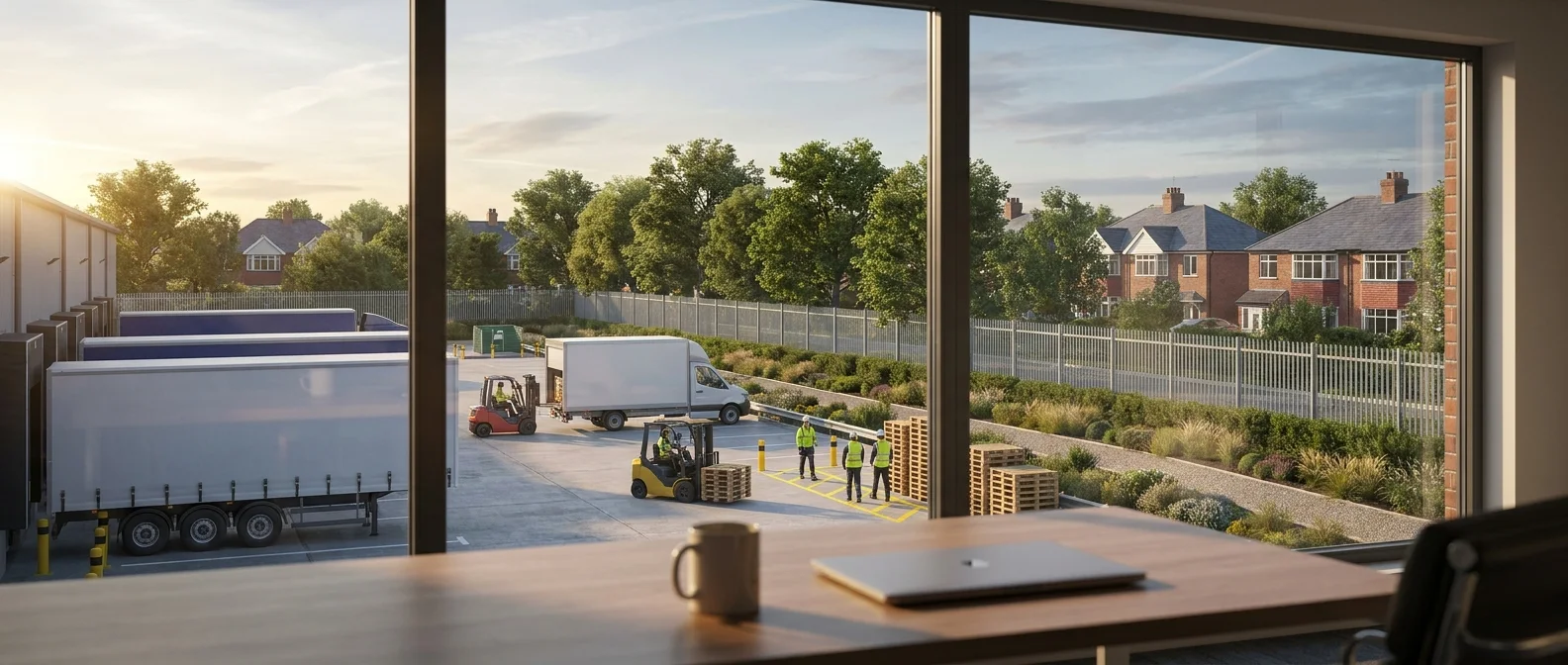
Each stakeholder reads the same scene for a different signal:
Verified views reach officers' committee reports when viewpoints are agreed with the LPA, swept paths align with the transport assessment, and screening reads at the same time of year as the application.
Yard depth, frontage length, and dock door count read from a single elevated angle, so enquirers qualify the building against their brief before a site visit.
Scheme massing and pre-let marketability read from a fully-let occupied scene with HGV activity at scale, so the IC pack shows the asset as an operating logistics estate rather than a speculative shell.
Dock cadence, internal flows, and the segregation of staff routes from HGV movements let occupiers test the building against their operation before signing heads of terms.
StratumCGI produces the full B8 warehouse CGI suite from planning application drawings, site survey data, and a single verified model. That model furnishes verified viewpoints for the planning pack, hero renders for pre-let marketing, leasing visuals for landlords and agents, and massing studies for investor review.
Planning CGI stays tied to agreed viewpoints, accurate surrounding context, and unstaged exteriors, escalating to verified views or photomontage when the authority requires stricter evidence. For decision-stage logistics evidence, see logistics development planning application CGI. Commercial CGI reuses the approved geometry with raised cameras, occupied-hour lighting, and calibrated HGV activity that reads as a fully-let facility.
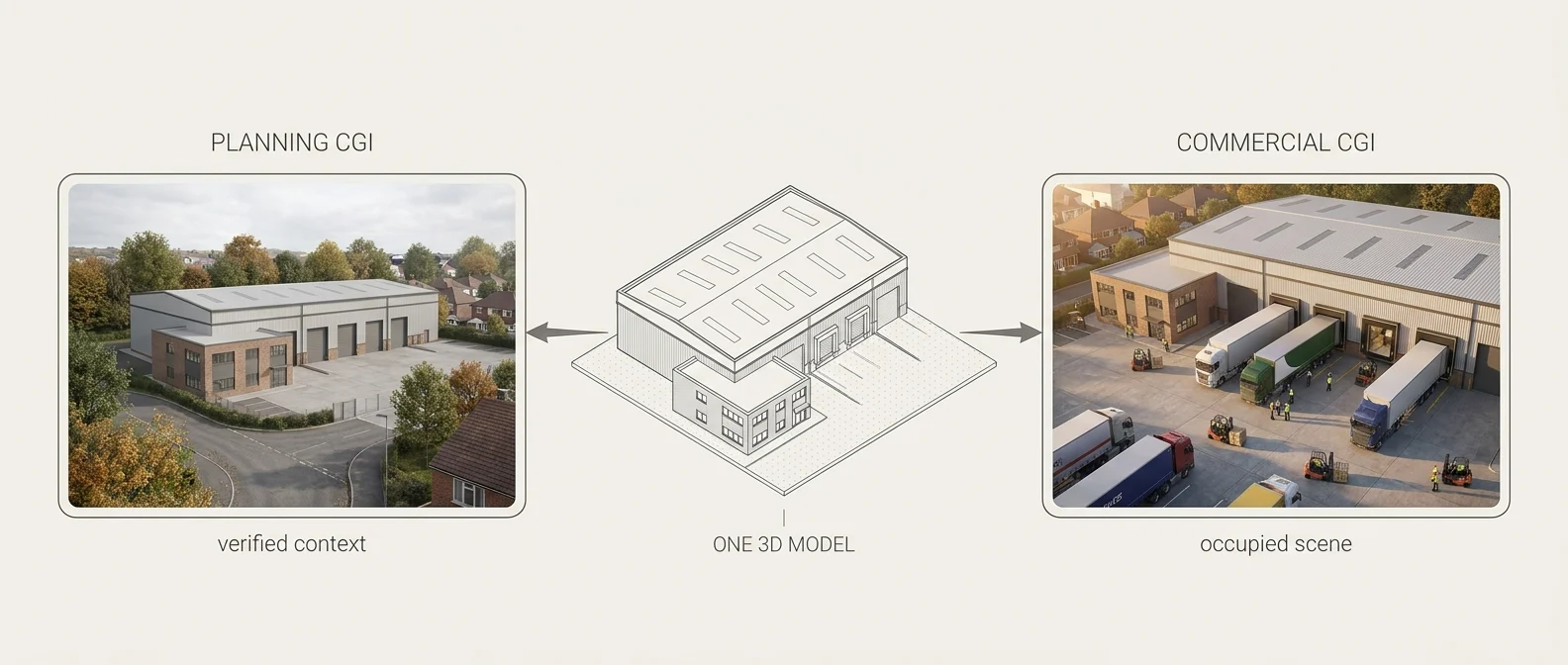
Warehouse and logistics CGI sits within StratumCGI's broader industrial CGI services and centres on how speculative logistics schemes are presented to planners, leasing teams, and investors.
The parent service covers B8 warehouses and logistics facilities for logistics developers, landlords, agents, and occupiers, with specialist sections below for distribution, fulfilment, cold storage, last-mile, and freight-led schemes. Where a brief spans a logistics park or multi-building estate, the CGI scope includes the gatehouse approach, security perimeter, HGV marshalling yard, dock face, trailer parking, and boundary landscape context.
Big-box warehouse CGI in the UK typically costs between £12,500 and £28,000 for a six-frame planning and marketing package. Line items, verified-view uplifts, and animation add-ons are quoted separately below. The ranges shown are StratumCGI's published guide figures for UK big-box warehouse commissions in this typology class.
Big-Box Warehouse CGI · Line Items
| Deliverable | Indicative price |
|---|---|
| Final still frame, planning or marketing ready | £1,100 to £2,700 per frame |
| 3D base modelling from the architects' CAD package | £2,800 to £6,500 per scheme |
| Material, lighting, and landscape setup | £1,400 to £3,200 per scheme |
| Post-production and grade pass | £180 to £420 per frame |
| AVR Type 3 verified view uplift, Landscape Institute TGN 06/19 | £600 to £1,200 per view |
| Drone survey planning and viewpoint capture | £900 to £2,400 per site visit |
| Consultation flythrough animation, 60 to 90 seconds | £6,500 to £14,500 per animation |
| Revision rounds beyond the first two | £220 to £480 per frame per round |
| Planning portal formatting and delivery | Included with planning-spec packages |
Typical six-frame package, all in
£12,500 to £28,000
Range driven by modelling depth, verified-view uplifts, and whether a consultation animation is included.
Operationally complex B8 schemes need imagery that resolves circulation, dock sequencing, and site access before planning review or pre-let launch. The approved model can then support verified planning views, leasing imagery, investor crops, and occupier review frames without rebuilding the scheme for each audience. Cross-dock operations are configured within that model when dual-yard flow or trailer sequencing needs to read clearly.
The shared model base serves three commercial audiences inside a four-week production cycle: planning officers reviewing the submission, leasing agents briefing occupiers, and investors assessing covenant strength. One model replaces three briefs, three schedules, and three marketing budgets with one commercially coherent workflow.
For occupier profiles, planning-evidence requirements, and per-type CGI brief checks, use the UK warehouse typologies guide for developers.
Build-to-suit warehouse CGI shows how a speculative warehouse visual changes when a named occupier needs specific dock doors, racking, office fit-out, yard movement, ESG features and pre-let presentation views.
StratumCGI can model the baseline warehouse once for planning and agent marketing, then reuse the same approved geometry for a build-to-suit occupier version. The frontage, massing, service yard and planning context stay consistent while the CGI shows the operational changes that matter to the tenant, investor and letting team.
That makes the image set useful before occupier sign-off, because the same model can show the market-ready warehouse, the agreed fit-out direction and the pre-let pack without rebuilding the visual context from scratch.
Where a logistics asset is being tested for higher-power reuse, the warehouse-to-data-centre conversion guide shows how StratumCGI can compare the retained warehouse shell, powered-shell option, modular insertion and full data centre redevelopment from one coordinated model.


Speculative warehouse CGI versus build-to-suit warehouse CGI
| CGI brief area | Speculative warehouse CGI | Build-to-suit warehouse CGI |
|---|---|---|
| Building and frontage | Market-ready building, office pod, entrance approach and estate frontage. | Occupier-specific entrance treatment, office/welfare emphasis and brand-neutral presentation. |
| Dock configuration | Standard dock rhythm and level-access assumptions for agent marketing. | Agreed dock-door layout, loading sequence and vehicle movement for the occupier brief. |
| Clear height and racking | Indicative storage volume and general internal scale. | Racking, mezzanine, VNA aisle, automation or process-zone logic where supplied. |
| Yard and HGV movement | Baseline service yard, trailer parking and turning geometry. | Occupier-specific HGV circulation, trailer staging, loading sequence and yard-use explanation. |
| ESG features | Visible PV, EV charging, landscaping and screening where part of the planning brief. | Tenant and investor-facing ESG features adjusted for the fit-out, roof, parking and presentation set. |
| Commercial use | Planning pack, agent marketing and early investor review. | Pre-let pack, occupier approval, investment committee review and leasing presentation. |
Four production concepts drive the total: building and site modelling as the one-off shell build, each new camera position at the full frame rate, lighting and fit-out variants once the shell locks, and high-res crop exports drawn from the master render.
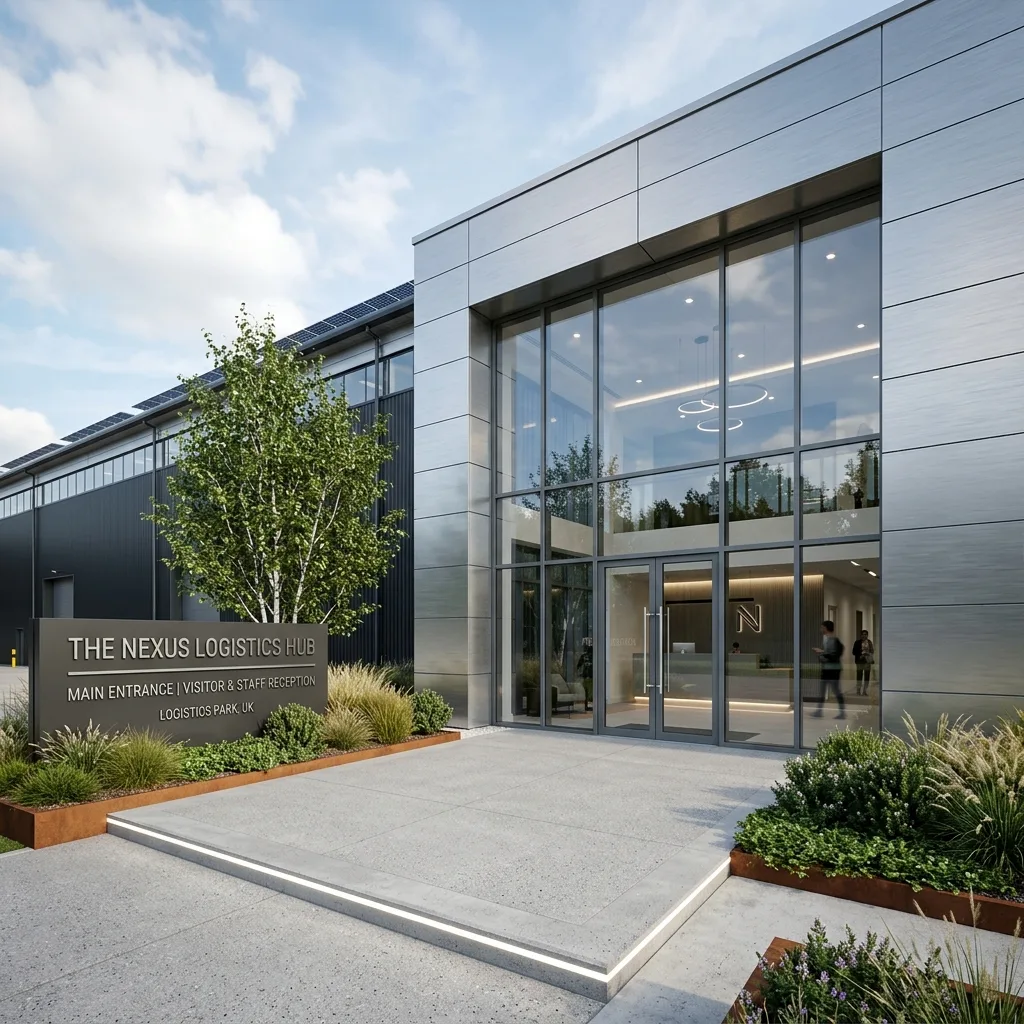
The modelling stage. The building is assembled from the architect's CAD pack (envelope, structural grid, dock line, roof plant, office frontage), and the environment is assembled from site survey data (yard geometry, landscape buffer, access roads, OS mapping context). Cladding palette, material set, and daylight rig lock across the shell. 3D base modelling £2,800 to £6,500; material and site setup £1,400 to £3,200 per scheme.
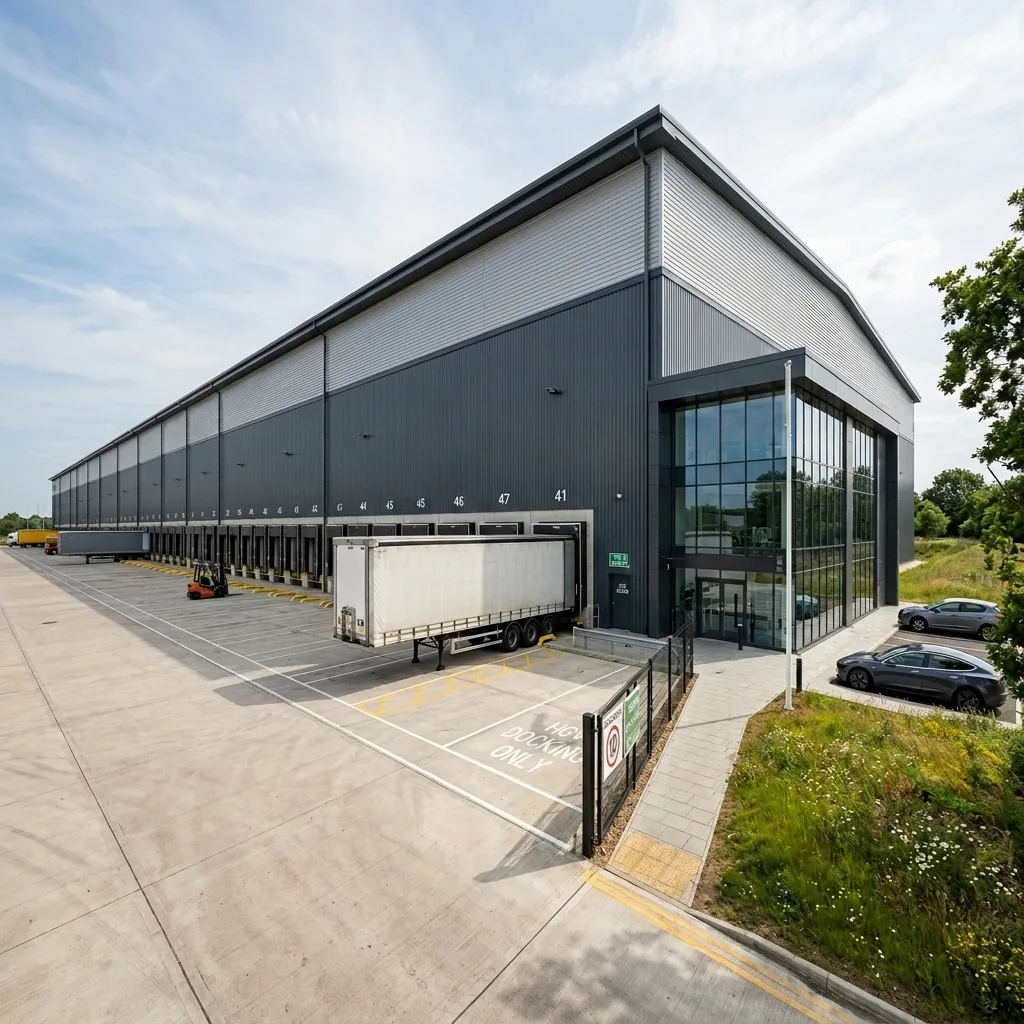
Every fresh camera angle on the approved shell is priced at the full frame rate. The underlying model is reused, but the view requires new composition, lighting treatment, and render time. Typical warehouse briefs specify three to five full-rate frames.
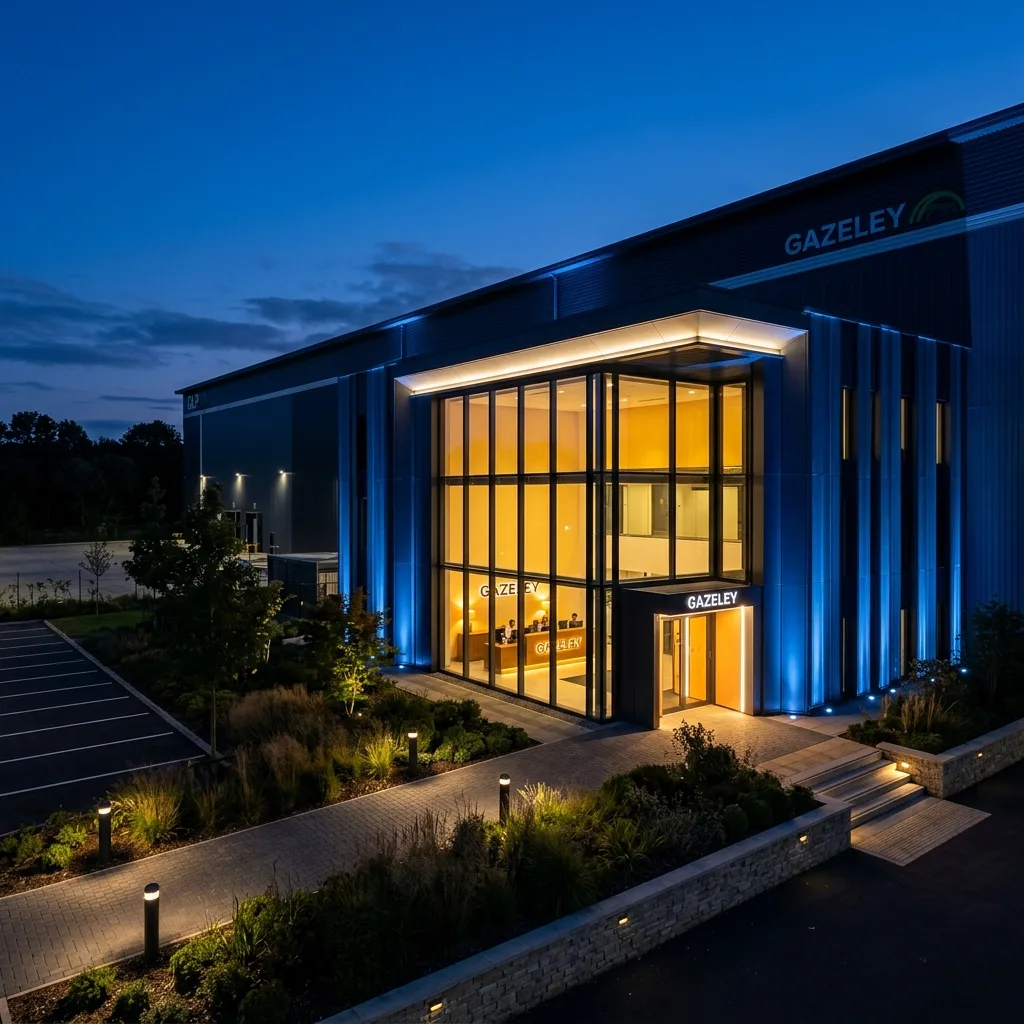
After the shell locks, alternate marketing views (like this cinematic dusk shot) inherit over 50% of the approved model, dramatically dropping the cost per visual.

Detail crops drawn directly from the master render. Perfect for investor packs, portal re-sizes, and social media without incurring any new modelling costs.
Late Change Penalty
Geometry changes after approval, including the shell envelope, yard logic, structural grid, or planning facts, re-quote from £900 upward because the work returns to model-update scope, breaking the reuse economics of the package rate.
Planning CGI, aerial views, dock and yard stills, sustainability frames, and investor pack imagery, prepared from your CAD or BIM, site plan, elevations, and landscape plan. NDA-safe publication on request.
Share the scheme type, dock count, yard layout, cladding specification, and whether the CGI is for planning submission, pre-let marketing, or both. StratumCGI reviews each warehouse brief before confirming scope and price.
Nicolette leads StratumCGI's warehouse and logistics CGI delivery. Contact her directly for briefs already in progress or with drawings ready to review.
Distribution centre CGI covers the largest B8 shells in the warehouse and logistics cluster, summarised here at parent level. For the full deep-dive on pallet racking, HGV dock operations, deep yard geometry, and neighbour-amenity proof, see the dedicated Distribution Centre CGI page.
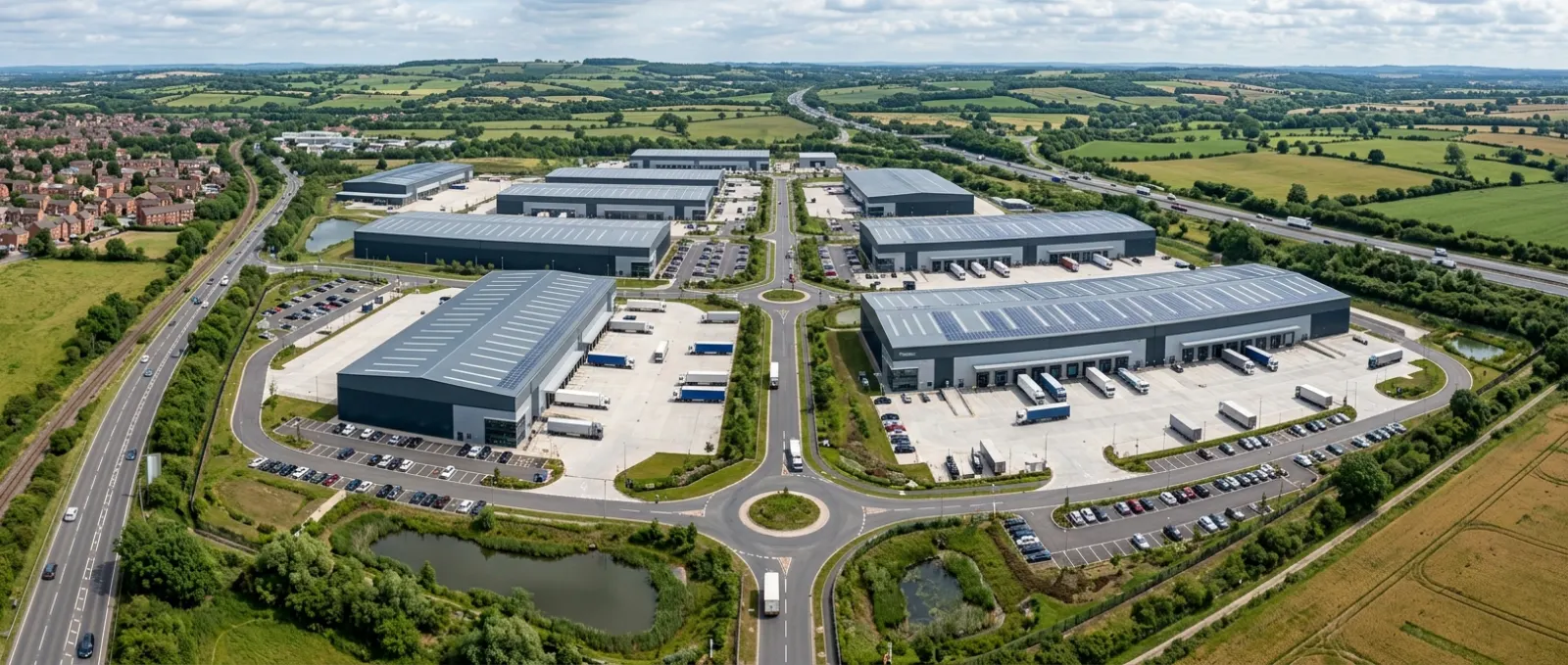
Distribution centre CGI captures the scale, yard discipline, and dock rhythm that planners and occupiers need to evaluate before a scheme is approved or marketed. A typical scheme spans 200,000 to 1,000,000 sq ft, with clear internal heights of 15 to 21 metres, 50-metre deep service yards, and dock-leveller counts running into the dozens.
StratumCGI models distribution centre schemes from structural GA drawings so the imagery serves as a reliable communication tool for planning officers reviewing the transport assessment, not just a marketing image. This technical accuracy ensures:
Aerial compositions show the full estate layout, internal road hierarchy, and landscape strategy in a single frame. Ground-level stills demonstrate the principal elevation quality and the human-scale experience at the gatehouse, reception, or office entrance. Together, these outputs form the core visual package for a planning application and pre-let marketing campaign.
Scroll to compare planning, leasing, and 24-hour use →
Planning scrutiny, leasing presentation, and 24-hour yard operation share one approved logistics shell across the three frames.
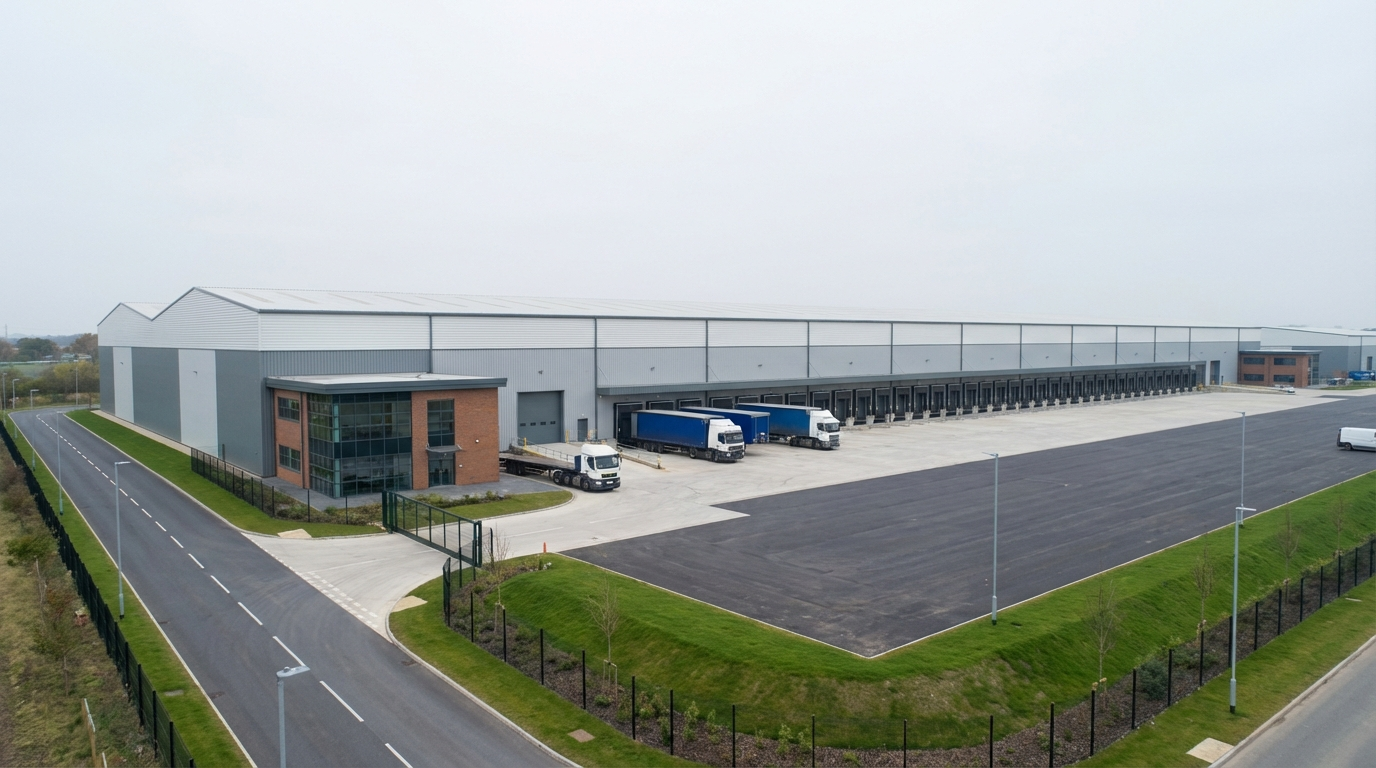
The approved warehouse envelope, dock line, and yard geometry stay legible for officer review in the planning-state frame, so planning teams can assess access, massing, and screening before any marketing treatment is introduced.
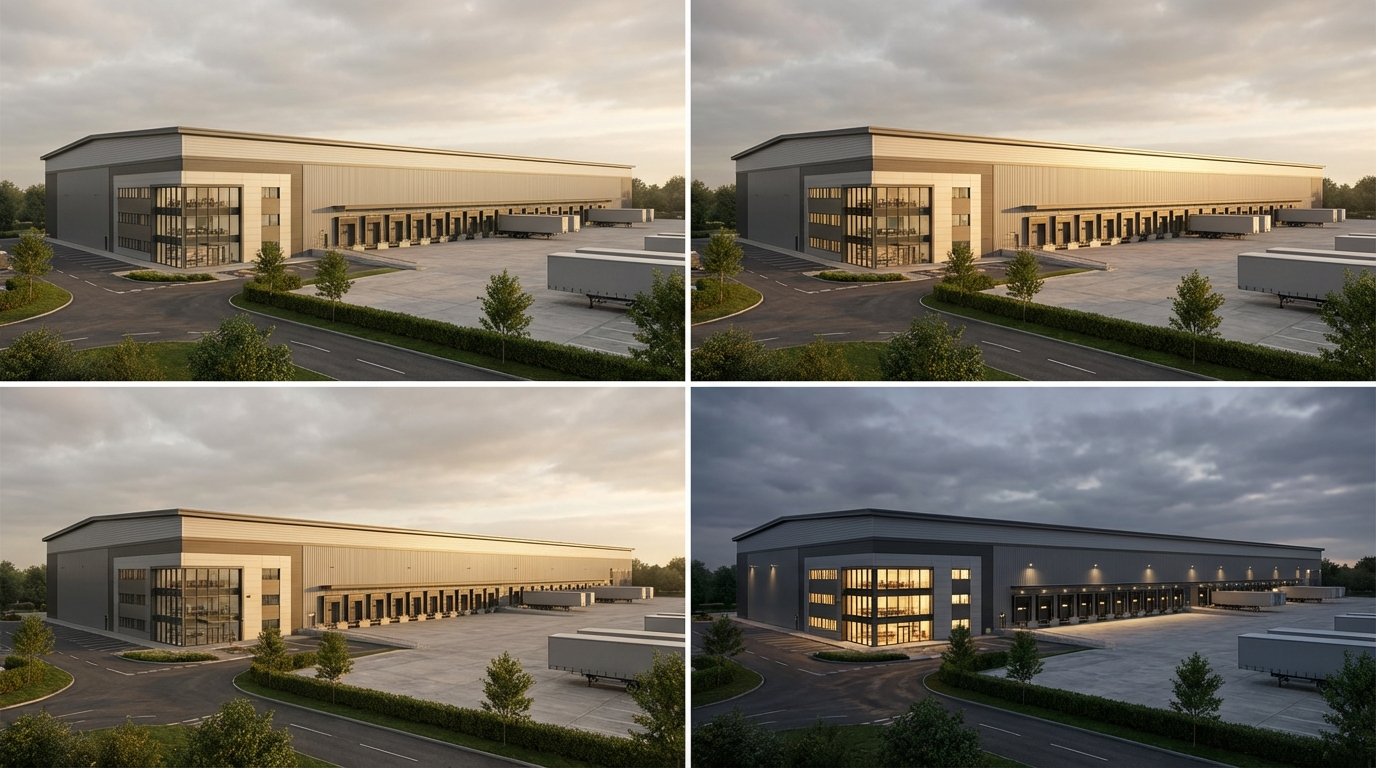
Office frontage, warmer light, and occupier-facing composition move to the front of the leasing-state image, and the approved geometry carries through to brochure, portal, and pre-let campaign use without any envelope change.
High-mast lighting, secure circulation, and visible service readiness carry the same yard into night operation, confirming the distribution centre as a genuine 24-hour logistics asset rather than only a daytime marketing image.
Within warehouse and logistics CGI, the distribution-centre sequence tests one survey-locked model against planning scrutiny, leasing presentation, and 24-hour operational review.
The North West Logistics Hub case study (SCGI-004) shows an example of multi-unit distribution centre CGI.
For tall-format and automated variants exceeding 11m internal clear height, see High-Bay Warehouse CGI below for eaves heights 12 to 50m.
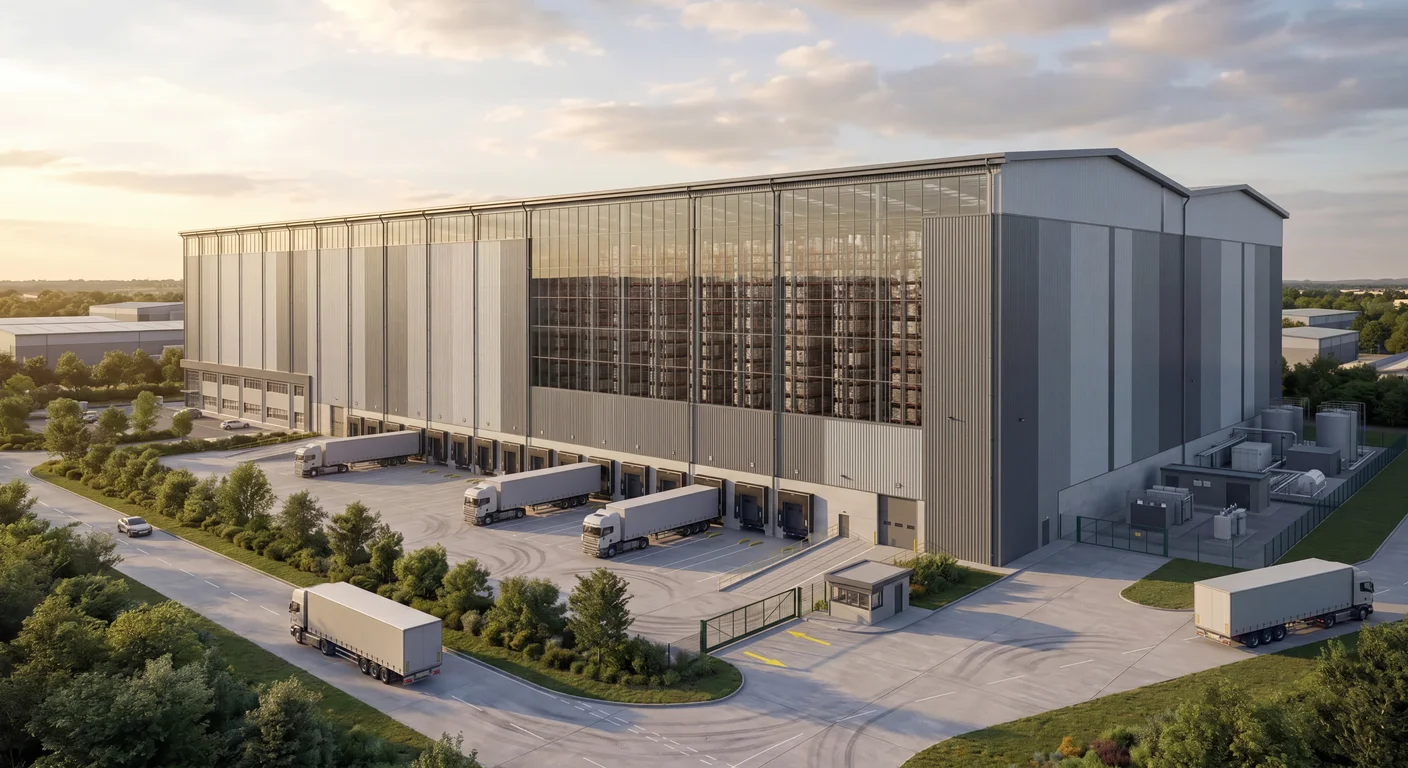
Vertical stacking rhythm is the distinguishing constraint in high-bay warehouse CGI: eaves height, rack density, VNA movement, and ASRS massing must read clearly in planning and occupier review imagery. Tall-format storage facilities range from 12 to 50m eaves, with clear internal heights of 11 to 48m. The brief separates a high-bay racking warehouse from a low-bay warehouse by clear height, MHE class, and pallet retrieval rhythm, so the visualisation keeps the building class legible without turning the section into an architecture or construction brief.
Stratum models high-bay schemes at the brief depth this building class demands. Eaves profile, upper-glazing tier density, ASRS massing, and VNA aisle rhythm resolve together in one coordinated view set, which suits e-commerce fulfilment operators and 3PL automation retrofits planning tall-format storage.
High-bay imagery must resolve the exterior eaves profile, the internal tier density legible through upper glazing, mezzanine structure where present, and the mass of automated storage and retrieval systems (ASRS) equipment at ground and elevated levels. The rendering challenge differs from standard warehouse visualisation. Tall format demands precise perspective control to register vertical stacking rhythm, and automated equipment must read as operational complexity rather than visual clutter.
High-bay warehouse typology occupies the convergence zone where distribution and automation economics meet. Golden Triangle logistics operators, national e-commerce fulfilment teams, and 3PL providers commission this building class when pallet density and throughput per square metre become the dominant performance metric. The construction-cost premium resolves only when throughput or density uplift offsets the capex differential against single-storey schemes.
For standard pallet-distribution schemes, see Distribution Centre CGI above. For cross-dock and e-commerce throughput, see Fulfilment Hub CGI below.
Two-sided throughput, dual-yard activity, and higher vehicle frequency define the fulfilment hub and cross-dock brief, and a single corner view cannot explain them. Goods arrive at one dock face, are sorted or processed within the building, and depart from a second dock face on the opposite elevation.
Where the brief is specifically about parcel sortation, mezzanine pick-pack floors, van staging, and dual-sided dispatch, see Fulfilment Centre Architectural Visualisation. Fulfilment-hub comparison, cross-dock yard logic, and same-shell operating variants sit within the wider warehouse and logistics CGI cluster.
UK cross-dock benchmarks are concrete. The 150,000 sq ft Hermes parcel-sorting facility at Omega Business Park (Omega North), Warrington (Chetwoods Architects, Hannan Associates MEP) sets the dual-yard automated parcel sortation reference. The Greggs PLC national distribution centre at Symmetry Park Kettering, a 311,000 sq ft cross-dock by Stephen George + Partners, and the adjacent 500,000 sq ft Tritax Symmetry cross-dock define current Net Zero in Construction and BREEAM Excellent expectations. The DP World London Gateway Logistics Centre by RPS Group sets the port-adjacent cross-dock case.
StratumCGI uses those benchmarks as evidence cues for dock count, yard depth, parcel-sort flow, HGV swept paths, and trailer staging inside a single verified model.
The visualisation for cross-dock operations must demonstrate that both dock faces can operate simultaneously without vehicle conflict. StratumCGI models the full yard on each side of the building, specifically ensuring:
The dual-yard frames put throughput capacity in front of logistics operators before they commit to a lease, and supply planners with the exact evidence needed to assess the transport impact from both access points safely.
Scroll to compare throughput modes →
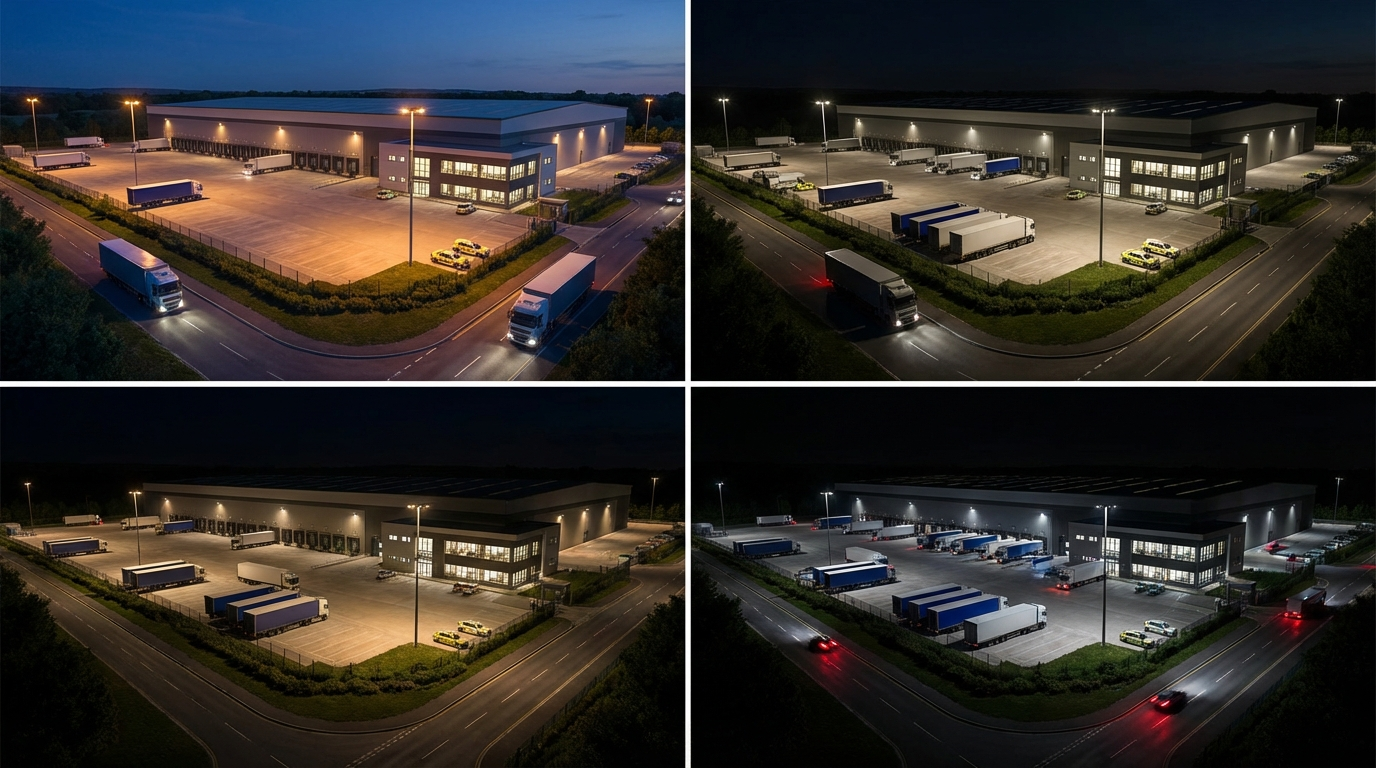
A single survey-locked envelope answers three operating reads, moving from standard throughput through dual-yard cross-dock flow to van-heavy e-commerce dispatch.
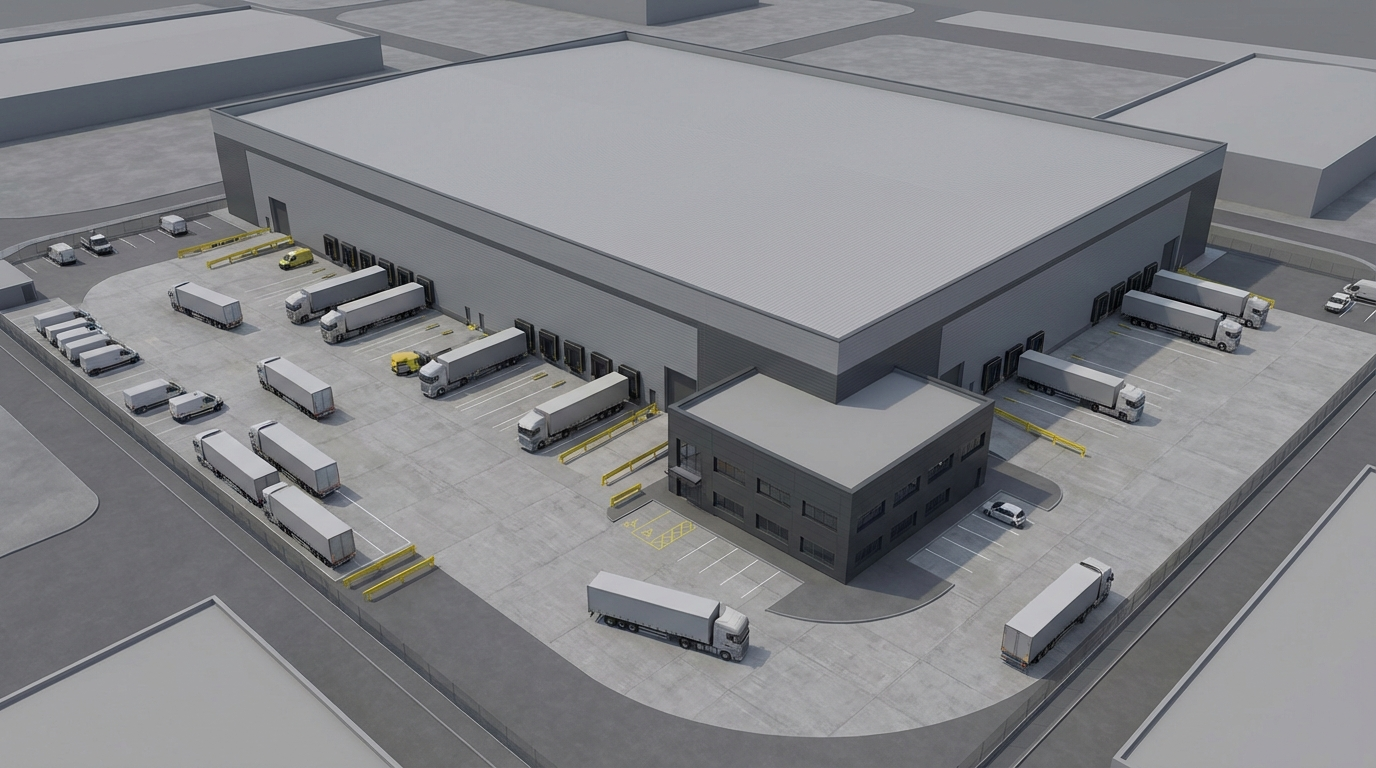
With one dominant dispatch rhythm and moderate yard intensity, the same fulfilment building reads as a conventional hub, establishing the base operational case for a general 3PL or retail-distribution occupier.
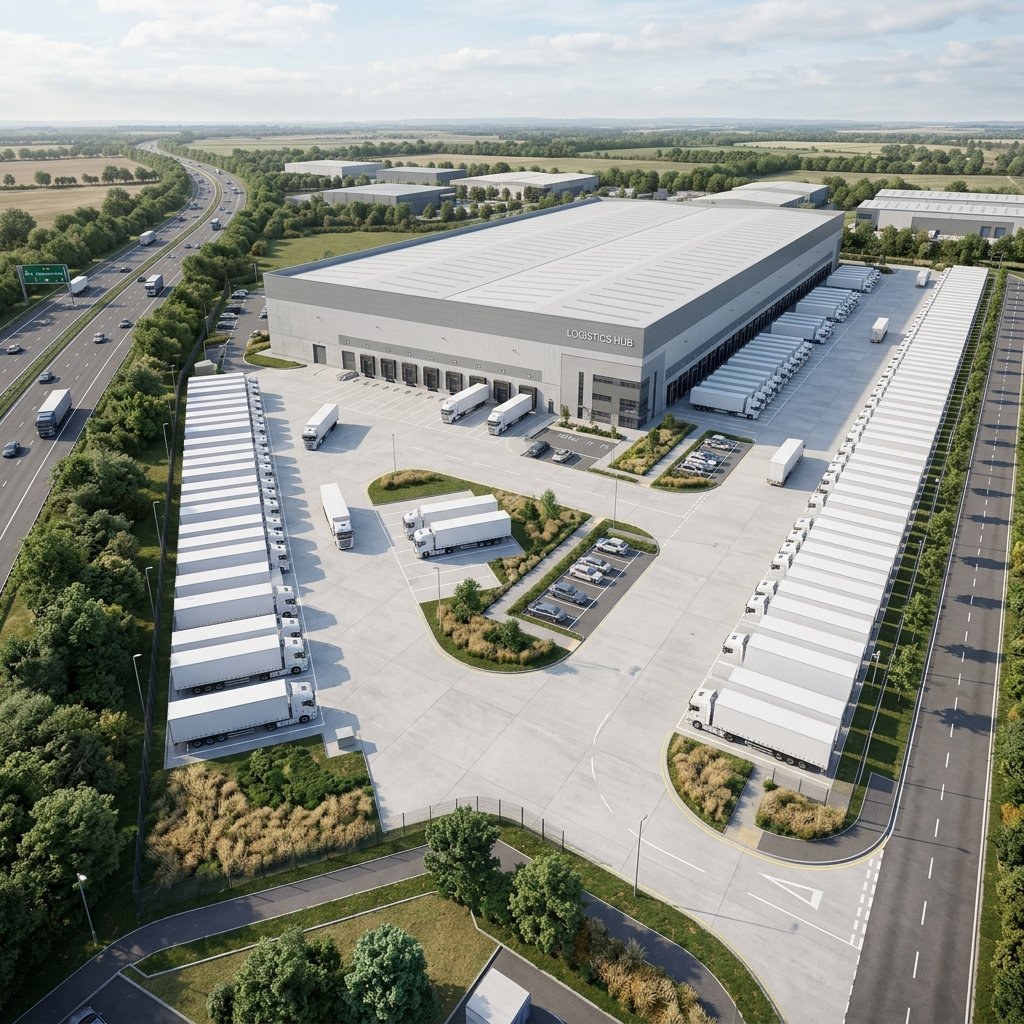
With active loading logic on both sides and clearer trailer sequencing between the elevations, the same fulfilment building confirms the approved envelope can support two-sided throughput.
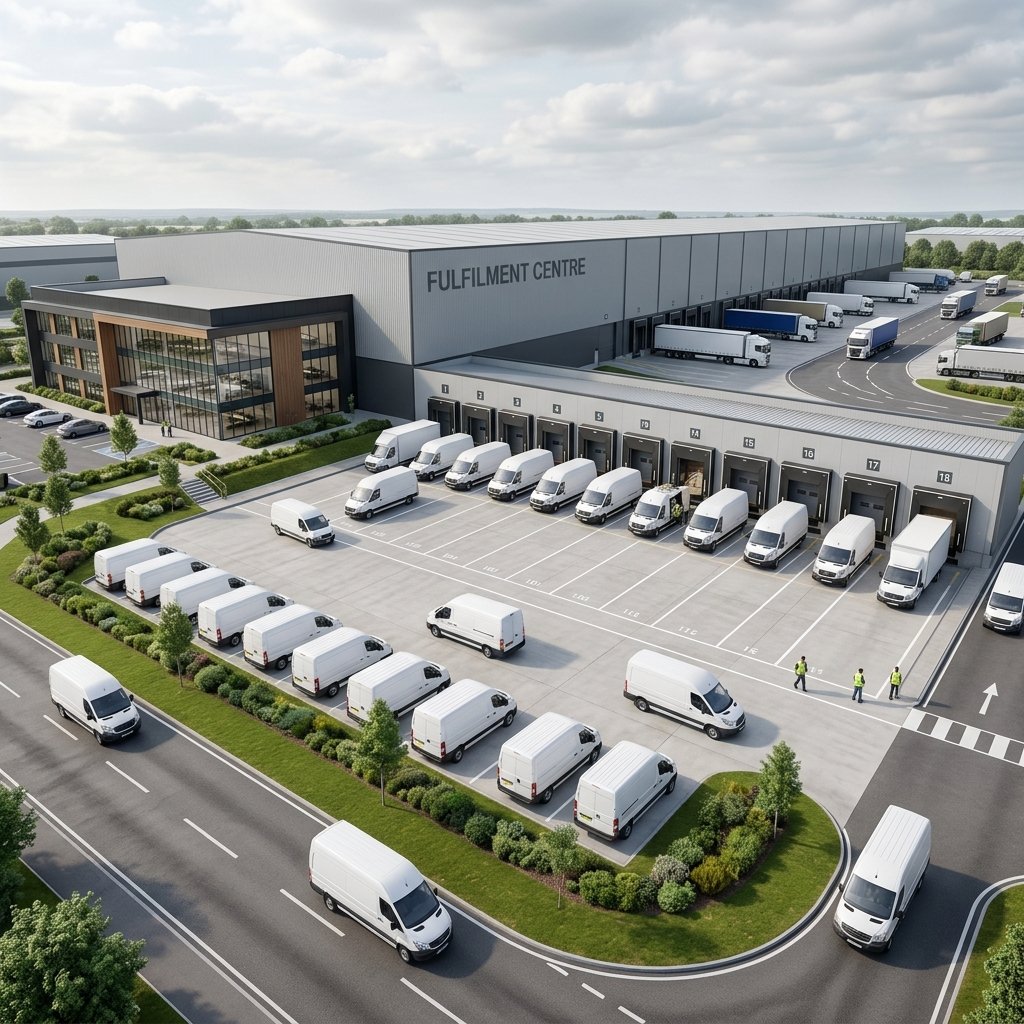
With a denser final-mile rhythm and stronger delivery cues, the same fulfilment building demonstrates a faster, van-led use within the same footprint.
One logistics shell carries the fulfilment sequence across standard throughput, cross-dock flow, and van-led e-commerce dispatch.
The dock-face and yard-discipline case study (SCGI-005) shows warehouse-led CGI for loading-bay rhythm and service-yard control.
Where refrigeration plant, insulated envelope, and temperature zoning drive the brief rather than dock throughput, Cold Storage and Temperature-Controlled Facility CGI below takes over; last-mile and urban depot briefs follow it under Logistics Depot CGI.
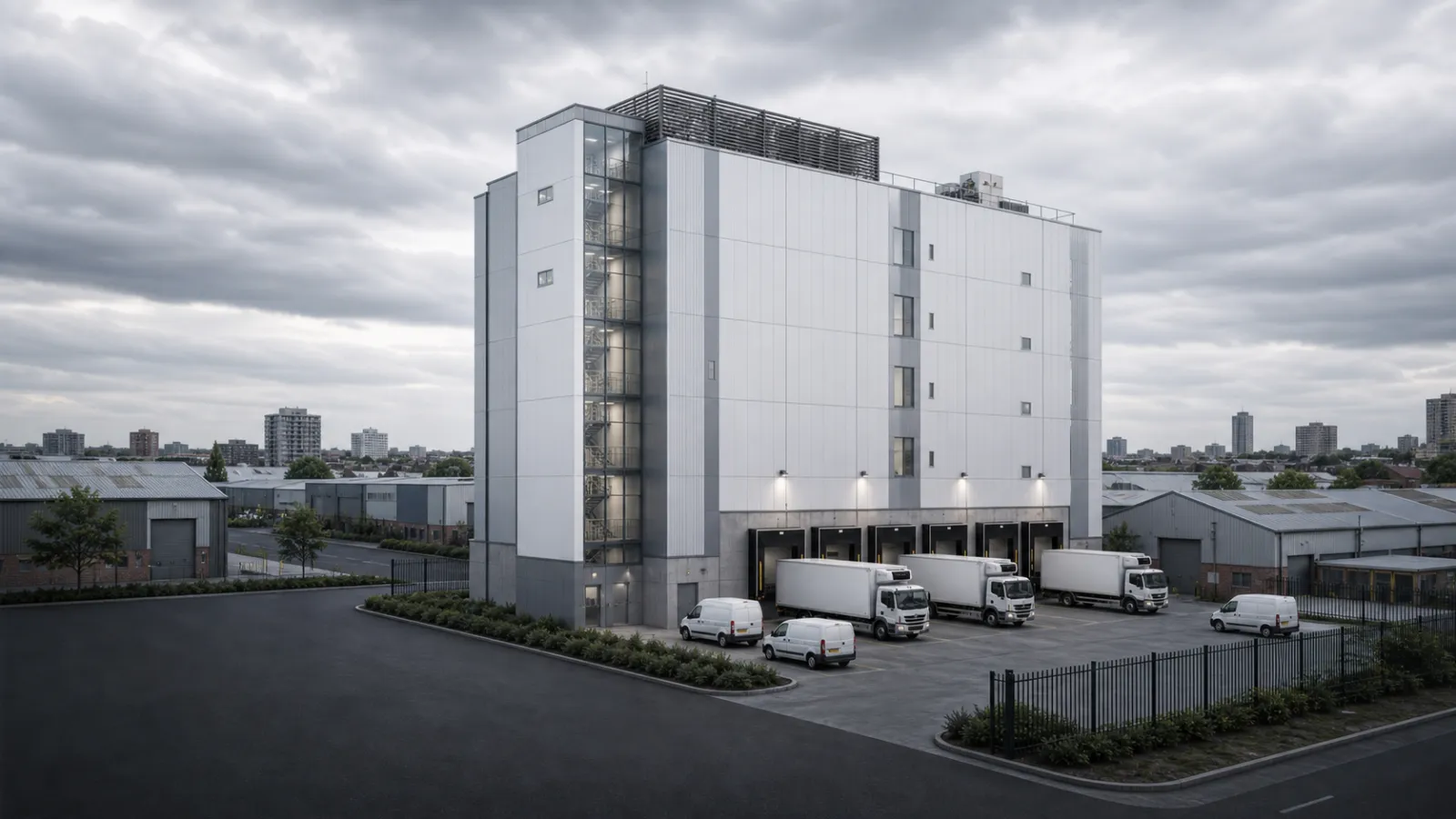
A cold-store CGI has to read as a cold store, not a recoloured shed. The lead view must show the insulated metal panel envelope, the roof-mounted refrigeration plant deck with screening, the dock elevation with thermal seals, and a yard organised around temperature-zoned vehicle movement. A BRCGS-grade pre-let review will check for all four; an image missing any of them fails that check on first inspection.
Public refrigerated warehouse briefs need the same exterior discipline, with the insulated envelope, plant screening, dock rhythm, chilled and frozen thresholds, and HGV circulation legible in one coordinated image set.

The thermal brief controls what the image contains. Temperature-zone boundaries fix the wall-line. Dock-seal positions determine the elevation rhythm and plant-screen height establishes how the roof reads at street level. Chilled, ambient, and service-yard vehicle flows set the yard fence position. A planning officer or occupier reading the scheme needs to locate every one of those constraints in the image, not infer them from the text.
StratumCGI models these elements from the mechanical engineer's plant layout and the architect's cladding specification, ensuring exact adherence:
Modelled detail at this level reduces compliance risk during officer review and supplies the operational logic and annotated stills that investor presentations require.
Scroll to compare cold-chain specifications →
Cold-chain specification rises through three tiers on one approved facility: a base chilled build, a plant-heavy screened specification, and an ESG-led cold-chain brief.
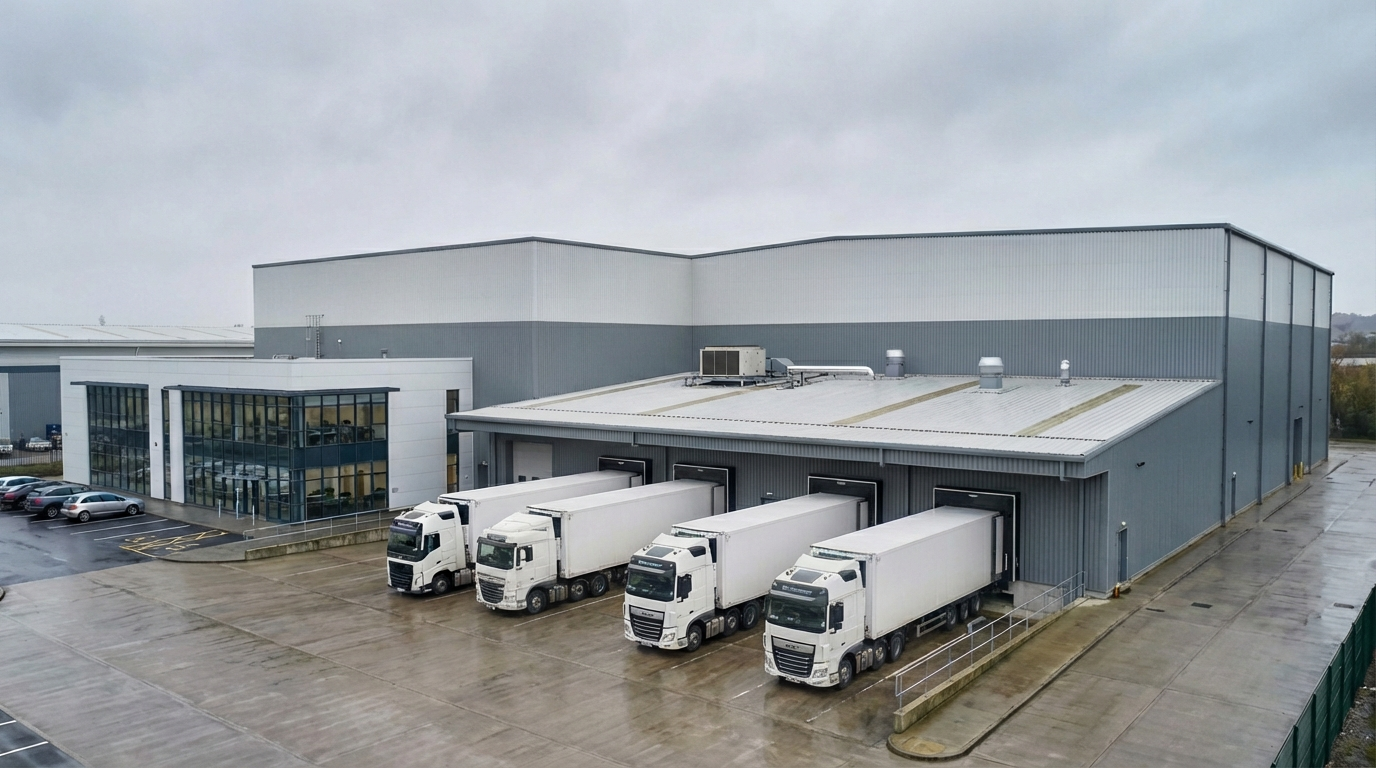
The base chilled tier sets the public refrigerated warehouse (PRW) baseline with insulated cladding, a controlled dock arrangement, and a straightforward service yard, ahead of the heavier plant and screening requirements introduced in later tiers.
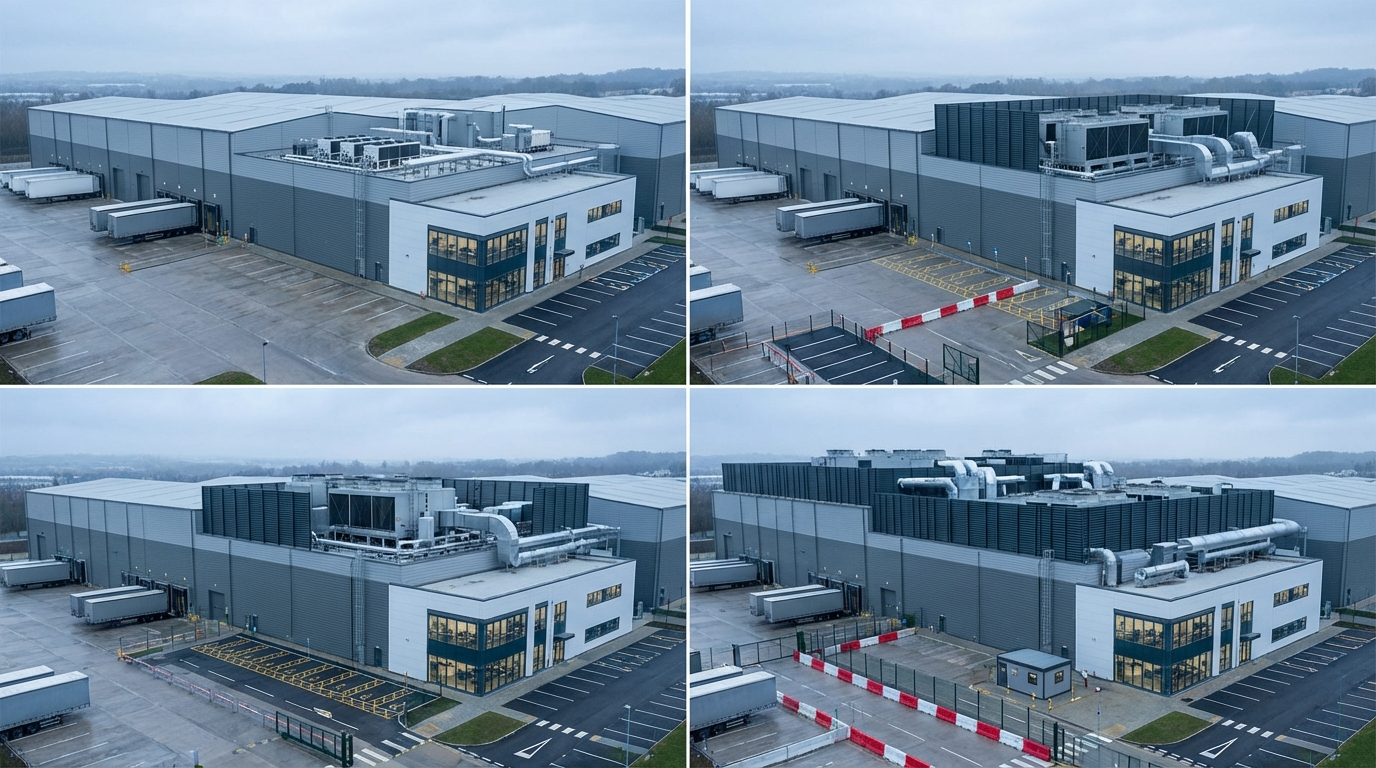
The enhanced-plant tier adds more visible rooftop plant, stronger screen treatment, and clearer service-zone separation to the same cold-chain envelope, confirming a high-bay plant-screened specification that stays legible in planning scrutiny.
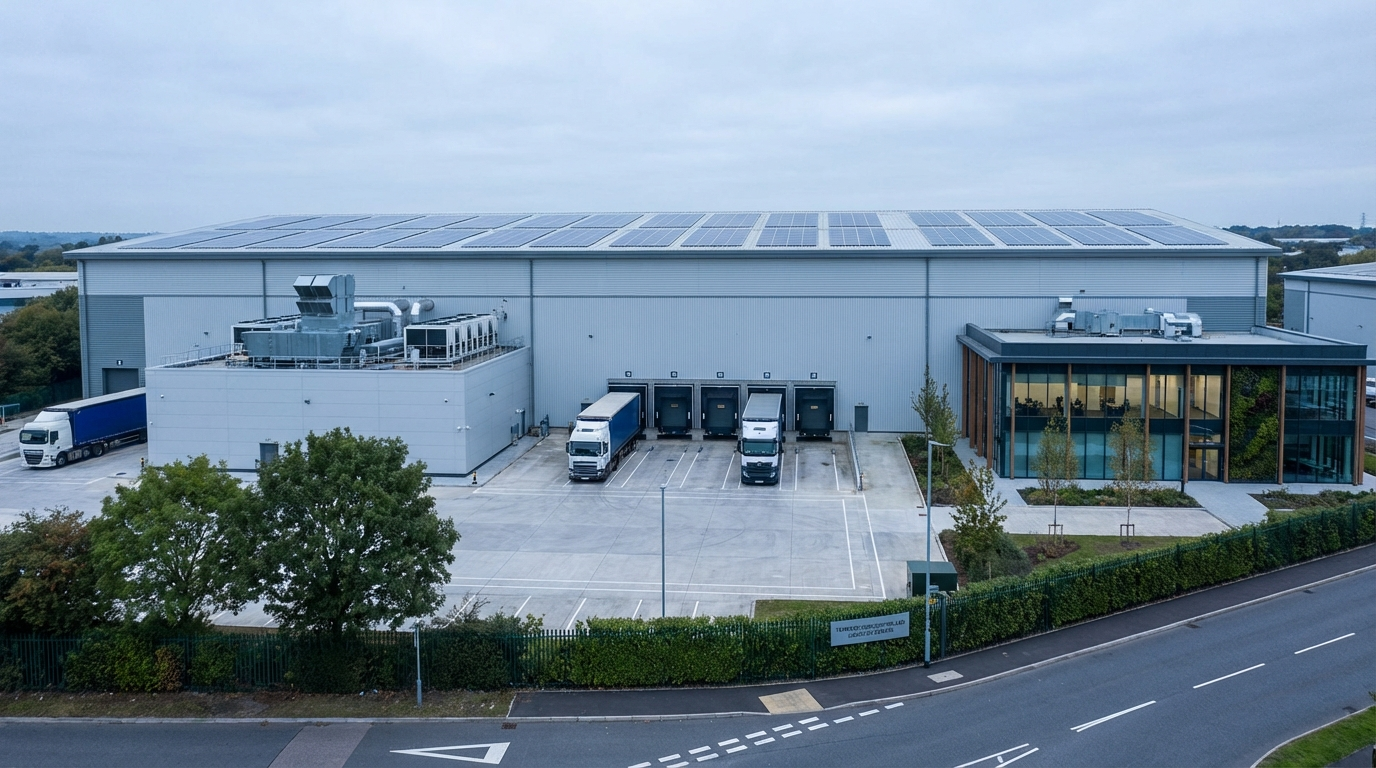
The ESG-led tier keeps the same cold-storage logic and adds roof-mounted solar, greener boundary treatment, and a cleaner office-front upgrade, establishing the specialist cold-store for ESG-sensitive investors and occupiers, with vertical and pharma applicability where the brief calls for it.
The cold-storage sequence frames one specialist envelope for baseline chilled use, plant-heavy screening, and ESG-led cold-chain review.
Six cold-store subtypes drive the UK industrial CGI brief. Public refrigerated warehouses, GDP pharmaceutical facilities, blast freezers, ASRS high-bay freezers, multi-temperature cross-dock buildings, and vertical urban cold stores each demand a distinct refrigeration plant, envelope specification, and yard discipline beyond the baseline cold-chain envelope. StratumCGI renders every subtype against the architect's cladding specification, the mechanical engineer's plant layout, and the production checks planning officers, 3PL operators, and pharmaceutical occupiers actually review.
Cold storage CGI glossary
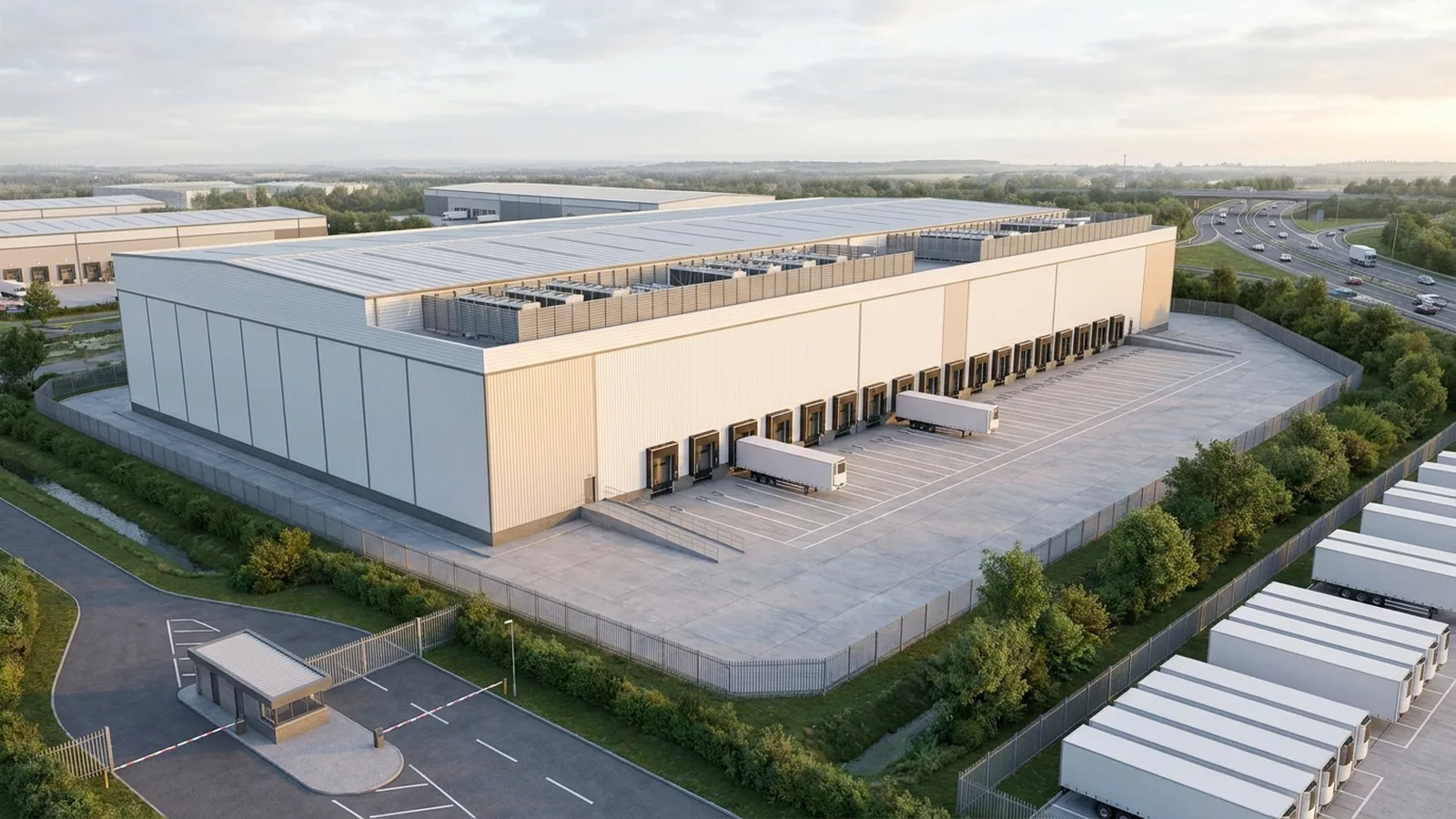
Public refrigerated warehouse CGI shows a speculative or build-to-suit cold store for third-party logistics, with an IMP envelope sized for any incoming occupier.
The render proves the IMP cladding, ammonia or CO2 rooftop plant, and a yard segregating chilled (0 to 4 degrees) from frozen (minus 18 to minus 25 degrees) movements. UK PRW operators (Lineage Logistics, NewCold, Constellation Cold Logistics, Magnavale) work the multi-tenant lease-by-pallet model defined by IARW.
StratumCGI builds one PRW model that upgrades to build-to-suit on occupier signing, so speculative and pre-let renders share one geometry. See the public refrigerated warehouse case study (SCGI-007).
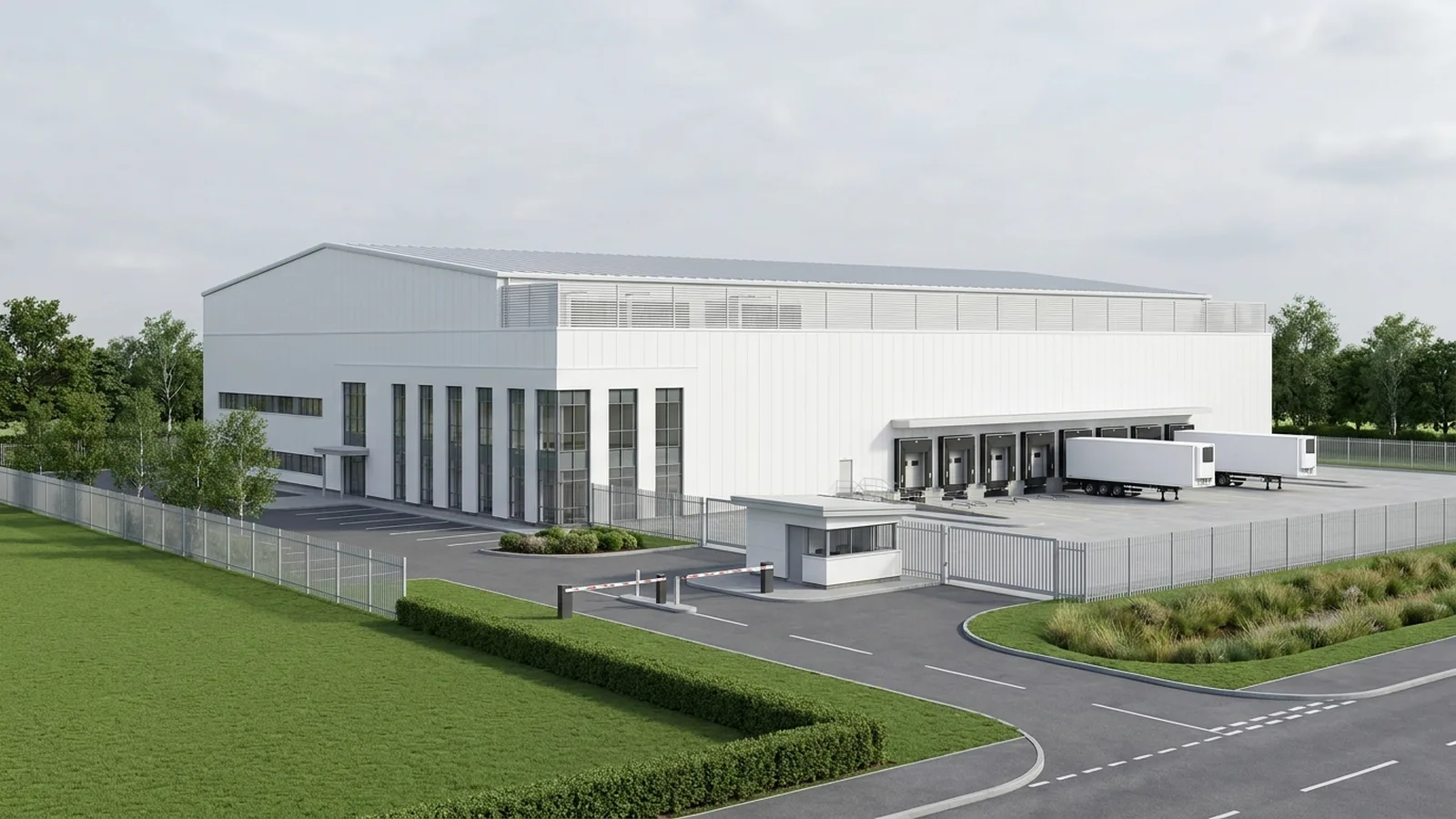
Pharmaceutical cold storage CGI presents a UK GDP compliant, MHRA-regulated building. Validated zones: ambient (15 to 25 degrees), chilled (2 to 8 degrees), frozen (minus 20 degrees), and ULT (minus 80 degrees).
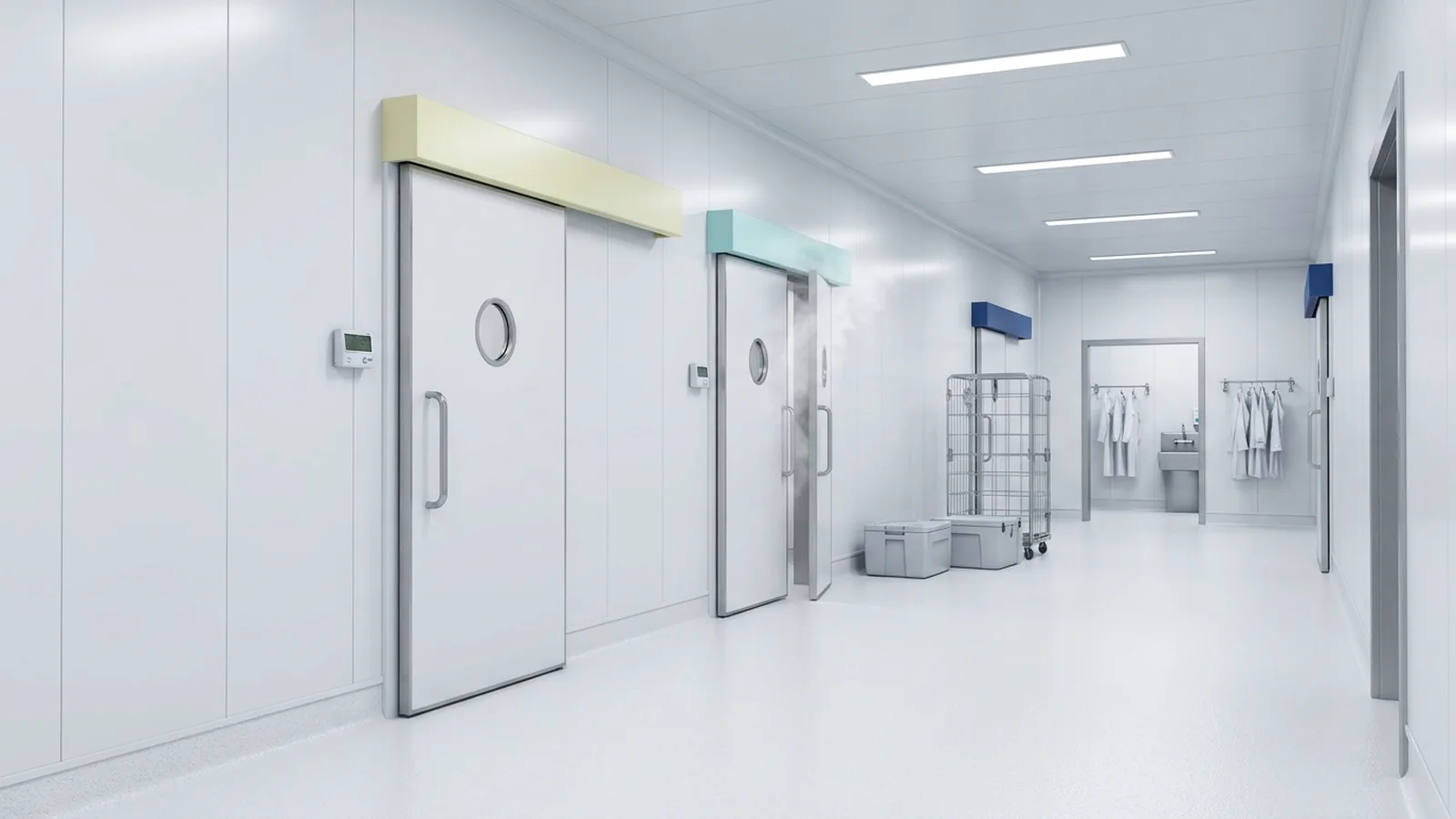
The render reads cleaner than food cold chain, with a controlled gatehouse, tighter landscape, and a parapet plant screen sized to validated zones, not bulk capacity. The audience: pharmaceutical distributors (UPS Healthcare, Movianto, DHL Supply Chain), planning officers, and architects briefing into life-sciences logistics.
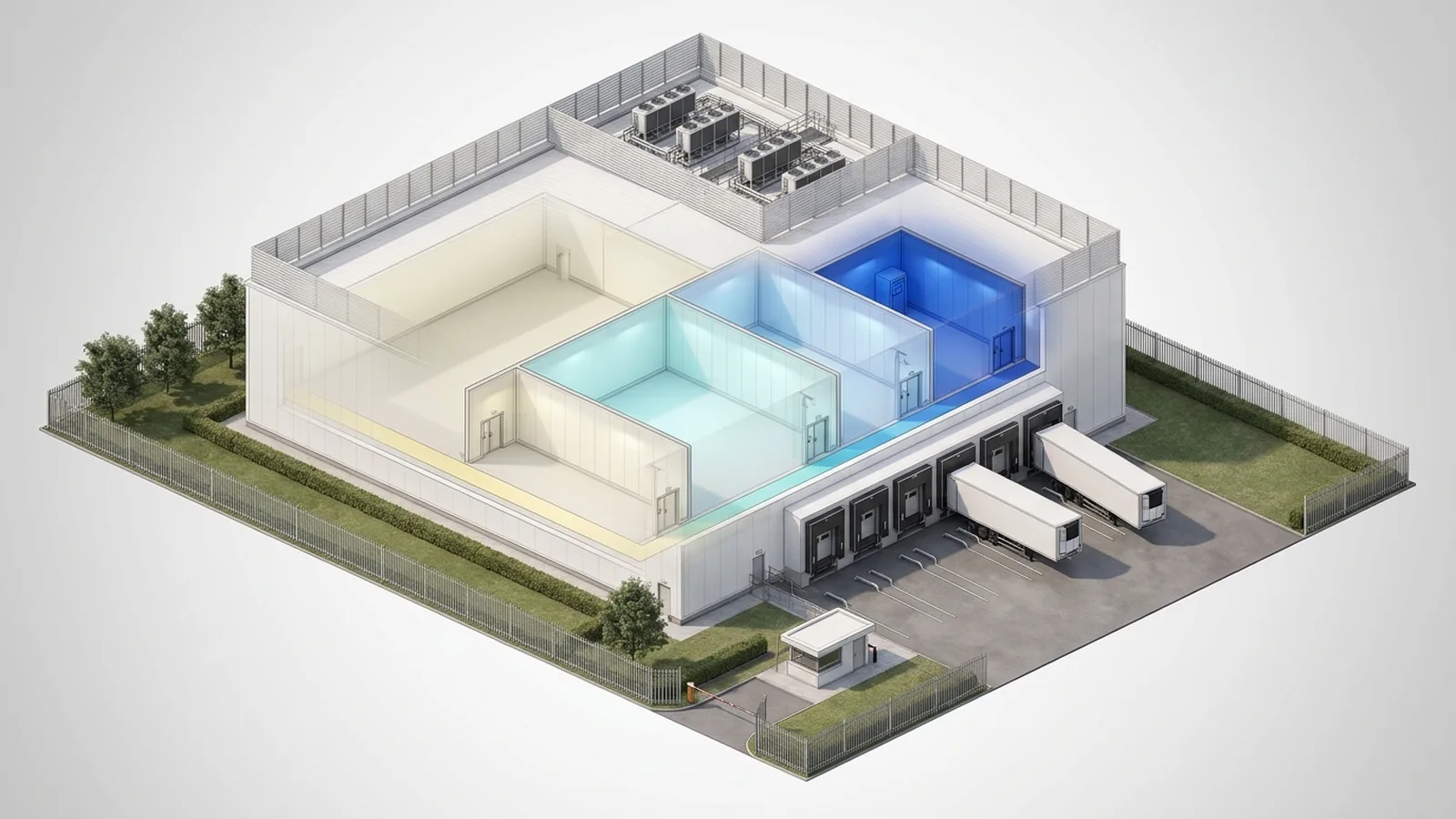
StratumCGI isolates each GDP-compliant zone as a discrete model element, so investor presentations, MHRA submissions, and planning reports can call out IQ, OQ, and PQ validation.
Blast freezer CGI shows how rapid pull-down shapes plant footprint and envelope geometry. The render proves the freeze tunnel, the ammonia (NH3) plant room with acoustic enclosure and screened parapet, and minus 30 to minus 40 degree storage segregated from chilled and ambient zones.
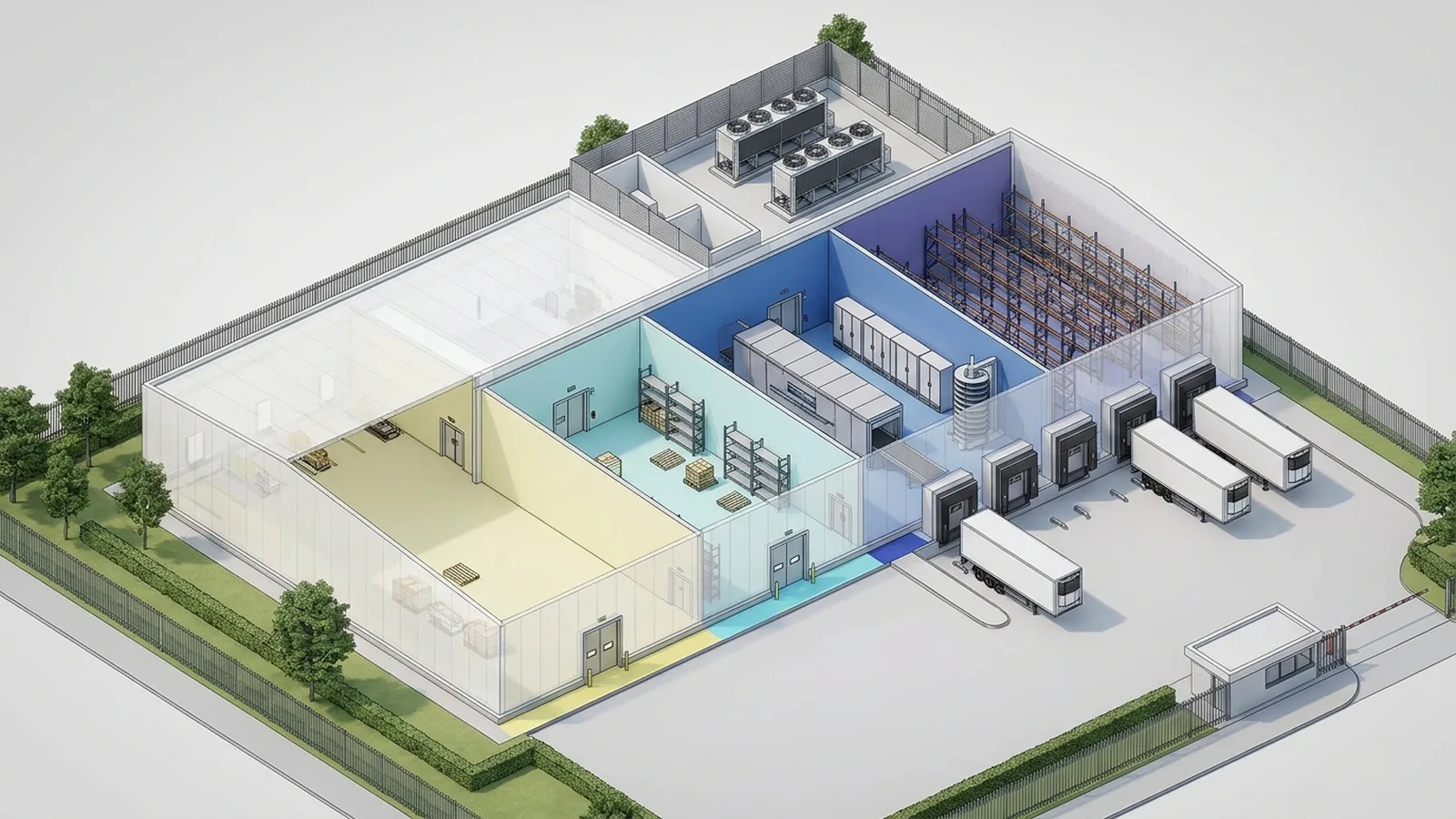
CO2 cascade refrigeration is rendered where F-gas regulation drives a low-GWP brief, with Star Refrigeration, J and E Hall, or GEA designing the plant. The audience: food producers (seafood, poultry, ready-meal, ice-cream), planning officers reviewing plant load, and operators testing freeze-tunnel throughput against IIAR ammonia-safety guidance.
StratumCGI models the plant from mechanical specification (refrigerant type, plate or spiral freezer, screen geometry), so the image proves the technical scheme.
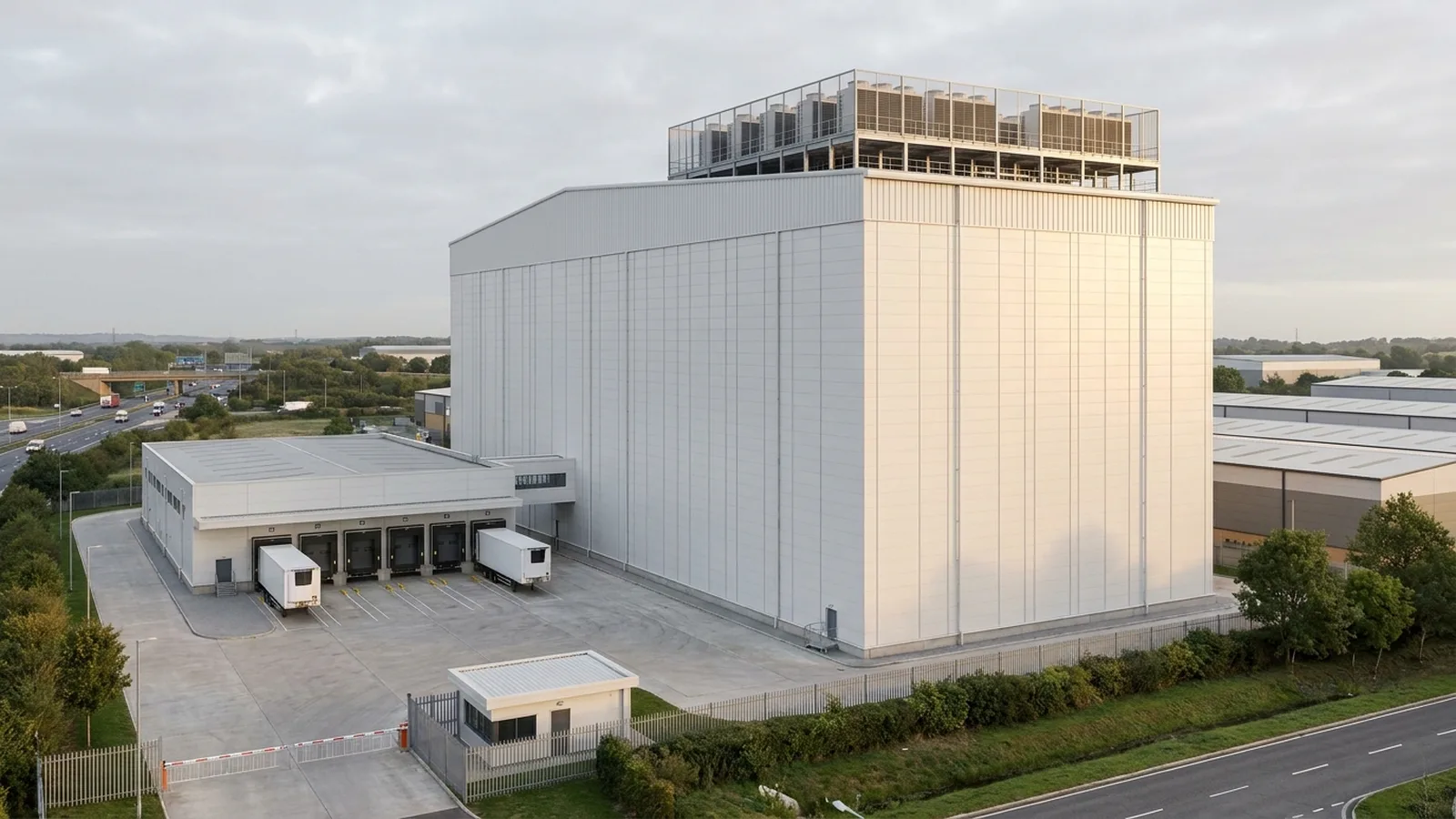
High-bay automated cold storage CGI proves an envelope different from a portal-frame shed: narrower footprint, 30 to 46 metre clear internal height, rack-clad or self-supporting single-volume freezer.
The render shows the ASRS envelope, narrow-aisle stacker-crane logic (Swisslog, Witron, Dematic, SSI Schaefer, Mecalux), the rooftop plant deck for the automated refrigeration load, and a yard supporting automated put-away. The audience: developers underwriting automated cold chain, planning officers assessing massing at greater height, and operators specifying ASRS racking against UK references like NewCold Wakefield.
StratumCGI models the rack-clad envelope to the engineer's structural specification, so the height reads correctly and IMP cladding resolves at full building scale, not portal-frame proportions.
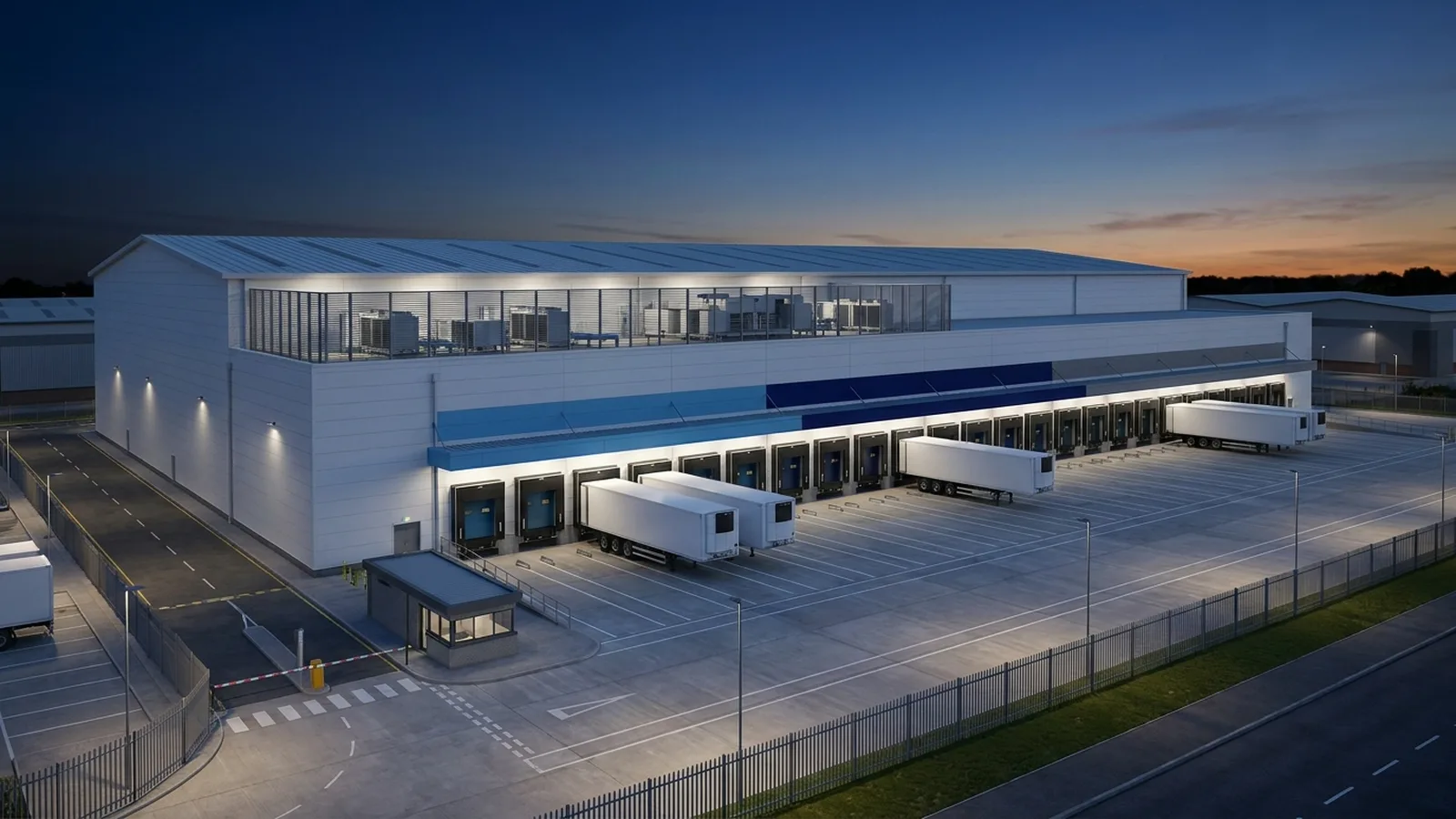
Multi-temperature cold storage CGI holds three zones inside one envelope: chilled (1 to 4 degrees), ambient (15 to 25 degrees), and frozen (minus 18 to minus 25 degrees). Cross-dock or block-stack operations run across a segregated dock face.
The render proves dock seals and levellers at correct opening sizes, the chilled-versus-ambient dock split, IMP partitions between zones, and a yard supporting cross-dock moves without zone contamination at NDC scale. The audience: grocery developers (Tesco, Asda, Morrisons, Sainsbury's, Bidfood, Brakes), 3PL operators handling mixed stock, and planning officers reviewing a 100-plus door yard discipline.
Vertical and urban cold storage CGI answers a brief the regional shed cannot: a constrained site, light-industrial neighbours, and cold-chain capacity stacked above a compact ground-level dock yard for in-city distribution.
The render shows the multi-storey or urban-edge form, IMP on a smaller footprint, and last-mile logic for urban grocery, dark-store, and pharmacy delivery. The audience: urban-edge developers, last-mile operators placing in-city cold capacity, and planning officers reviewing a cold building in a mixed urban context.
Click a question to expand
Cold storage CGI runs on the same productised tiers as standard warehouse work, with extra modelling days for the refrigeration plant deck, IMP envelope detail, and yard zoning. A Lite cold-store pack runs six working days of production effort; the Standard pack runs twelve; the Pro pack runs twenty. Cold-chain detail does not add a tier on top. It lives inside each tier's modelling phase, drawn from the mechanical engineer's plant layout and the architect's IMP specification.
Cold storage CGI carries an insulated metal panel envelope with PIR or PUR core, rooftop refrigeration plant on ammonia, CO2, or glycol secondary, dock seals and dock shelters at correct opening sizes, and a yard pattern that segregates chilled from ambient movements. Standard warehouse rendering carries none of these production checks.
Yes. StratumCGI builds one coordinated cold-store model and renders speculative marketing views and build-to-suit pre-let views from the same geometry, so the upgrade path between the PRW baseline and a named occupier configuration stays visually consistent.
A cold-store render carries four production checks in a single front three-quarter exterior: the insulated metal panel envelope, the roof-mounted refrigeration plant deck with screening, the dock elevation with thermal seals, and the yard organised around temperature-zoned vehicle movement. Planning officers read that image for plant impact and yard segregation. BRCGS-grade pre-let review tests envelope integrity and dock-seal positions against the storage standard. One image carries both audiences.
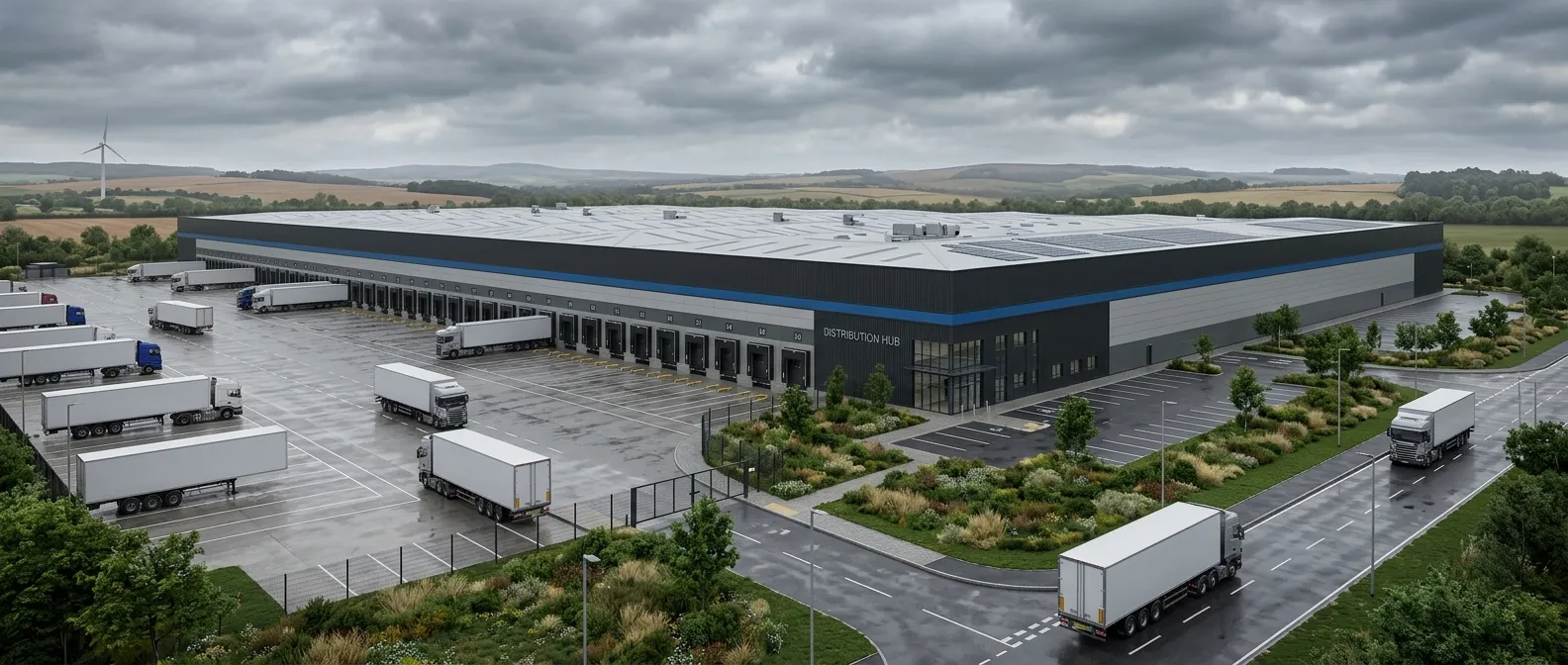
Because the street edge sits closest to the neighbours, last-mile and urban logistics depot CGI places the building inside its street context so neighbour impact, van circulation, and frontage quality can be read in one view. The sites are smaller, the surrounding context is urban or peri-urban, and the primary vehicle is a delivery van rather than an articulated lorry. Drone-enabled last-mile schemes with rooftop pads and BVLOS corridors sit in a separate fulfilment-hub guide rather than the core depot CGI proof path.
StratumCGI produces last-mile depot imagery from street-level viewpoints that accurately represent the building in its urban context:
Vehicle noise, delivery hours, lighting spill, and street-facing elevation quality all come under planning-officer scrutiny in one contextual view.
Scroll to compare urban operation modes →
Camera position holds still while the operating mode changes: one camera-matched urban shell reads for baseline planning, courier-led dispatch, and neighbour-sensitive frontage review.
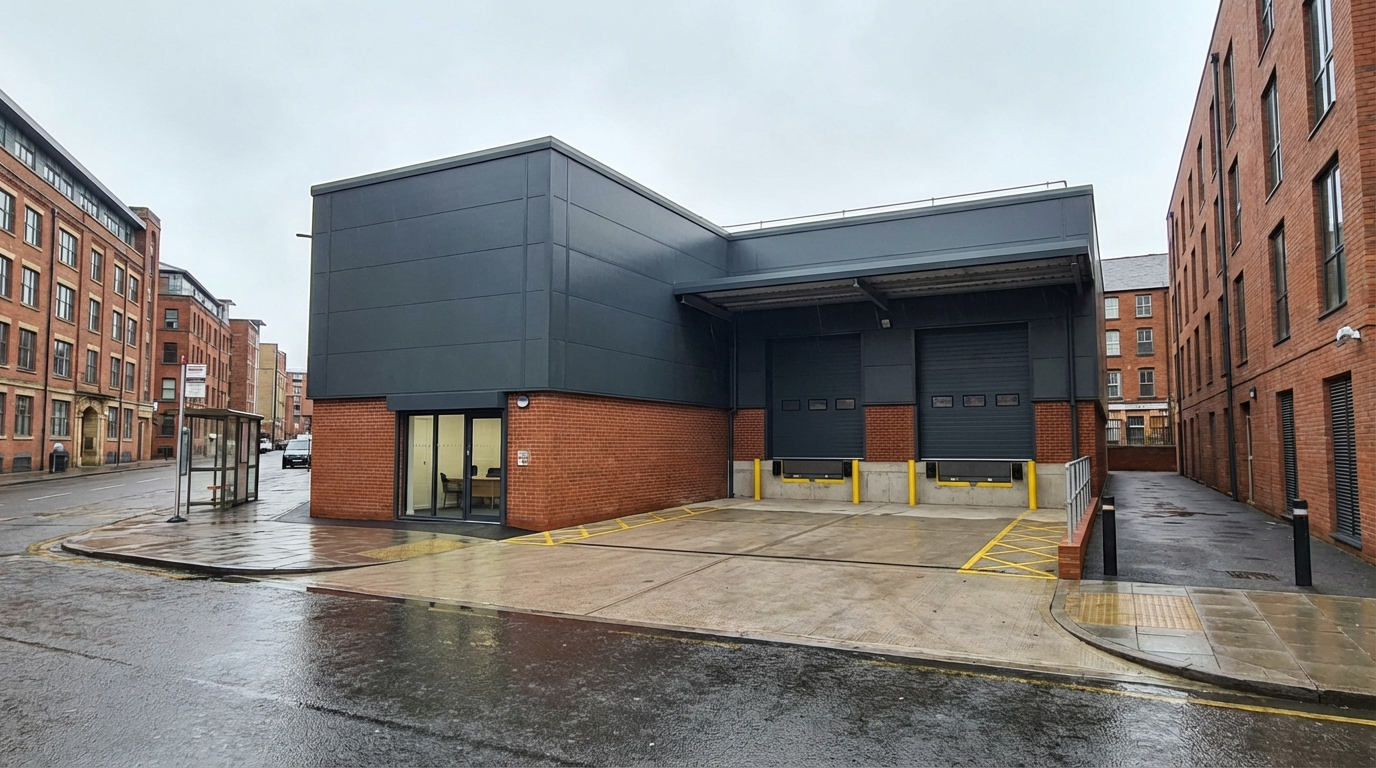
What the baseline view establishes is the planning-safe read for an urban logistics building: a restrained depot form, clear street edge, low-noise frontage, and controlled service access.
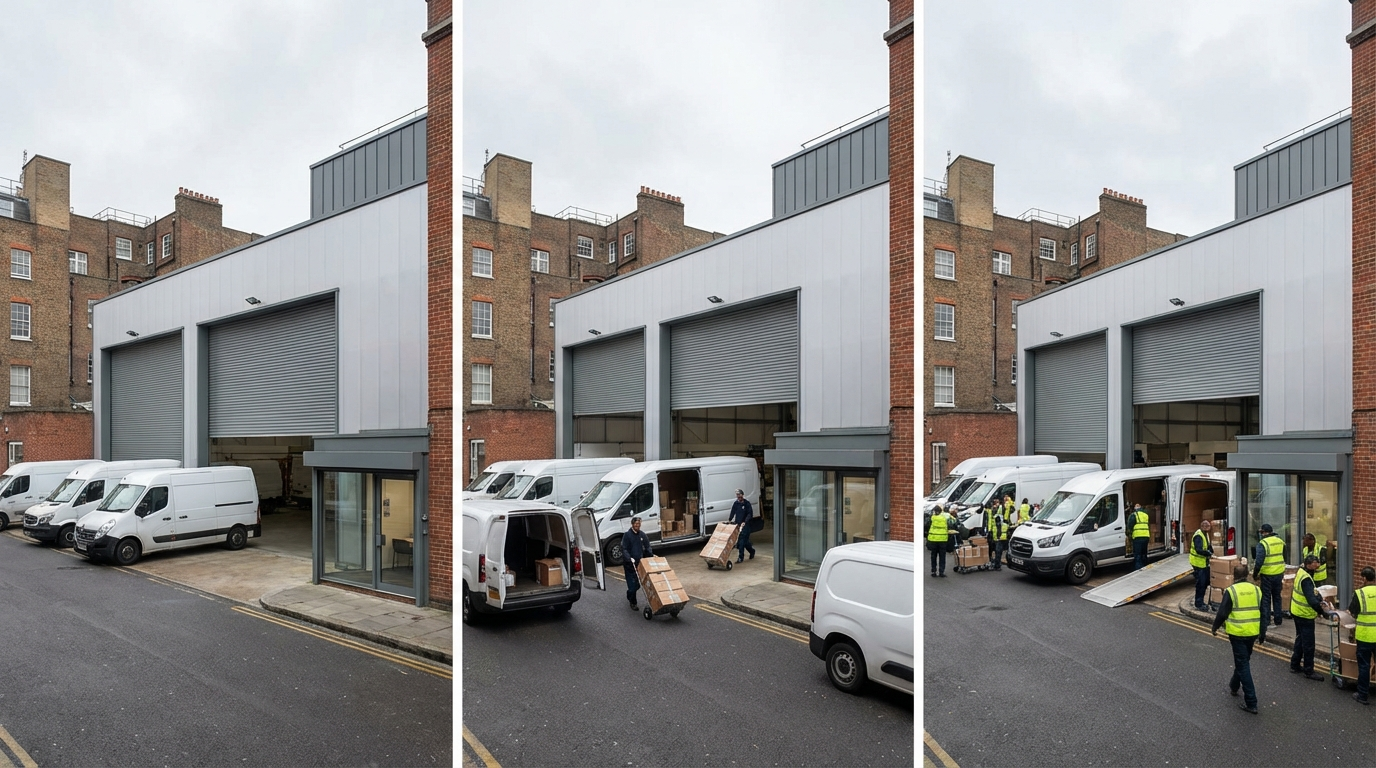
The courier-state read changes the operation, not the built form, confirming higher-frequency courier operation through stronger van-dispatch cues, tighter loading activity, and a faster service rhythm.
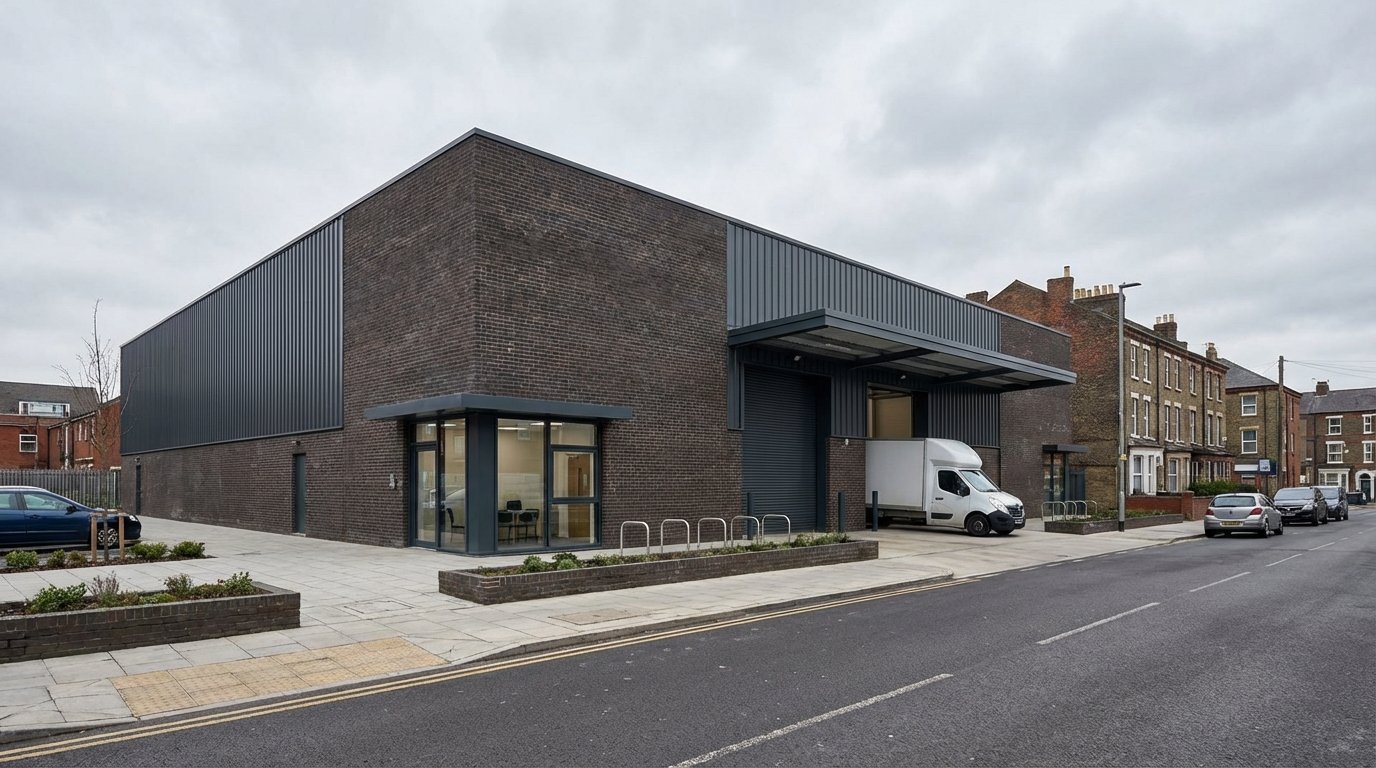
For sensitive urban frontage assessment, the same logistics function is recast with calmer staging, softer frontage emphasis, and a more planning-sensitive street relationship, its operational purpose unchanged.
The last-mile depot sequence recasts one urban shell for planning review, courier dispatch, and neighbour-sensitive frontage control.
View the Urban Edge Last-Mile Depot case study (SCGI-006) for an example of compact urban logistics CGI.
Warehouse depot CGI renders regional mid-scale facilities at 5,000 to 50,000+ sqm, covering the operational and planning ground that sits between urban last-mile depots and full-scale distribution centres. The imagery models yard depth, dock count, HGV circulation patterns, and landscape context where planners and operators evaluate regional depot briefs.
Warehouse depot CGI resolves what standard 2D planning drawings cannot convey. The visuals show how a mid-scale facility sits within its road network, what the driver experience reads at arrival, and how building mass and surface activity are perceived from neighbouring properties. This visual clarity gives operators a clearer read on road hierarchy, arrival sequence, and surrounding amenity context before the depot brief moves into consultation or pre-let review.
For big-box distribution and standard pallet density, see Distribution Centre CGI above. For cross-dock throughput and e-commerce consolidation, see Fulfilment Hub CGI. Airside and landside freight schemes, where security lines and apron geometry set the frame, continue below under Air Cargo and Specialist Freight Facility CGI.

Air cargo and specialist freight facility CGI separates airside, landside, and security-controlled movement so the scheme reads as an operational freight asset rather than a generic shed by a runway. Air cargo terminals coordinate under strict requirements that shape the building's form.
StratumCGI models air cargo schemes from the airport operator's layout plan, ensuring exact regulatory alignment:
The planning authority and the airport operator review the scheme in its operational flow rather than as an isolated building, because the strict segregation is already in the model.
Scroll to compare freight operating conditions →
One georeferenced freight shell, three operating contexts: landside flow, airside control-line separation, and secure night operation.
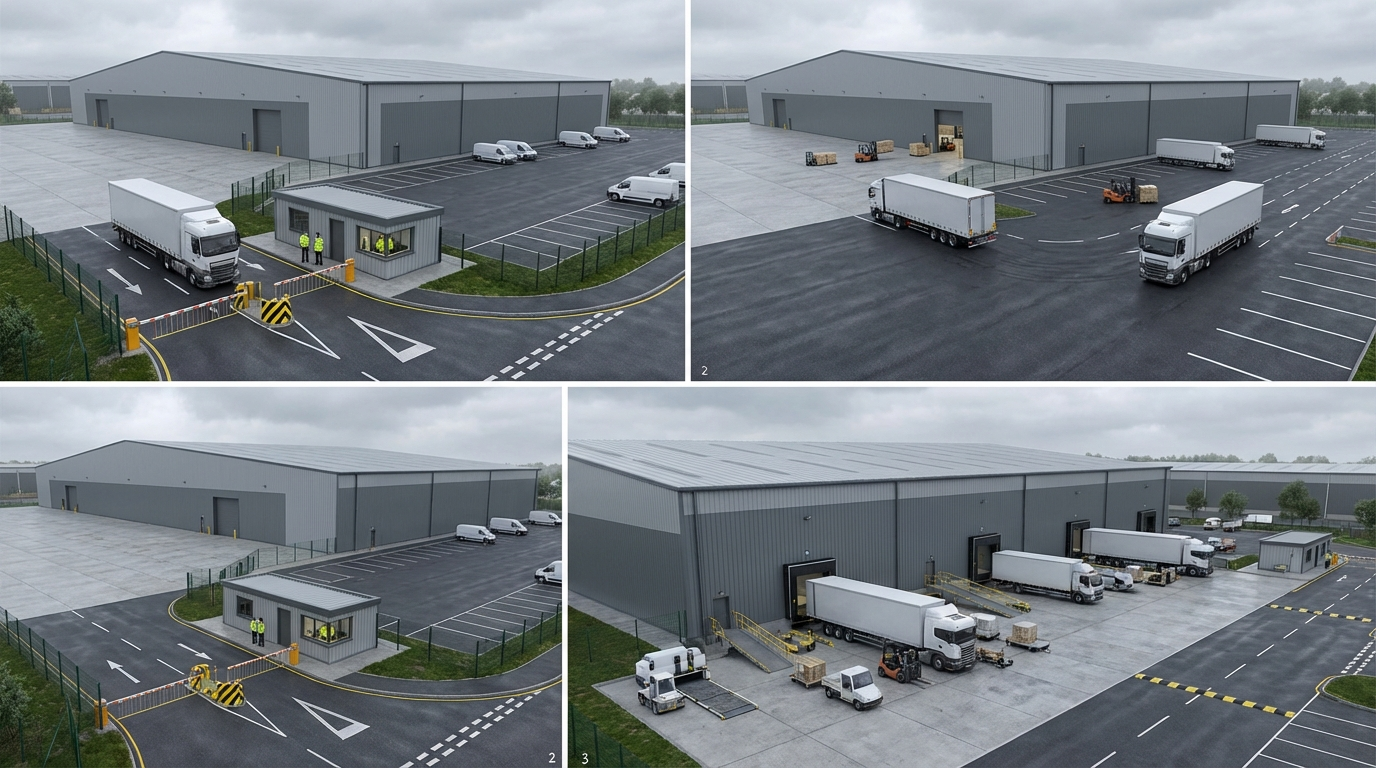
The baseline logistics read for specialist freight handling comes from the landside frame's emphasis on servicing, access control, and heavy-freight circulation, outside the pure airside context.
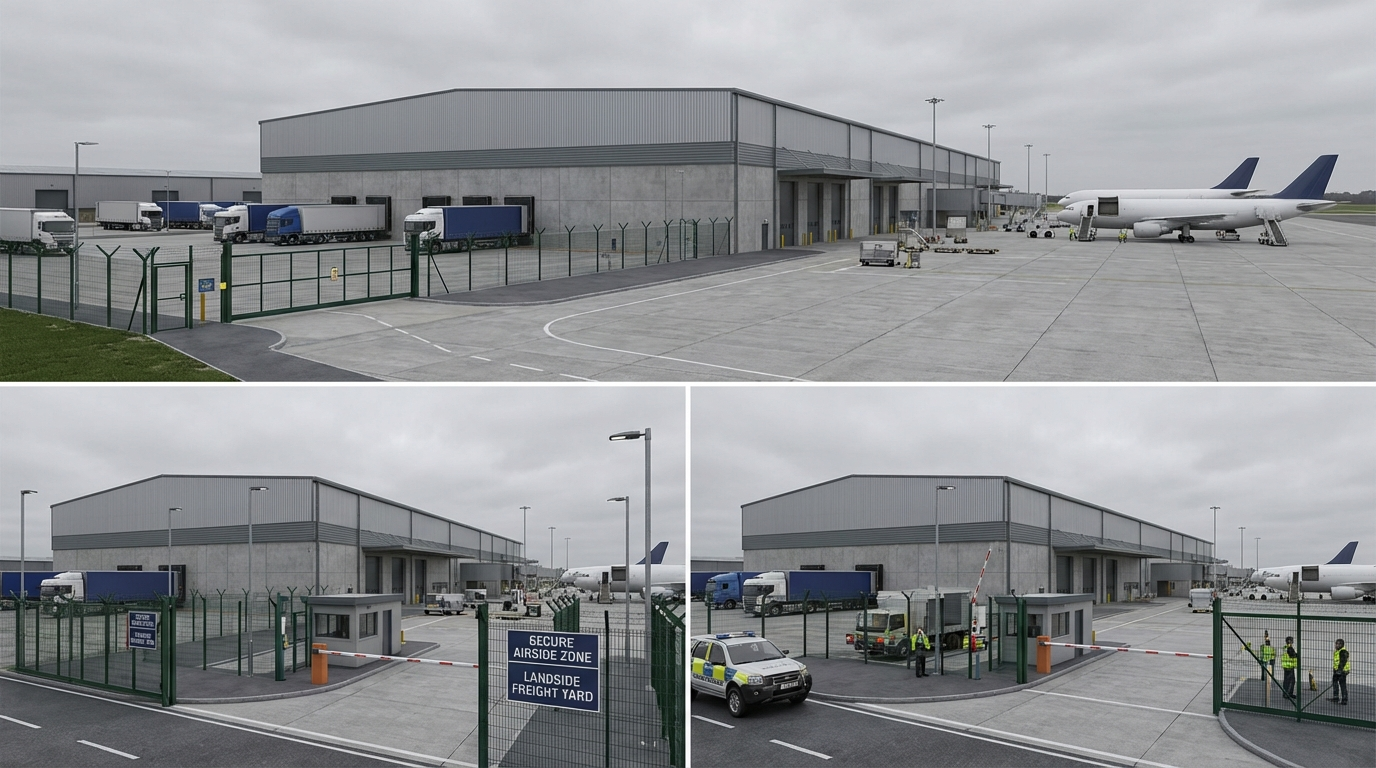
Secure zone separation, rather than only general warehouse function, is what the airside-interface view clarifies through the relationship between the control line and aircraft-side operation, with the same freight building and camera.
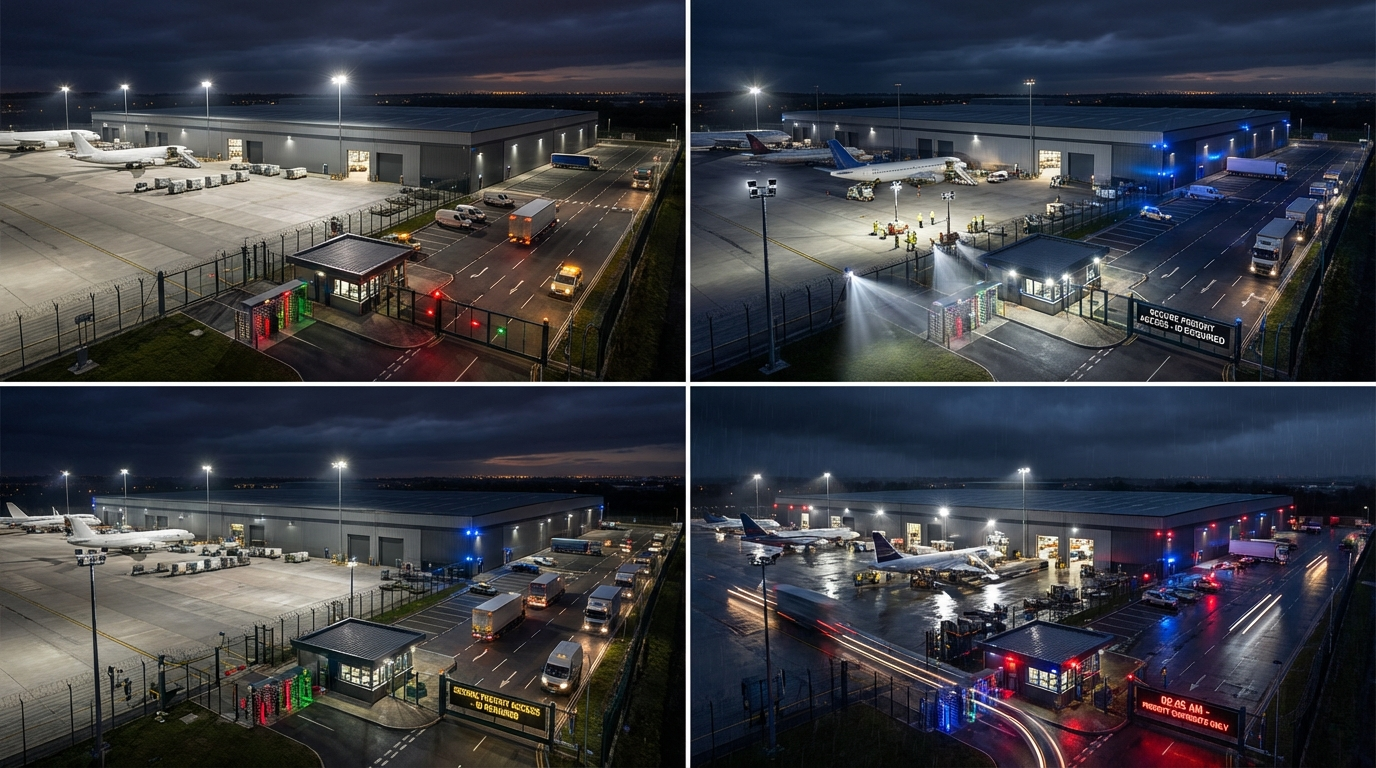
The night-freight test confirms the facility as a specialist, secure, time-sensitive cargo environment, applying stronger secure-lighting logic and clearer controlled access to the same freight building.
Across landside flow, airside separation, and secure night operation, the air-cargo sequence maps one freight model.
View the Regional Air Cargo Terminal case study (SCGI-008) for an example of specialist freight facility CGI. Across every typology above, BREEAM targets, PV capacity, and biodiversity net gain now shape the frame list as much as dock geometry does; Sustainable Warehouse CGI and ESG Features below shows how those attributes are rendered.
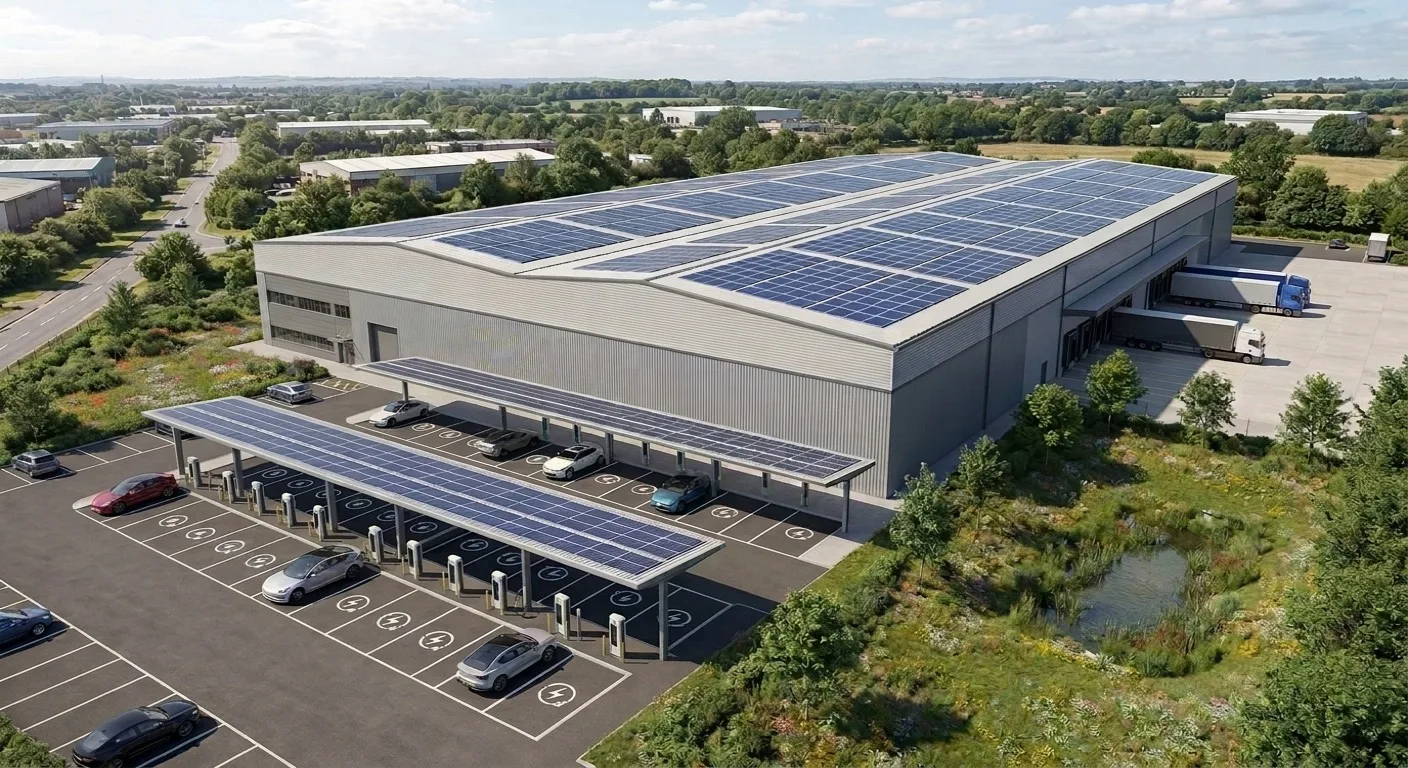
Daylight Aerial, BREEAM Outstanding Scheme
Full rooftop PV array, dedicated EV charging hub with solar canopies, biodiversity net gain buffer with wildflower meadow and wetland, and HGV service yard on a UK BREEAM Outstanding logistics site.
Sustainable warehouse CGI renders the environmental performance attributes that UK logistics developers now specify as a baseline. SEGRO Park Tottenham scores 92.7 to 94.9% BREEAM Outstanding, which SEGRO reported at completion in January 2023 as the highest BREEAM score recorded for a UK industrial building.
Prologis Park Hemel Hempstead DC3a sustained 88.8% BREEAM Outstanding, with DC12 at the same park certified EPC A+. The imagery must resolve five distinct systems at a level an institutional investor or planning officer can read without a specification document.
A BREEAM Outstanding render set carries the PV array, the EV charging hub, and the biodiversity buffer as readable geometry, not as background texture. Each element is positioned and sized to the approved specification, so the render scores against the BREEAM scorecard at the same resolution it reads against the planning officer's site plan.
StratumCGI produces the BREEAM-submission render set, the net zero carbon pathway render, and the planning neighbour-amenity view from the same survey-locked model. The aerial view carries the PV array and EV charging hub for the energy assessor. The ground-level biodiversity view carries the habitat schedule for the ecologist. The night aerial carries the lighting layout for the BREEAM assessor's operational-energy credit.
The institutional pack operates against the same BREEAM-and-net-zero evidence standard. Prologis, SEGRO, Tritax, and GLP run net zero portfolio commitments that move carbon and biodiversity evidence forward to planning stage, so the documents that satisfy the planning officer also feed the investor sustainability report and the BREEAM submission.
The biodiversity buffer render set shows the qualified habitat the ecologist has scheduled: wildflower meadow, wetland with reed beds, native hedgerow, and green living roof, all positioned on the approved site plan. This is the visual record of the 10% statutory net gain required under the Environment Act 2021, produced at a resolution the planning officer and the Natural England auditor can read against the Biodiversity Metric 4.0 calculation.
StratumCGI receives the agreed Biodiversity Metric 4.0 output from the appointed ecologist: a habitat schedule listing each unit type, distinctiveness grade, and condition score. The render translates that schedule into a verified view set, showing each habitat at its correct extent, species composition, and management stage.
The 30-year statutory management plan renders as a habitat trajectory, modelling typical projections of 10 to 40 units for large-box schemes. Each frame is the same approved geometry under different management-stage conditions, so the planning officer reads habitat maturity without re-rendering the building.
Indicative large-box warehouse scheme, modified agricultural baseline
Pre-development Baseline habitat
Baseline total4.0
Post-development Delivered habitat
Post-development total20.8
Figures are indicative for a typical large-box warehouse scheme on modified agricultural land. Each commission is calculated by the appointed ecologist against its own baseline survey using Natural England Biodiversity Metric 4.0. StratumCGI visualises the delivered habitat set once the metric calculation is agreed.
Biodiversity warehouse CGI derives geometry from the landscape architect's reference set rather than originating the landscape design. The reference documentation supplied to StratumCGI covers hard landscape drawings, soft landscape plan, planting schedule, and the 30-year management plan.
StratumCGI translates the landscape architect's reference set into photoreal rendering under Landscape Institute Technical Guidance Note 06/19 (Verified Views methodology), verifying visual accuracy against measured drawings and scheduled plant performance. The render set supplies planning evidence at the same standard the landscape architect briefs against.
Biodiversity warehouse CGI translates the landscape architect's mood board into a verified photoreal render. The mood board supplied to StratumCGI comprises watercolour concept sketches, photographic precedent references, planting palette tiles naming native species, and hand-drawn spatial diagrams.
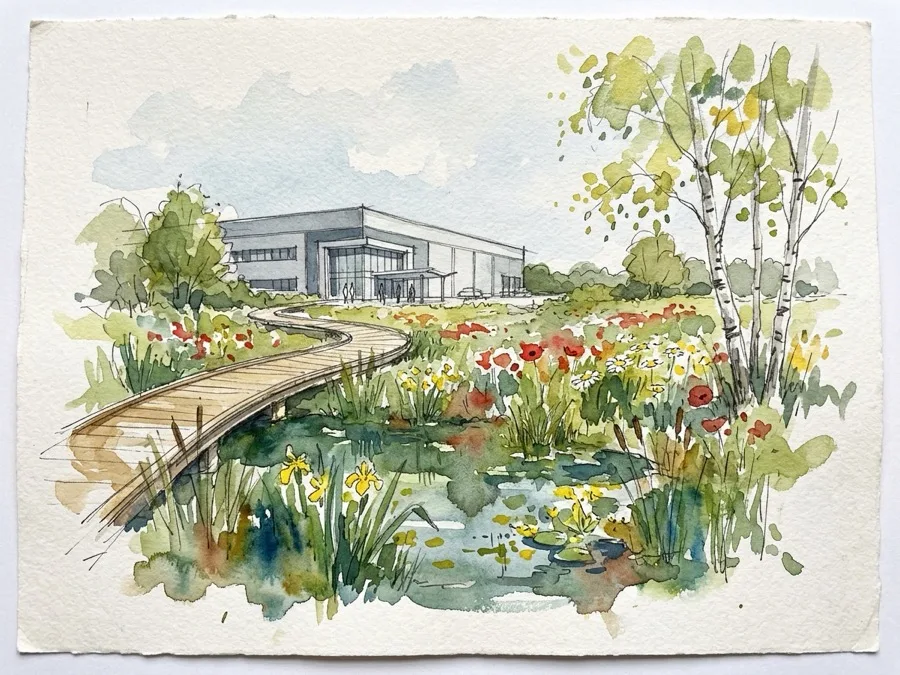 Watercolour
01
Watercolour
01
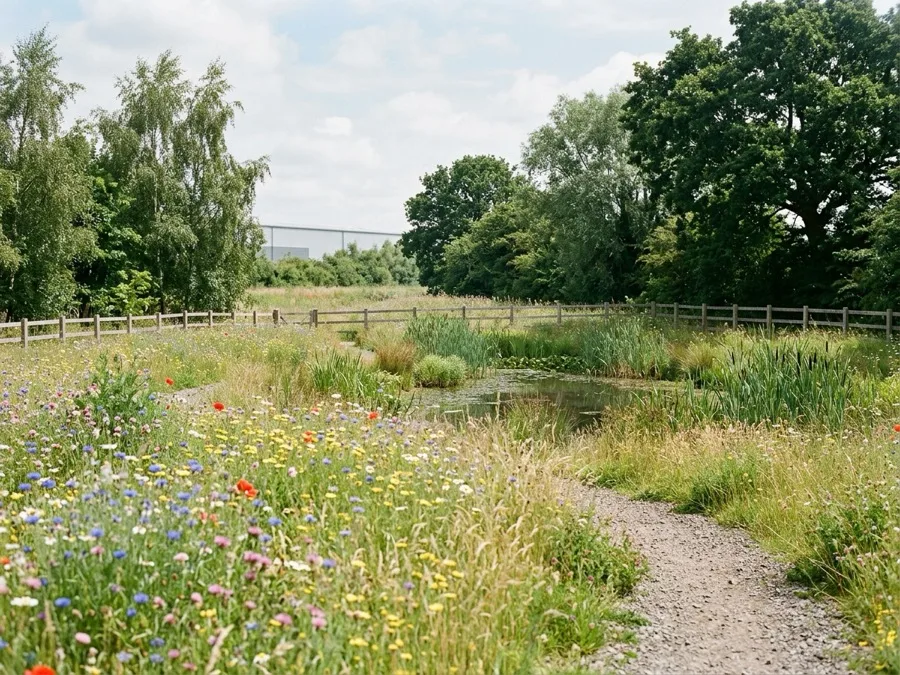 Reference
02
Reference
02
 Palette
03
Palette
03
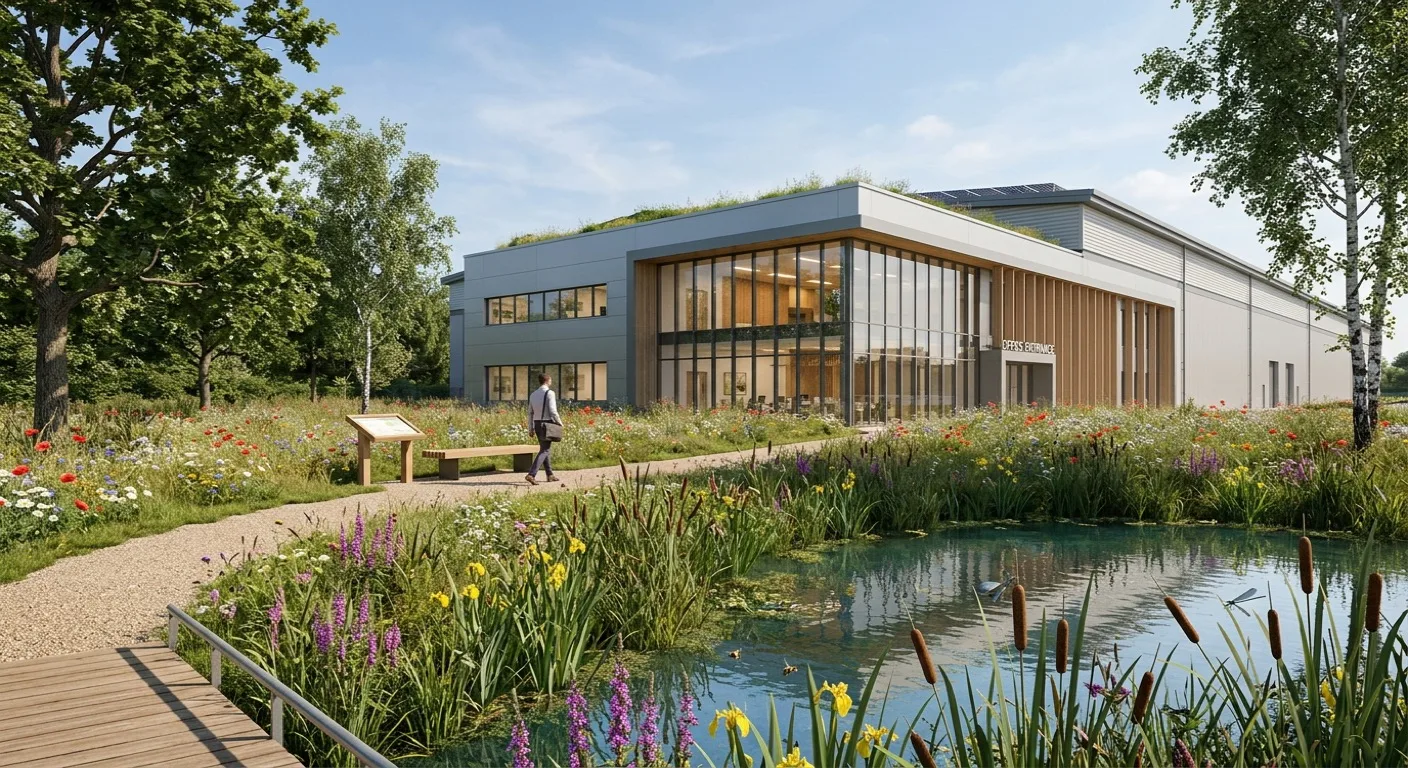 Final Render
04
Final Render
04
Design authorship credit belongs to the commissioning landscape architect. StratumCGI visualises the intent set without substituting authorship.
Biodiversity warehouse CGI renders the habitat features and public realm infrastructure that satisfy Biodiversity Metric 4.0 credit scores. StratumCGI resolves each credited feature to photoreal specification:
Ground-Level Biodiversity and Office Frontage
Eye-line view from the wetland pond across the wildflower meadow toward the office entrance. Boardwalk, native planting, and green living roof resolve the BREEAM landscape strategy and the staff amenity case in a single frame.
The four frames below show the same warehouse from the same camera at year one, five, ten, and twenty after planting. Only the canopy changes. Year one shows planting as built: saplings at two to three metres, timber stakes, exposed mulch, the cladding fully visible behind. Year five shows partial closure, with the upper third of the building still readable. Year ten leaves only the roofline and parapet showing above the screening. Year twenty hides the building behind a mature canopy with only fragments of cladding visible through the gaps.
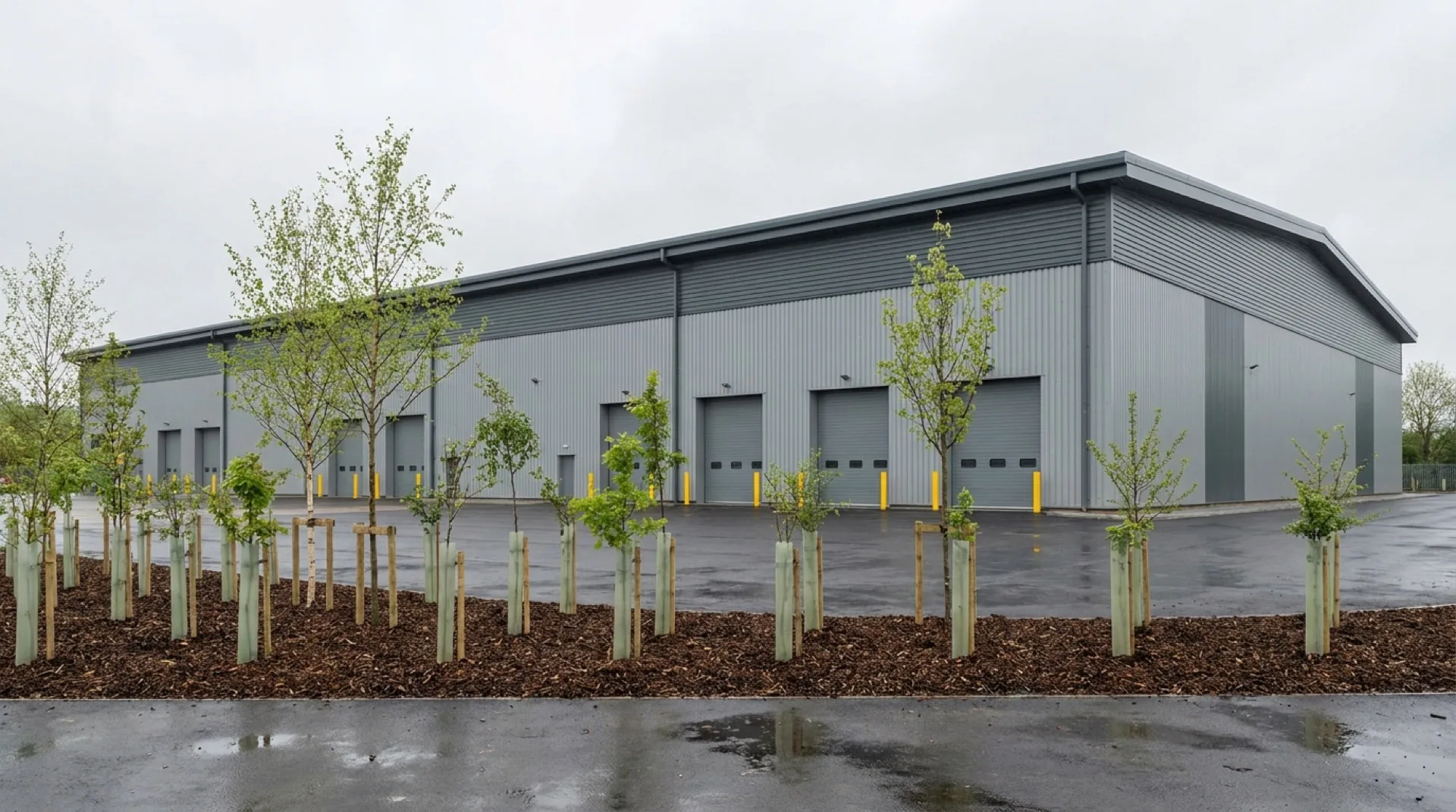
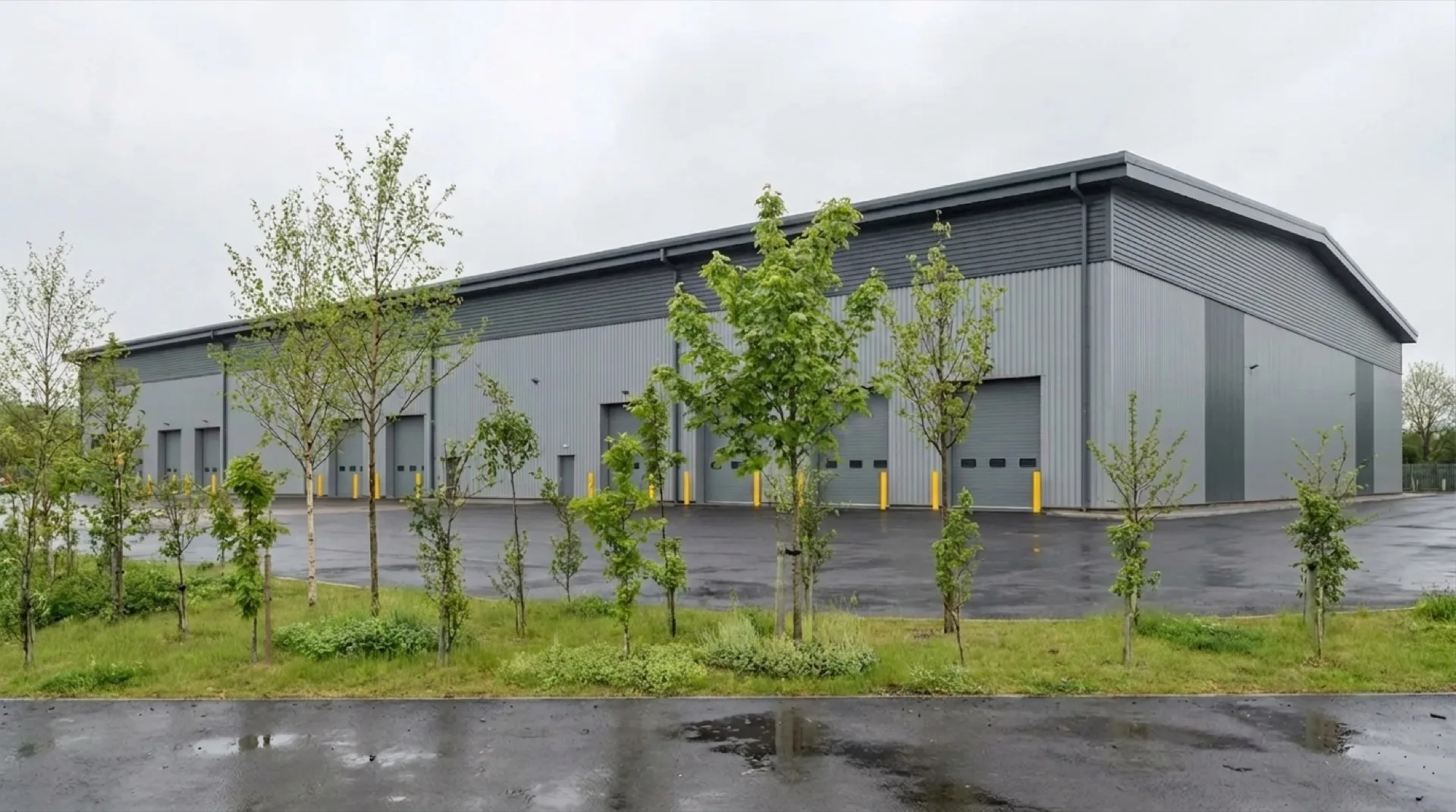
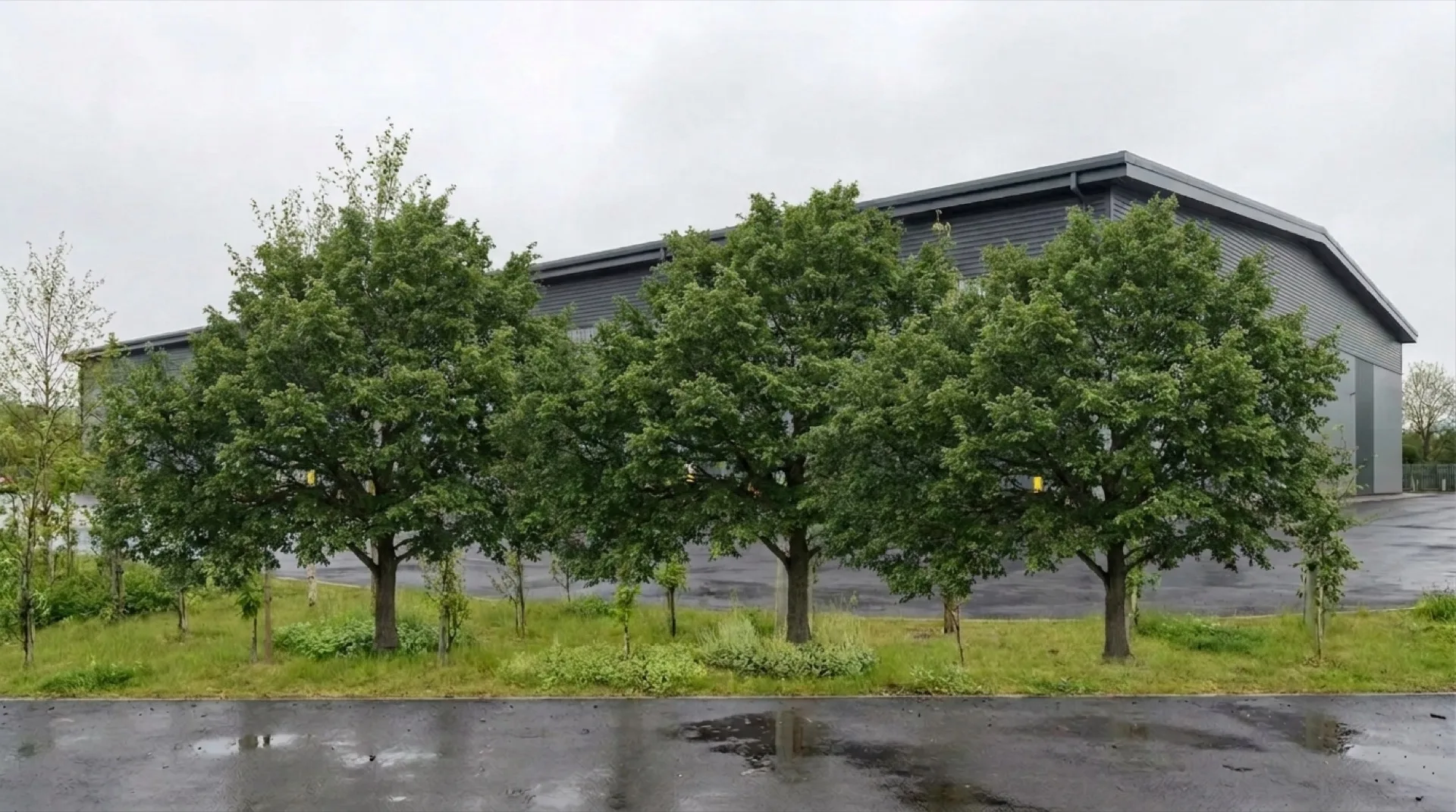
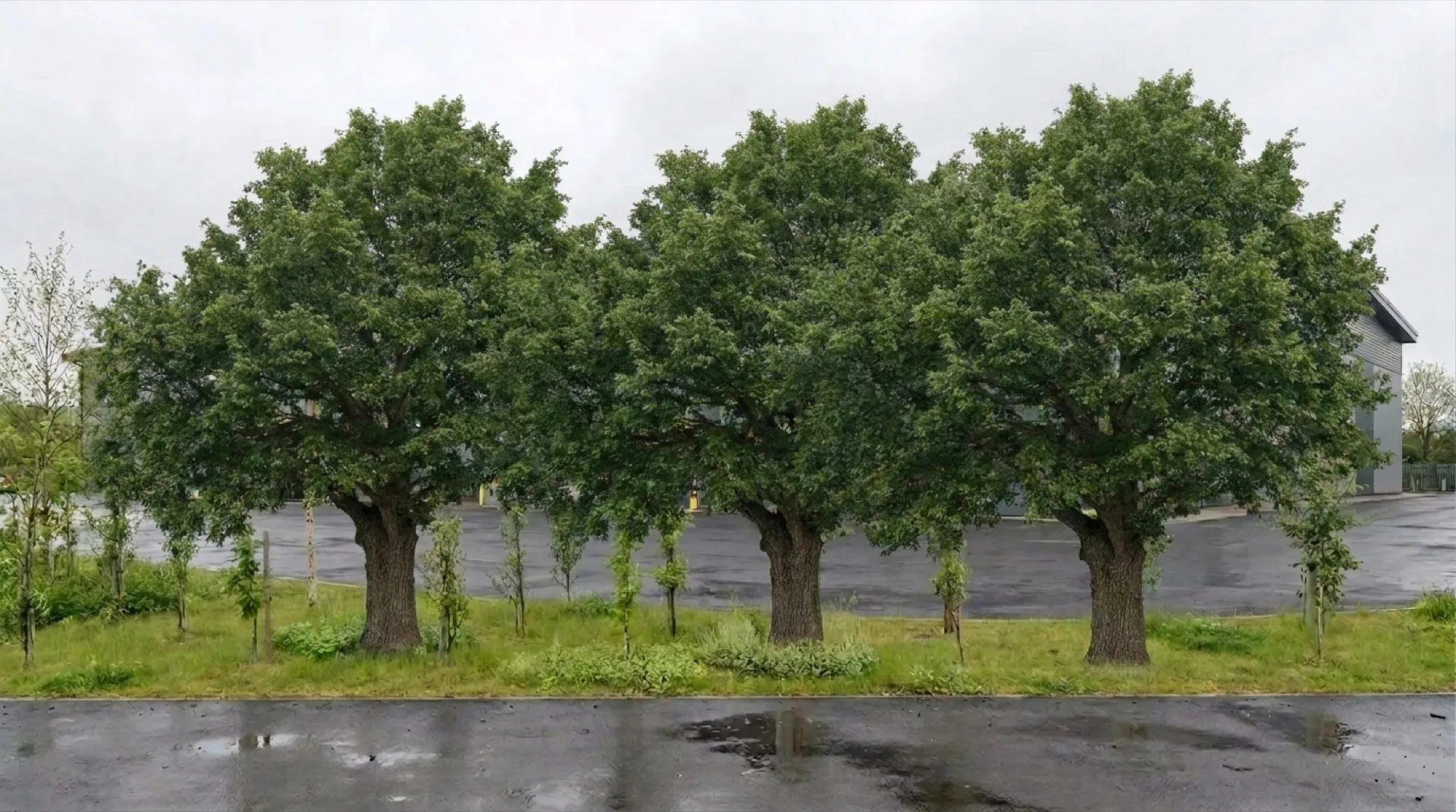
Each frame uses the same oak, birch, alder, and hawthorn species mix. Growth rate and crown spread are modelled per species, not averaged. Lighting, weather, and season are held constant across the four frames so the only variable a planner sees is canopy maturity. Officers read the screening trajectory in seconds, which removes the standard objection that a day-one render makes young planting look denser than it is and overstates the visual mitigation the scheme actually delivers in year one.
The net zero carbon render set resolves the four systems a planning officer and energy assessor need to read: the PV array at measured capacity, the EV charging hub at scheduled density, the embodied-carbon material specification, and the operational lighting load at night.
The UK industrial pack now pulls the carbon render set forward to planning stage rather than to handover. Prologis, SEGRO, and Tritax run portfolio-wide net zero commitments that put the four-system carbon evidence in the same submission window as the planning pack.
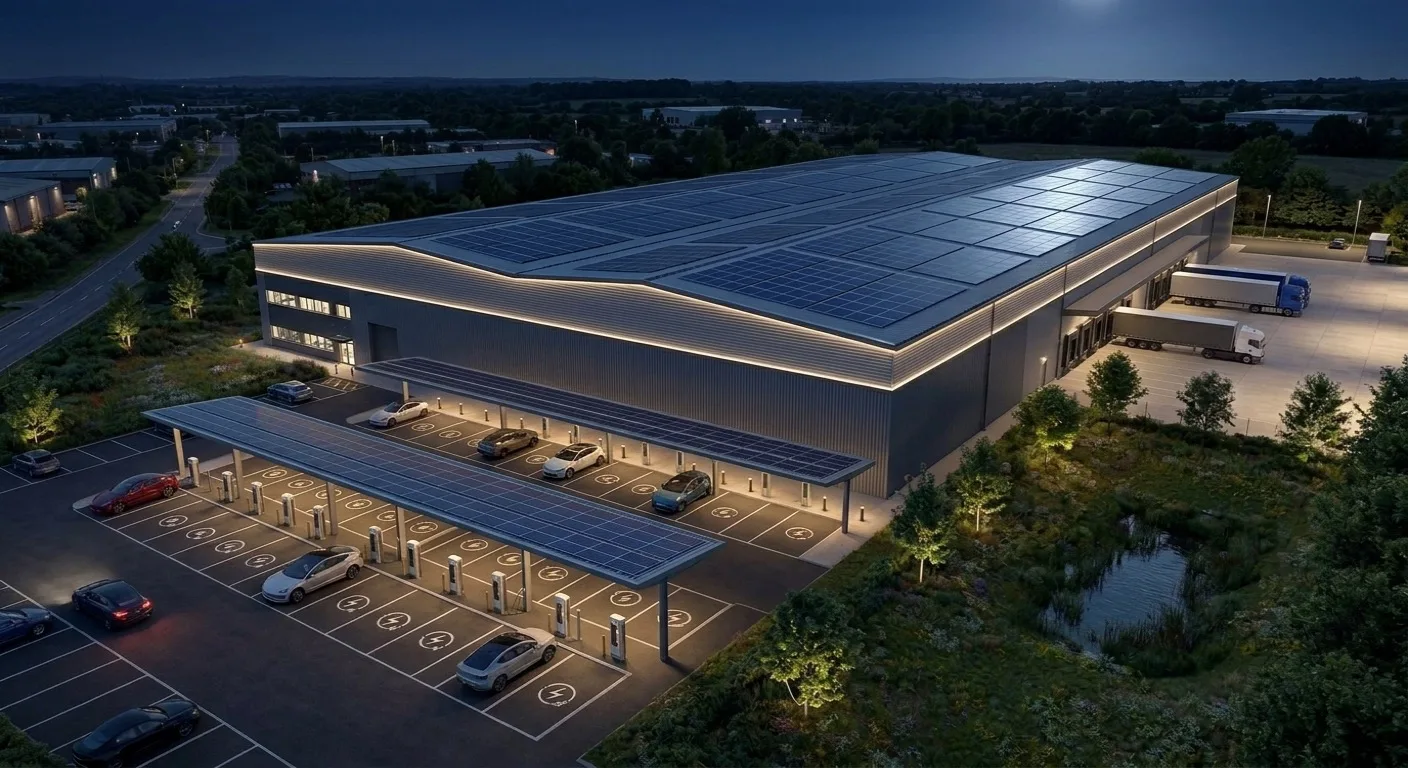
Night Aerial, 24-Hour Operational Credibility
Same georeferenced scheme at night. Perimeter LED lighting, illuminated EV charging canopies, controlled yard floodlights, and reception interior glow confirm that the net zero scheme reads as an operational 24-hour asset rather than a daytime marketing render.
The EV charging canopies, yard floodlights, and reception lighting in the render above read as auditable operational features, not as decorative night-lighting effects. The BREEAM Net Zero Addendum and the UKGBC Net Zero Carbon Buildings Framework both check operational lighting load at planning stage now, not at handover.
UK industrial portfolios run on Scope 1, 2, and 3 net zero commitments with operational lighting inside the audit boundary, which pulls the night-aerial frame forward to planning stage. The energy assessor and the investor sustainability committee read the same image.
Beyond the night-operation evidence shown above, a complete carbon evidence pack resolves four specific systems:
30-70%
on-site demand met
Annual operational demand met on site. Typical 30 to 50% from rooftop arrays, rising to 60 to 70% on schemes with battery storage.
40-60%
SCM concrete replacement
Material specification rendered visibly. SCM concrete at 40 to 60% replacement, steel reuse where specified, mass timber where the structural brief permits.
DISTRICT
network tie-in
District-network connections with heat exchangers, pipework runs, and tie-in points drawn at surveyed positions.
ROOF + FACADE
integrated renewables
PV arrays and BIPV facade panels positioned against the approved building envelope rather than added as visual decoration.
Three UK certification regimes set the evidence threshold for a net zero warehouse render set, and each regime reads a specific element of the carbon evidence pack. The UKGBC Net Zero Carbon Buildings Framework checks operational intensity at 8 to 12 kgCO₂e/m²/yr post-occupancy, and the PV offset stat plus the night-aerial view carry that evidence.
The RIBA 2030 Climate Challenge checks embodied carbon transparency, and the material-specification view (SCM concrete at 40 to 60% replacement, mass timber where the brief permits) supplies it. The BREEAM Net Zero Addendum checks carbon intensity at practical completion and operational phase, and the full render set is the document the BREEAM assessor reads. Three frameworks, one coordinated view set.
StratumCGI develops each warehouse and logistics CGI package from architect's drawings, structural GA, site plans, and operational layouts. The approved geometry then carries planning scrutiny and commercial promotion without splitting into two separate model builds.
StratumCGI ships each package with planning stills, marketing hero images, aerial estate views, street-level perspectives, and cropped assets sized for brochures and investor decks. Cladding specification, service-yard geometry, and site context stay consistent across every file because every output renders from the same source geometry.
The discovery brief locks camera positions, priority viewpoints, operational features, and approval dates before production starts. Locking those dates upfront keeps the visual package aligned with planning submission programmes, pre-let launch windows, and internal investment reviews on UK logistics developments where the leasing window is short. Clients then route the same approved geometry through StratumCGI's five-stage production process without rebuilding the proposal for each audience. Committee-facing stills from that geometry are planning CGI for warehouse and logistics developments when the pack must show massing, access, and yard layout to the authority.
Planning-grade warehouse CGI is built from specific consultant inputs, not visual approximation: architect's drawings, structural GA, site levels, and agreed viewpoints. Planners can then compare the resulting render directly against the planning pack, the transport assessment, and the landscape strategy without having to translate between different visual conventions. For camera-matched viewpoint packs, see verified views for logistics planning applications.
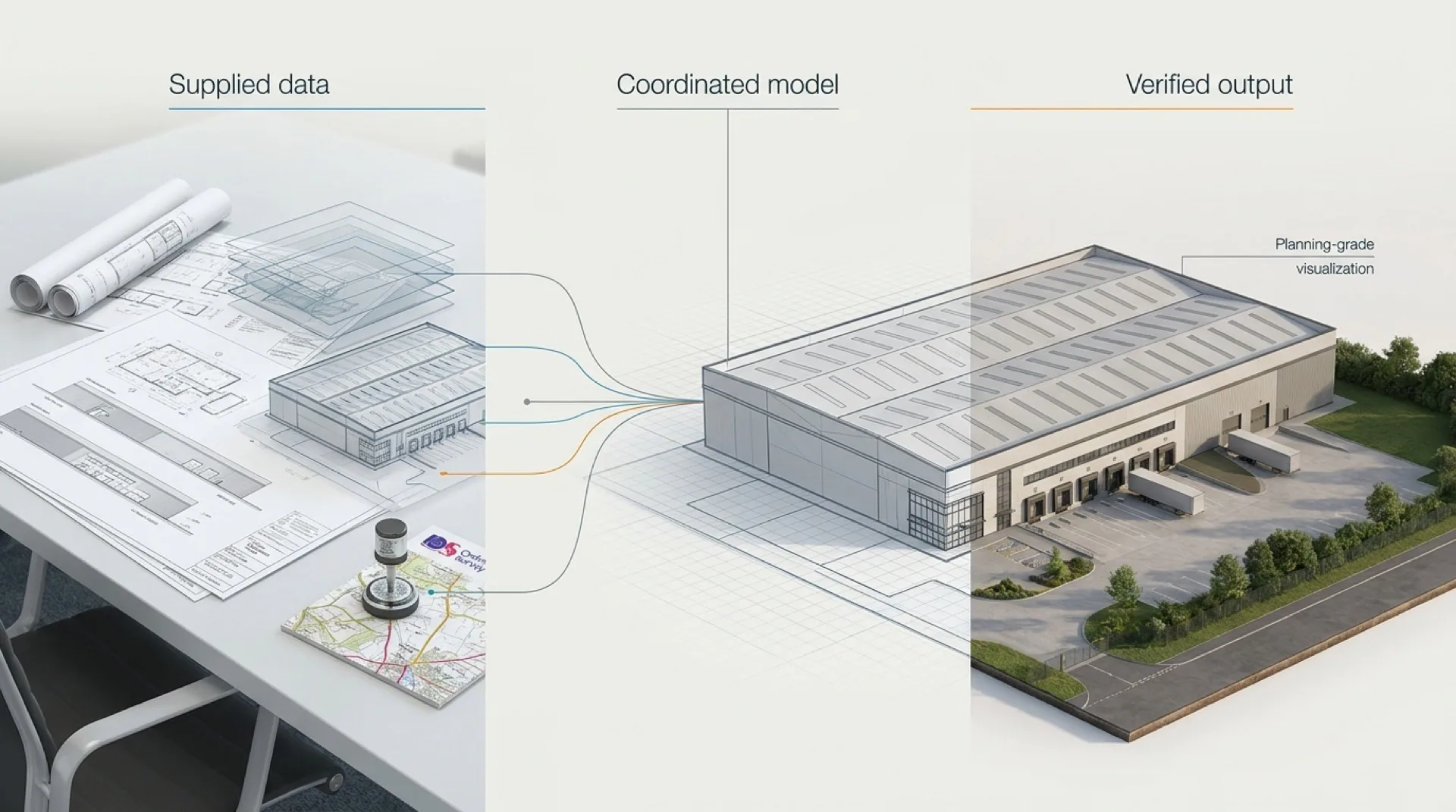
The consultant drawings, BIM geometry, OS mapping, and verified site photography listed above are folded into the base model before final rendering starts. The warehouse envelope, yard datum, dock height, and screening strategy then stay aligned with the material the planning authority and the consultant team are already working from, so the render reads as agreed evidence rather than as a separate creative artefact.
Warehouse CGI now needs to show more than cladding and dock count. Developers, investors, and planning teams often need the imagery to make BREEAM ambition, EPC A intent, PV roof arrays, EV charging, SUDS features, biodiversity net gain areas, and landscape buffers legible in the same frame.
When those features are handled properly, the render explains how sustainability measures sit within the operational logic of the development rather than reading as decorative extras. The warehouse CGI can then carry planning review, investor review, and pre-let messaging in one coordinated image set without splitting the scheme into disconnected visual stories.
The grid below isolates the four building components that matter most under planning and pre-let scrutiny. The first frame shows the roof PV array with monocrystalline panel pitch, ten-degree tilt, and walkway gaps every fourth row. The second resolves the polycarbonate dome skylights along their roof grid and the daylight they push through the cladding line. The third reads the cladding rib profile in close-up with joint detail and fastener line. The fourth frames the entrance architrave with the corporate signage panel sitting at agreed dimensions over the glazed entrance doors. Kingspan QuadCore, Tata Steel Trisobuild, and Eurobond Rockspan profiles are each held as separate models so the spec on the drawing matches the spec on the render.
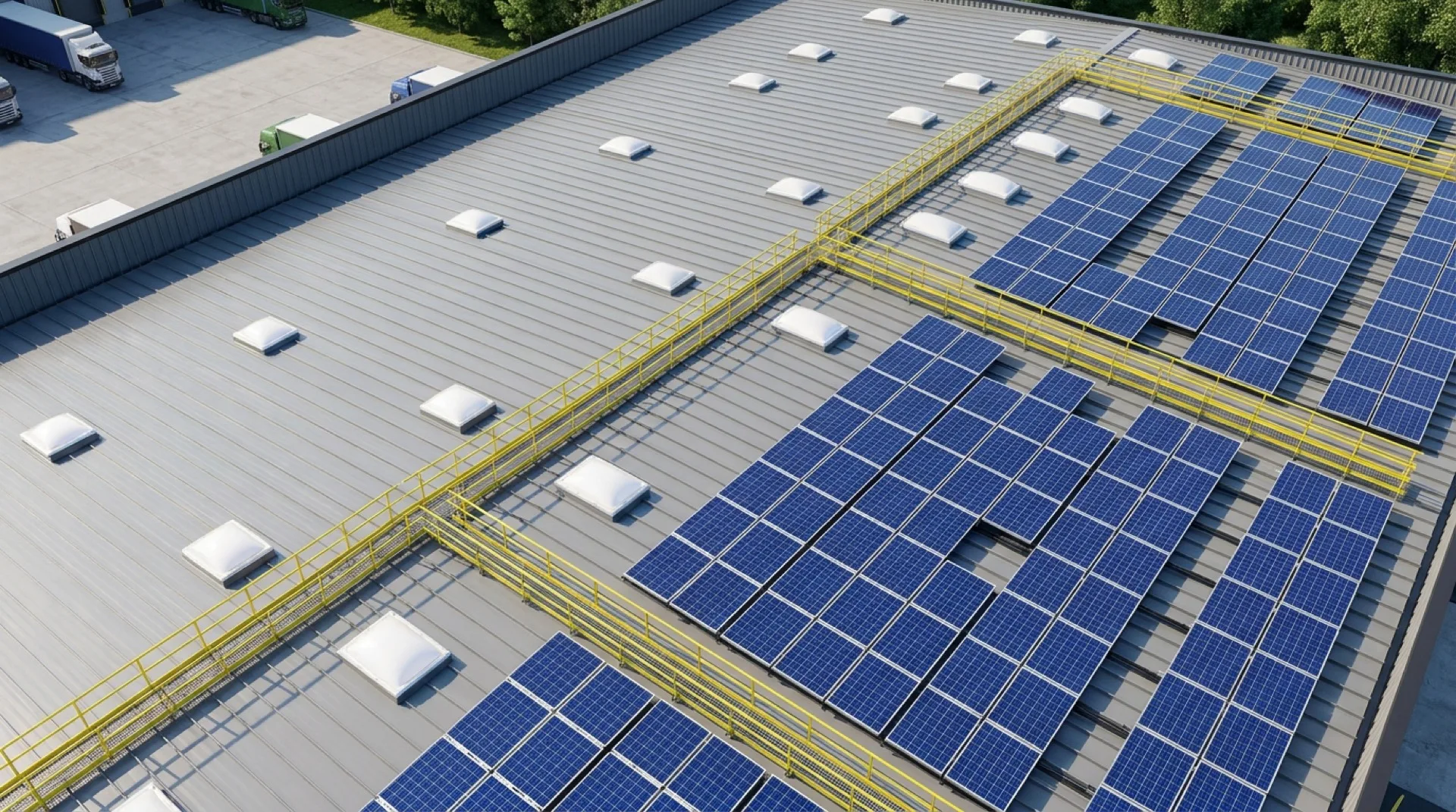
PV Array
Panel pitch, tilt, and walkway clearance modelled to M&E spec.
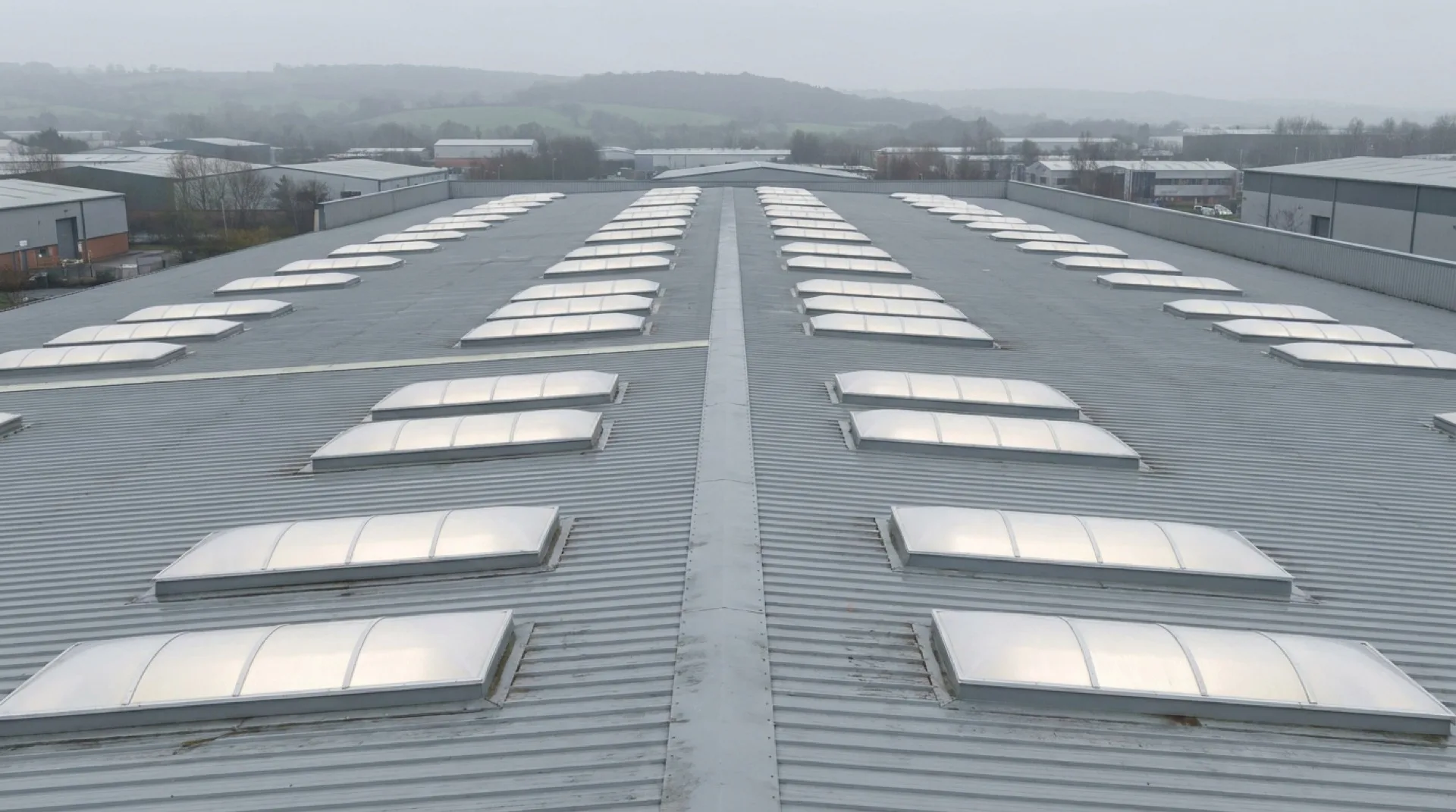
Skylights
Rhythm and size match the roof plan; daylight modelled at UK latitude.
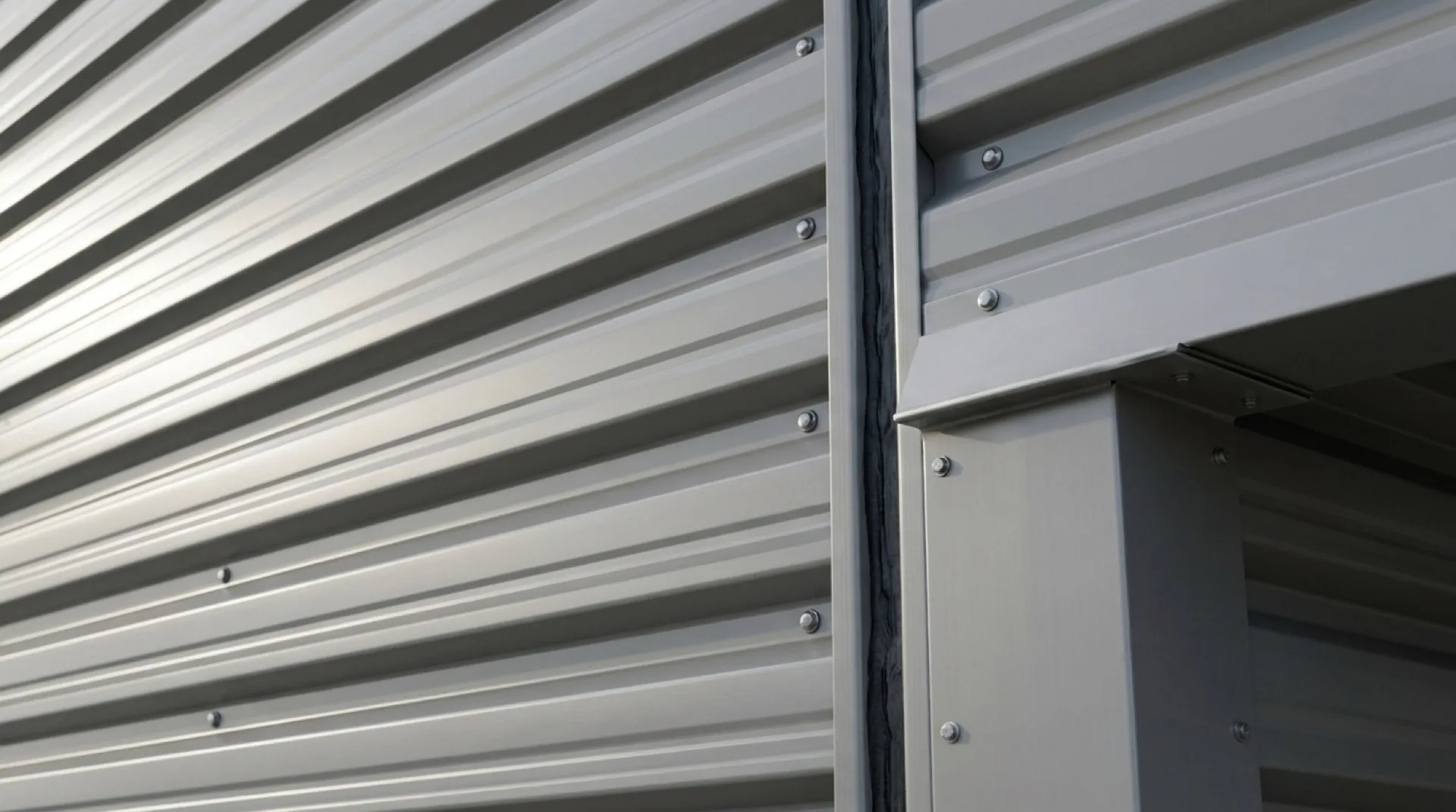
Cladding Profile
Kingspan, Tata, and Eurobond profiles drawn from manufacturer sheets.
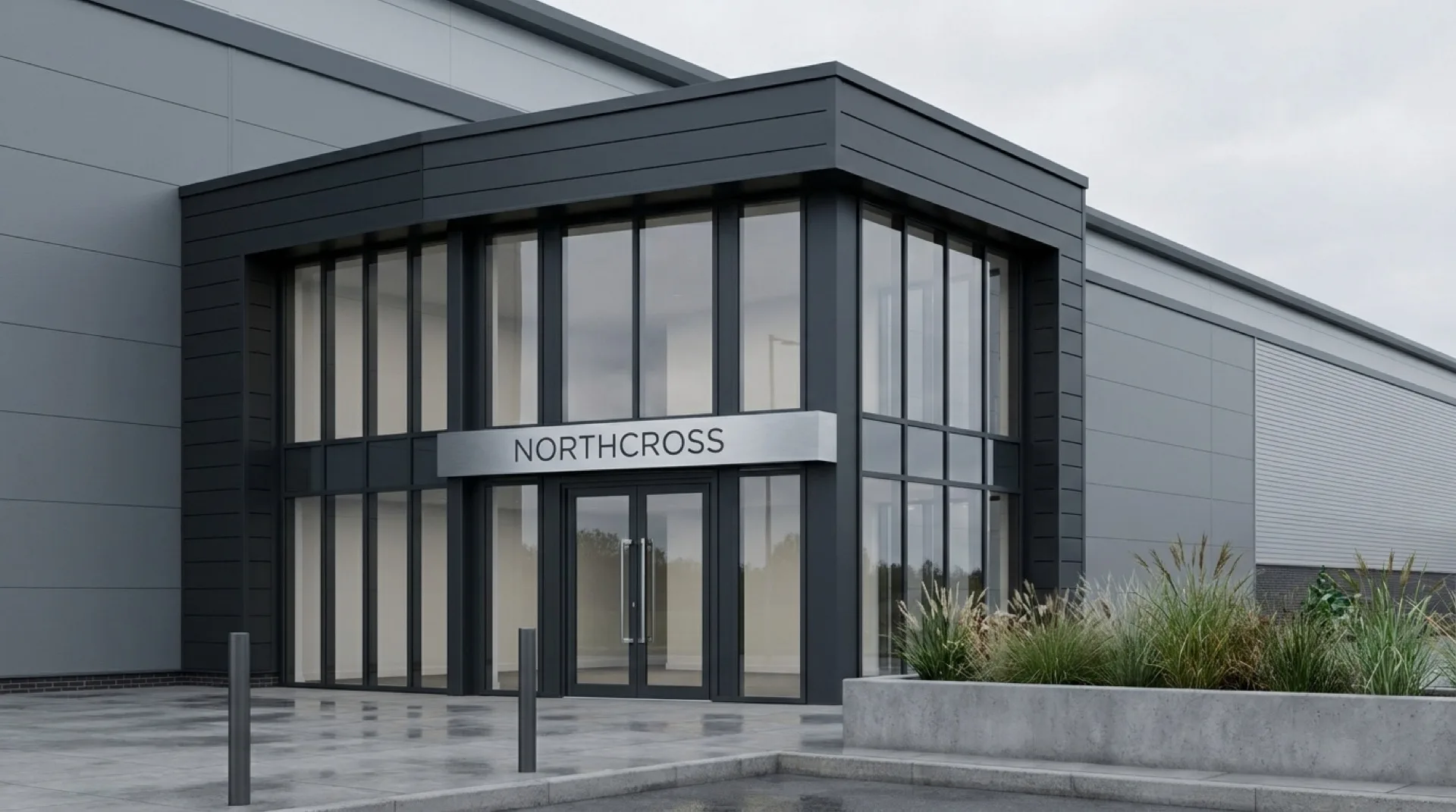
Signage and Architrave
Door colour and fascia branding matched to brand or house spec.
Every element in those four frames is geometry. The PV panels, the skylight domes, the cladding profile, and the entrance signage are all 3D-modelled objects placed from the supplied drawings, not Photoshop overlays composited onto a base render. What a planner or a prospective occupier reads on screen is what the contractor builds on site.
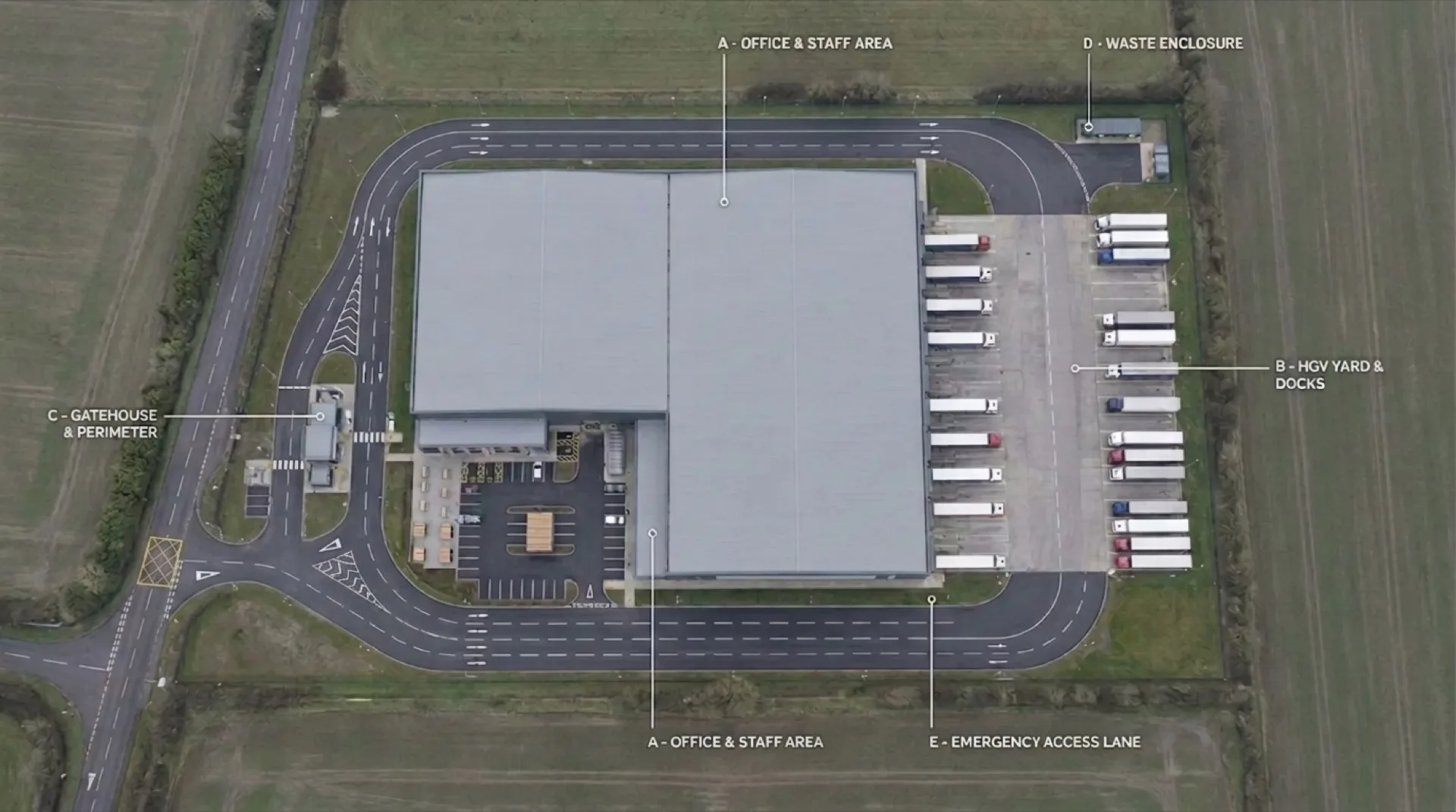
The annotated aerial above carries the planning committee checklist. Thin white callouts mark every element a planning committee will look for: the one-way HGV circulation loop with its swept-path overlay, the dock face with trailers backed in at right angles, the perimeter fence and gatehouse, the covered cycle shelter on the staff side, the picnic area, the EV bays separated from HGV traffic, the waste enclosure, and the emergency vehicle route running parallel to the main loop. A non-technical reader can navigate the whole scheme in seconds.
The two ground-level frames below pull the aerial down to human scale. The cycle and amenity image resolves the covered racks, the timber picnic tables on paving, the ornamental grass planting, and the staff entrance behind. The EV charging image shows the twin-head units, the painted accessible bay with wheelchair symbol, the bollard protection, and the bay numbering. Both follow BS 8300 guidance for accessible parking layout.
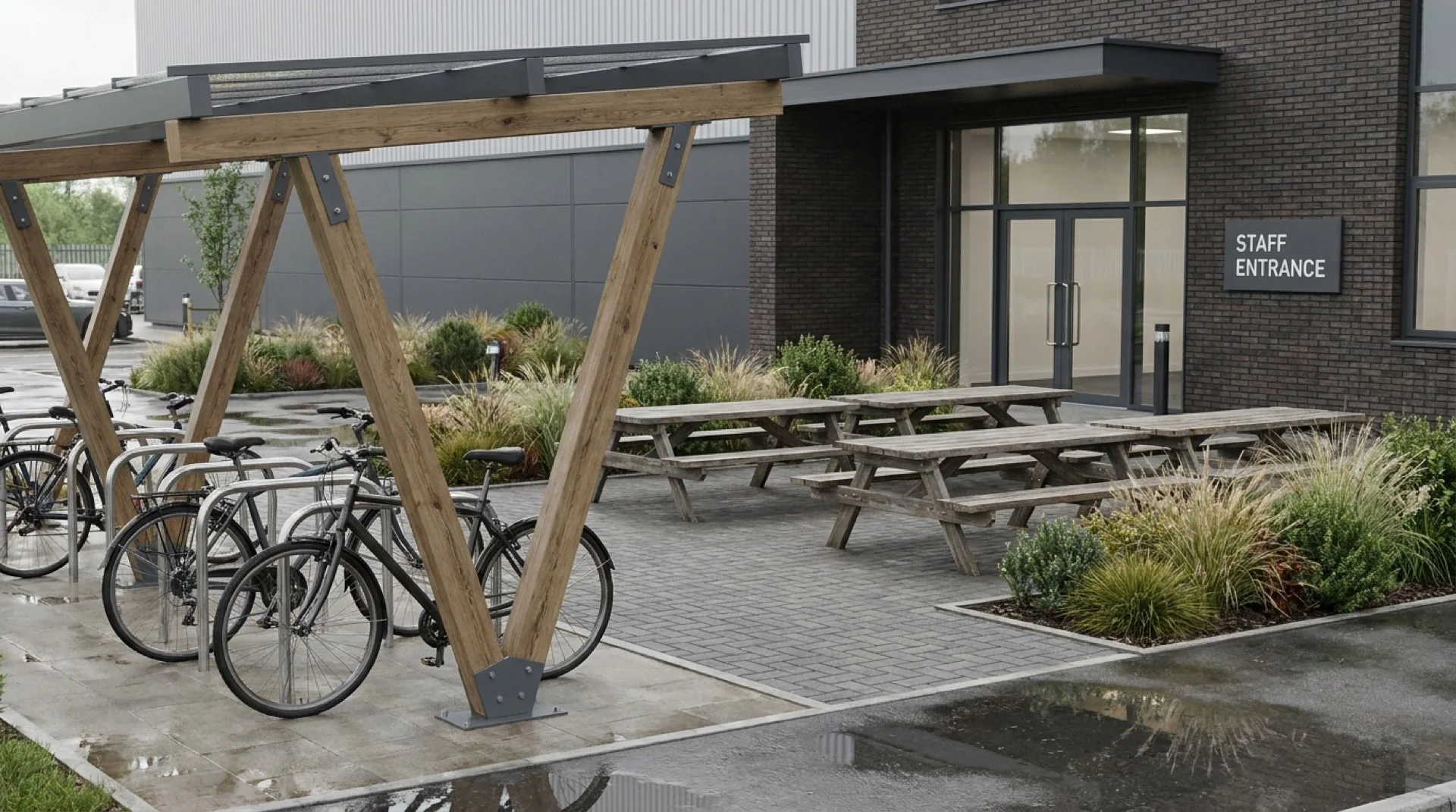
Cycle and Amenity
Covered racks, tables, and planting compose the staff entrance approach.
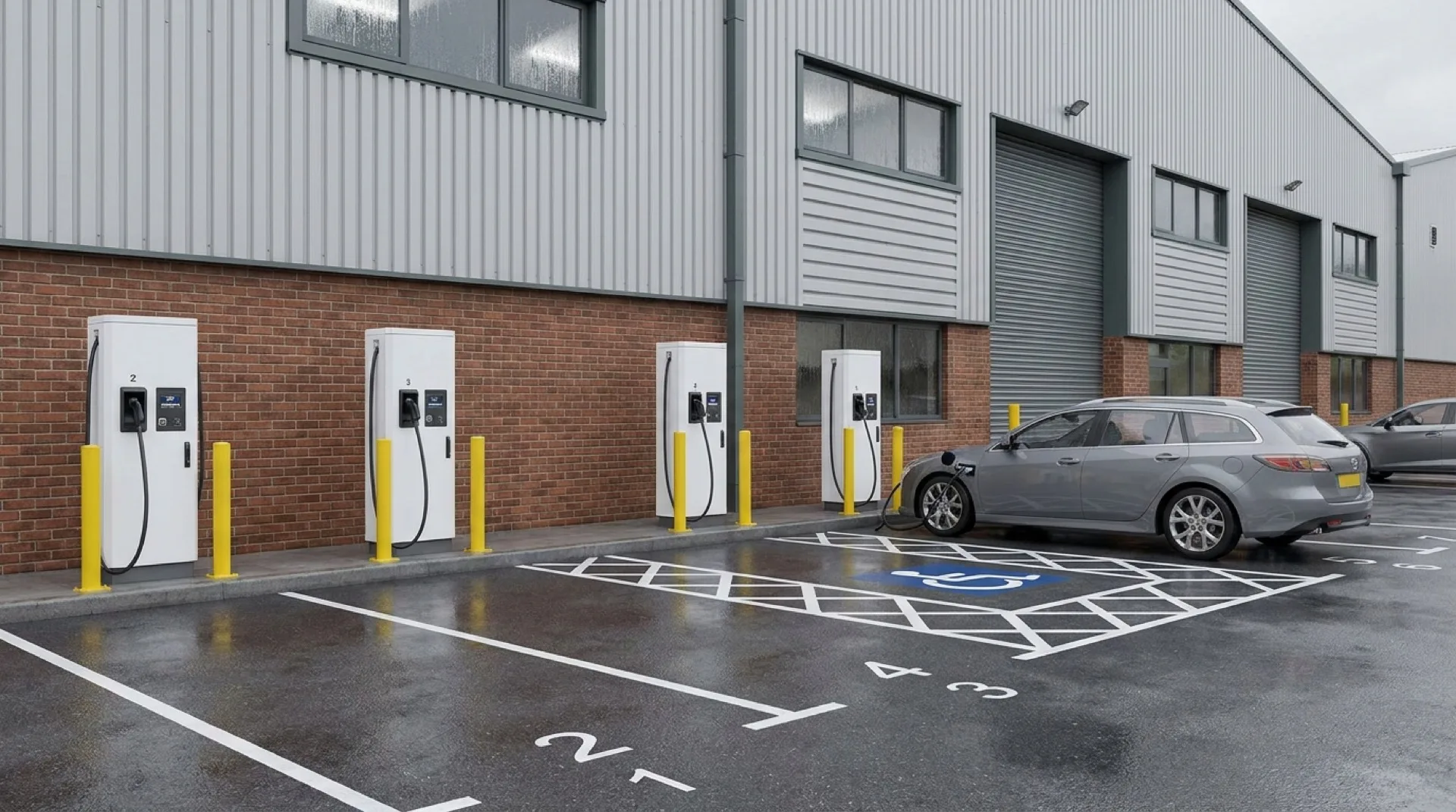
EV Charging
Accessible bay layout consistent with BS 8300 guidance.
Every bollard, charger, picnic bench, and tree pit visible across these three images is a 3D-modelled object placed at its surveyed coordinate. None of it is composited from a stock photo library. Hardscape and softscape both follow the consent drawings, which means the visual that wins planning is the visual that gets built on site.
A high-performing logistics image does not begin as a picturesque rendering. The process starts by checking the raw architectural and civil engineering data before any finish, lighting, or atmosphere is added. StratumCGI ingests the structural GA drawings, site levels, and turning circles directly from the consultant team, then blocks out the massing to ensure the approved geometry is correct.
Only once StratumCGI has checked the volume, roof pitch, dock datum, and yard topography against the planning pack does the visual refinement begin. At that stage, the approved model receives its specified cladding, lighting setup, and site context. Cladding specifications are matched to exact RAL codes, light mapping is calculated to show the building scale clearly, and context photography is integrated into the verified view set.
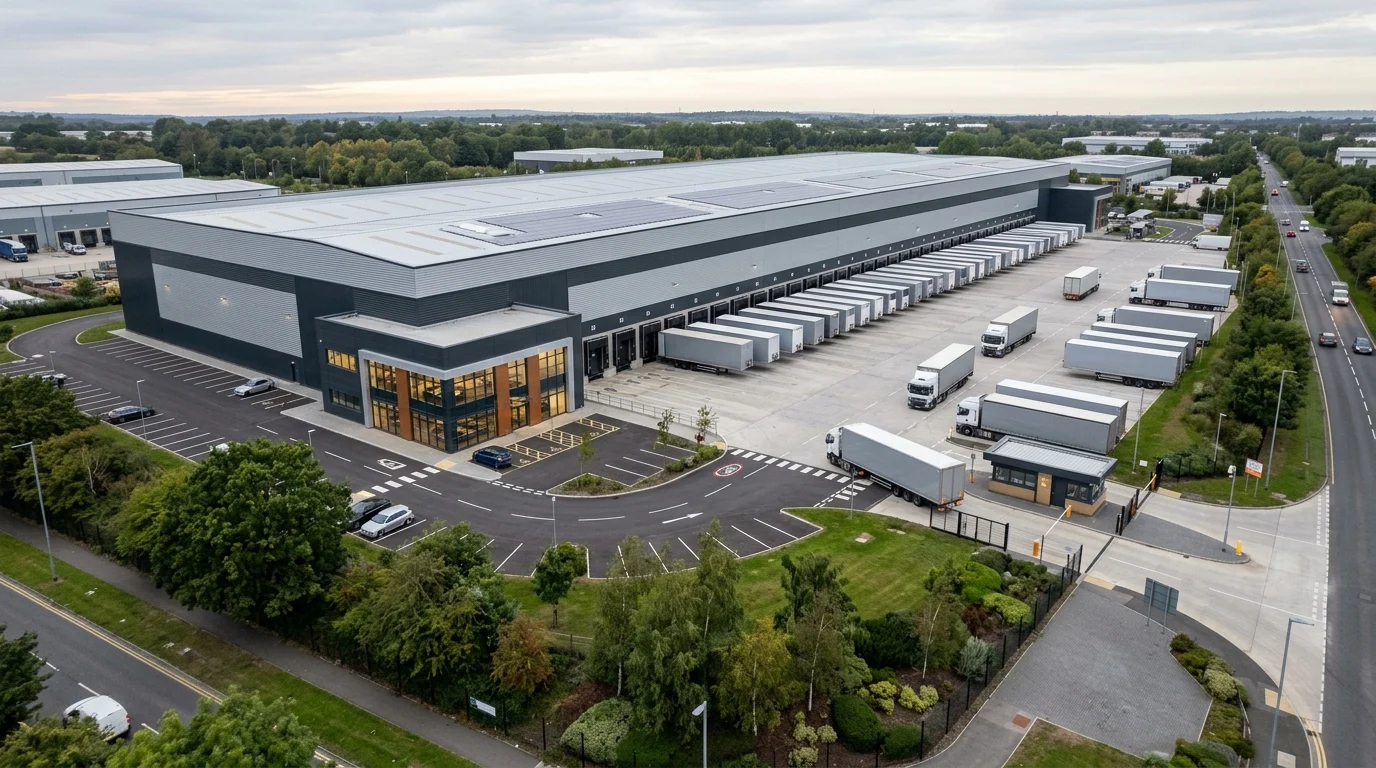
Render Validated
A-GRADE MARKETING
Final Hero Composition
The completed asset merges absolute precision geometry with atmospheric design. Lighting, material displacement, and context scale are locked to the approved consultant plans prior to the final 4K render pass.
Planning submission
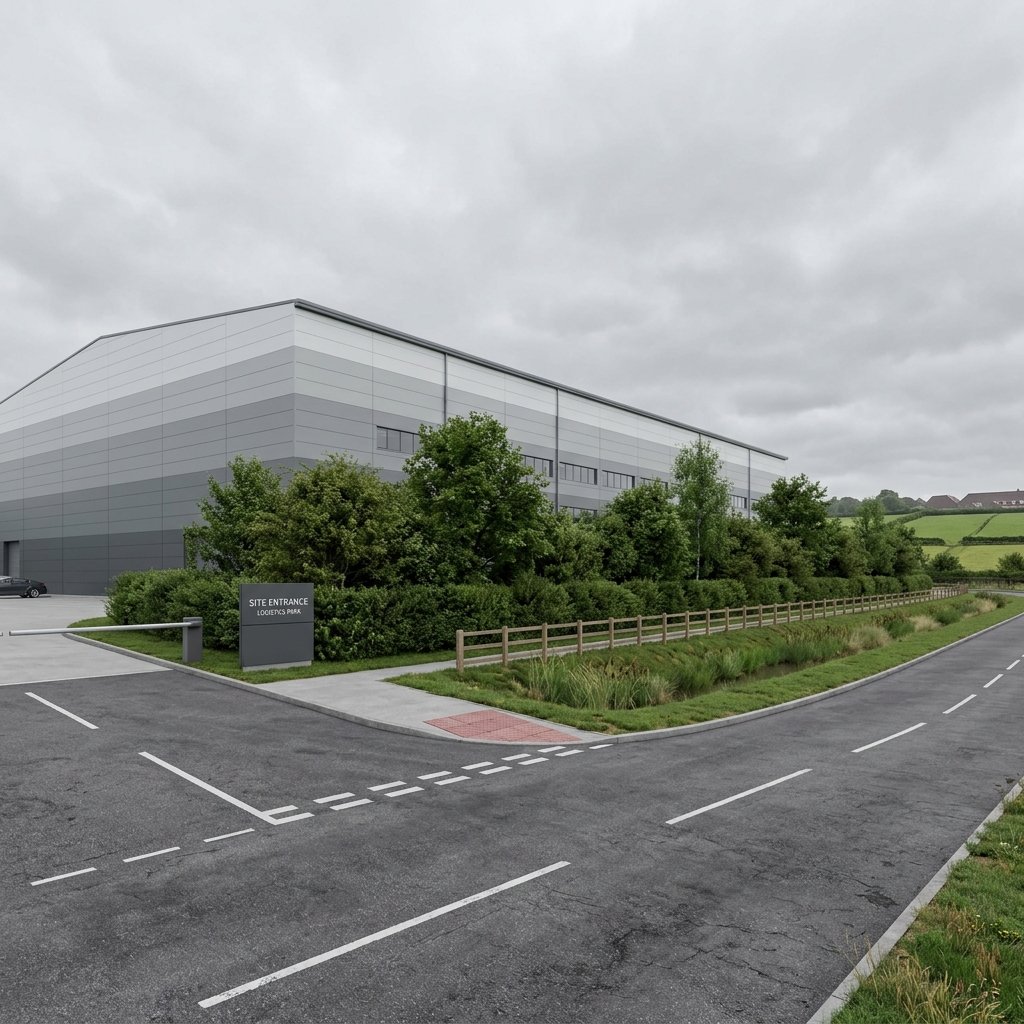
Render Class
PLANNING GRADE
Pre-let marketing
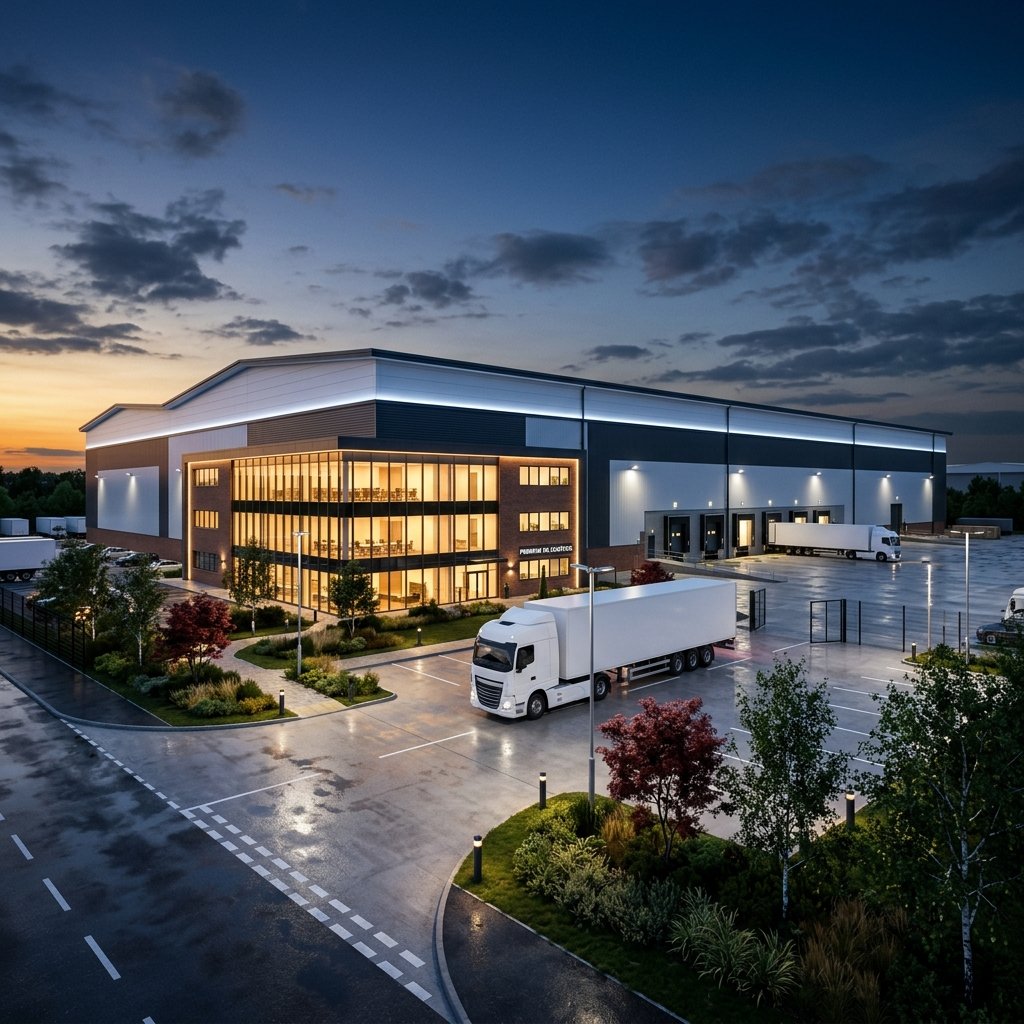
Render Class
A-GRADE MARKETING
Investor review
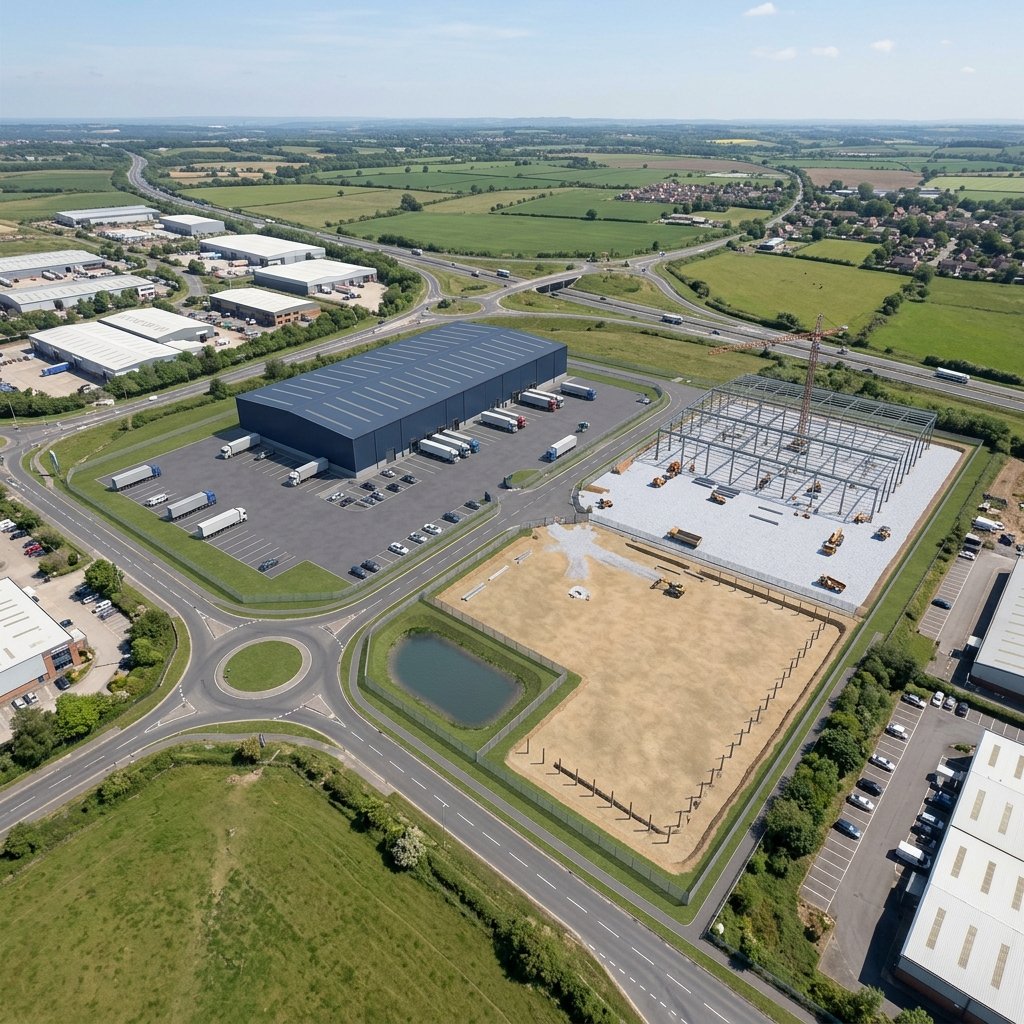
Asset Class
INVESTMENT GRADE
Speculative logistics unit
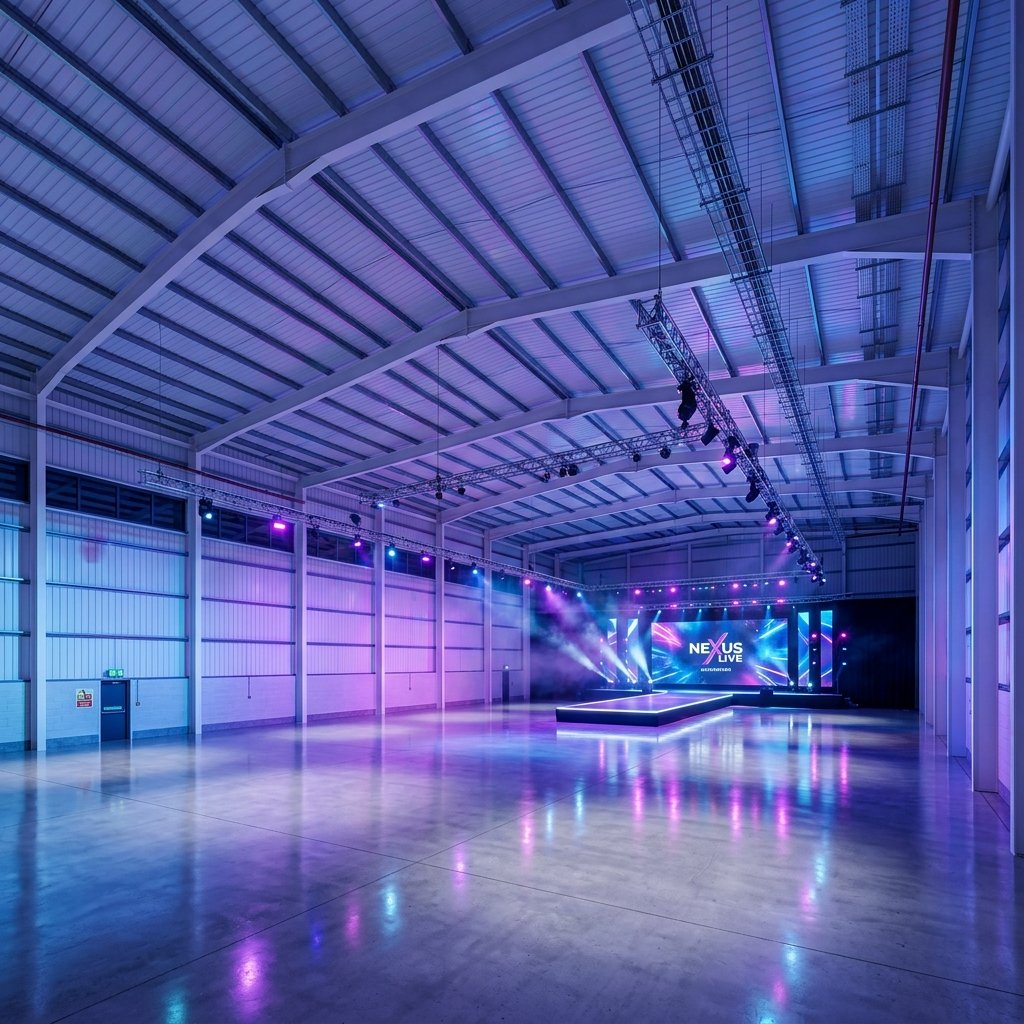
Use Class
VENUE / B8-FLEX
Spec-Build Venue Conversion
This variant tests how a completed speculative shell could be presented for temporary alternative use. The architectural envelope stays fixed while lighting and staging illustrate a different commercial read for interim leasing discussion.
Air cargo or specialist freight

Facility Class
AIRSIDE LOGISTICS
Once the brief moves beyond frontage and yard layout, warehouse interior capacity CGI tests what an approved logistics shell can hold. The approved model can test clear internal height, racking density, VNA aisle logic, mezzanine fit-out, ASRS zones, and van-sortation fit without changing the external planning facts.
Those images move from developer to leasing team, from leasing team to occupier, and from asset team to investor deck because they answer different versions of the same question: how much operational capacity does this shell offer, and how flexibly can that capacity be reconfigured for another occupier profile.
A warehouse interior view starts with measurable fit-out constraints: pallet count, clear haunch height, aisle module, beam level, and sprinkler clearance. Each interior view places dock-door relationship and FLT or turret-truck movement in correct spatial context. Racking, VNA, automation, and mezzanine fit-out options then read as different operating systems, not furniture swaps.
Scroll to compare →
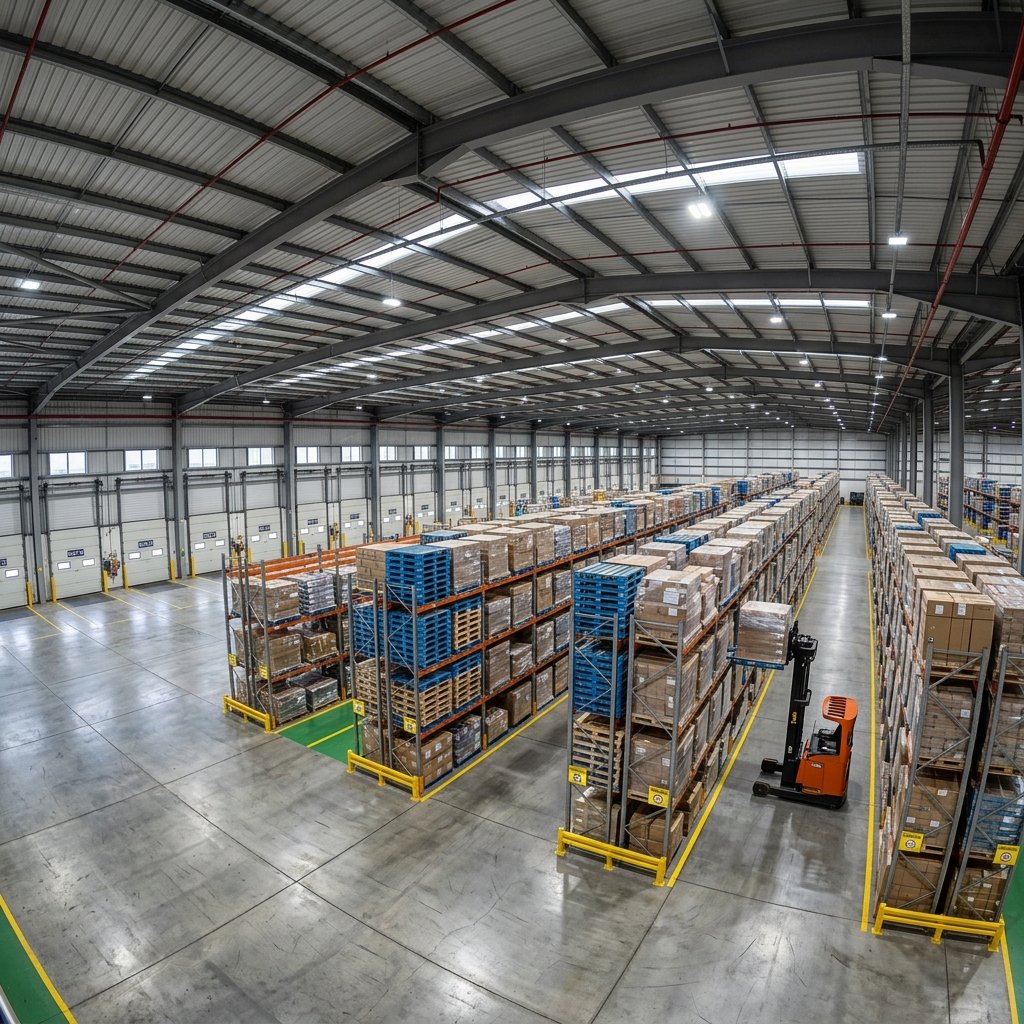
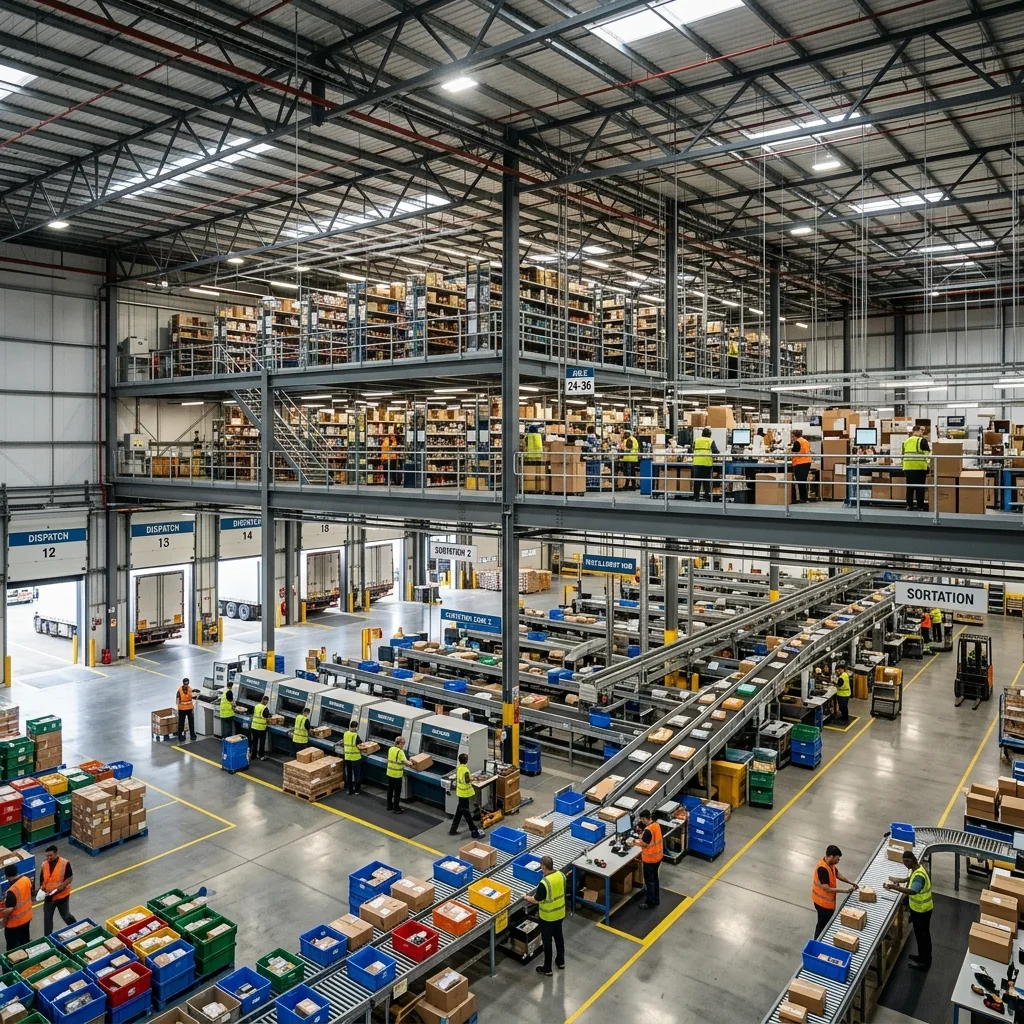
This version shows a standard 3PL storage layout with 3.0 metre aisles, five-level selective pallet racking, and reach-truck access. It proves basic pallet-distribution capacity in the same shell.
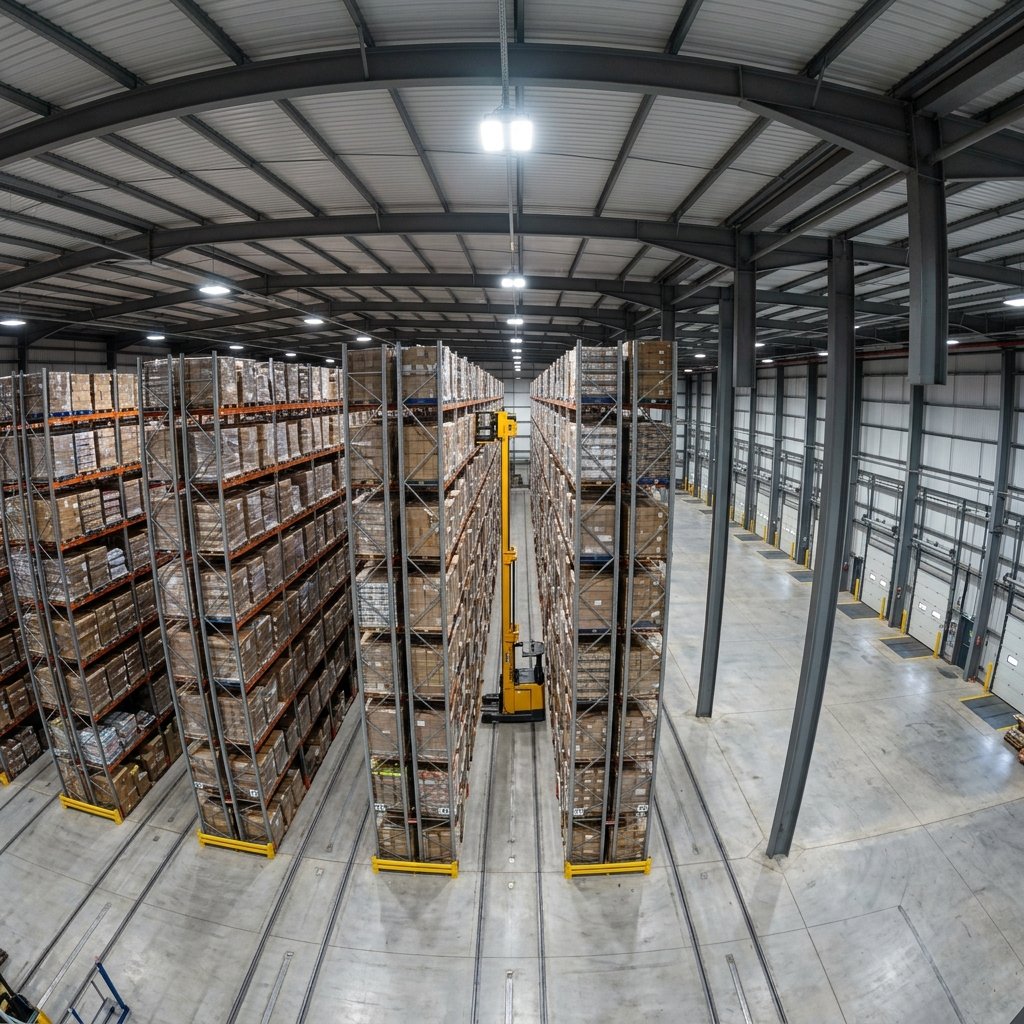
This version turns the same shell into a higher-density VNA layout with 1.6 metre aisles, guided turret-truck operation, and racking rising to the haunch. It shows how one building can deliver materially more pallet positions without changing the envelope.
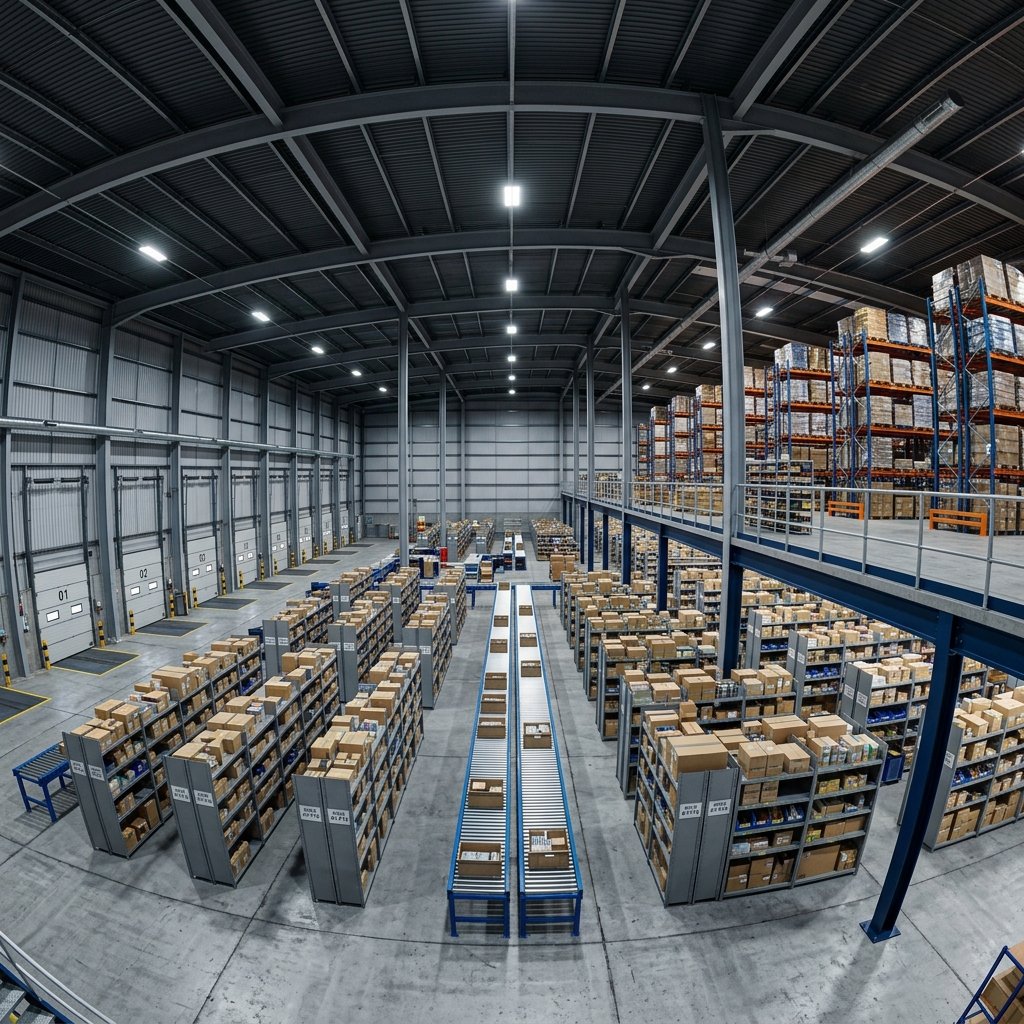
This version converts the shell into an e-commerce fulfilment layout with a 6 metre mezzanine, pick-face shelving on both levels, and conveyor sortation feeding the dock zone. It proves that the same building can support pick-and-pack operation as well as bulk storage.
The hero image below populates the same 12-metre-clear shell with deliberate scale references so the volume reads as workable cubic space rather than as an abstract spec-sheet figure.
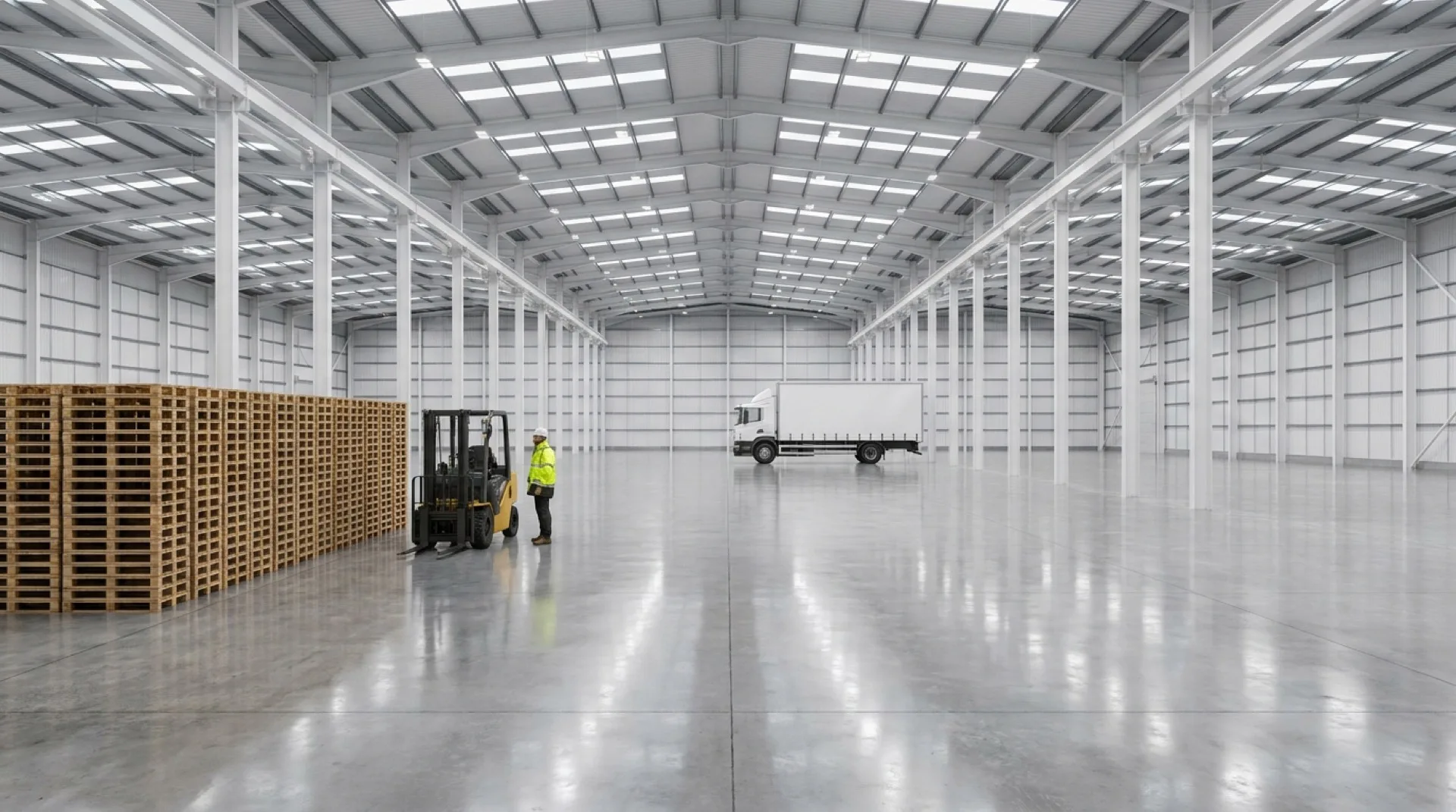
Volume legibility
Truck, pallet stack, forklift, and person silhouette set vehicle envelope, racking depth, working clearance, and human reference inside the same frame.
StratumCGI places deliberate scale references inside every interior render. An 18-tonne rigid truck on the dock floor fixes the vehicle envelope; a full 1.4-metre pallet stack calibrates racking depth. Working clearance comes from a counterbalance forklift at typical lift height, and human reference from a person silhouette at 1.75 metres. A mezzanine column or a structural haunch anchors the column grid.
Alternative occupier layouts can be tested inside the approved shell, including hybrid warehouse/manufacturing use, specialist production zones, clean-room insertion, and higher-intensity fulfilment fit-out. The comparison stays useful because the envelope, access logic, servicing route, and yard arrangement remain fixed while the interior operating read changes.
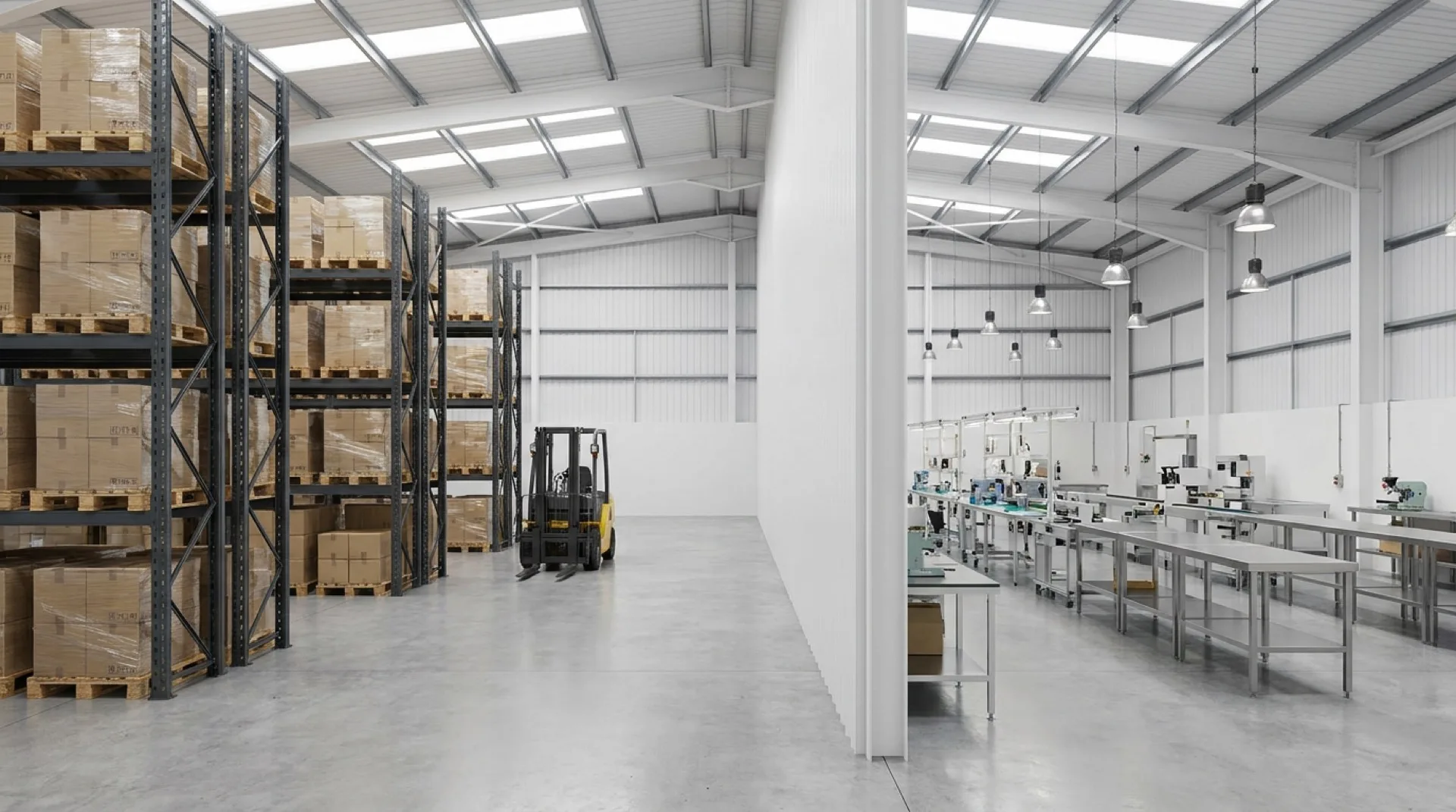
Mixed-Use Adaptability
Racking, light manufacturing, specialist production, and clean-room configurations from one shell model.
Both images use the approved shell model. A leasing agent can walk a prospect from the empty scale-reference view into a racked-and-manufacturing variant without commissioning a fresh 3D build, which makes occupier conversations faster and cheaper than the usual one-render-per-narrative workflow.
StratumCGI renders the same camera-matched logistics shell for three occupier positions: standard pallet distribution, automation-led storage, and higher-intensity fulfilment fit-out. Each version changes the operational read while keeping the approved envelope and servicing logic fixed.
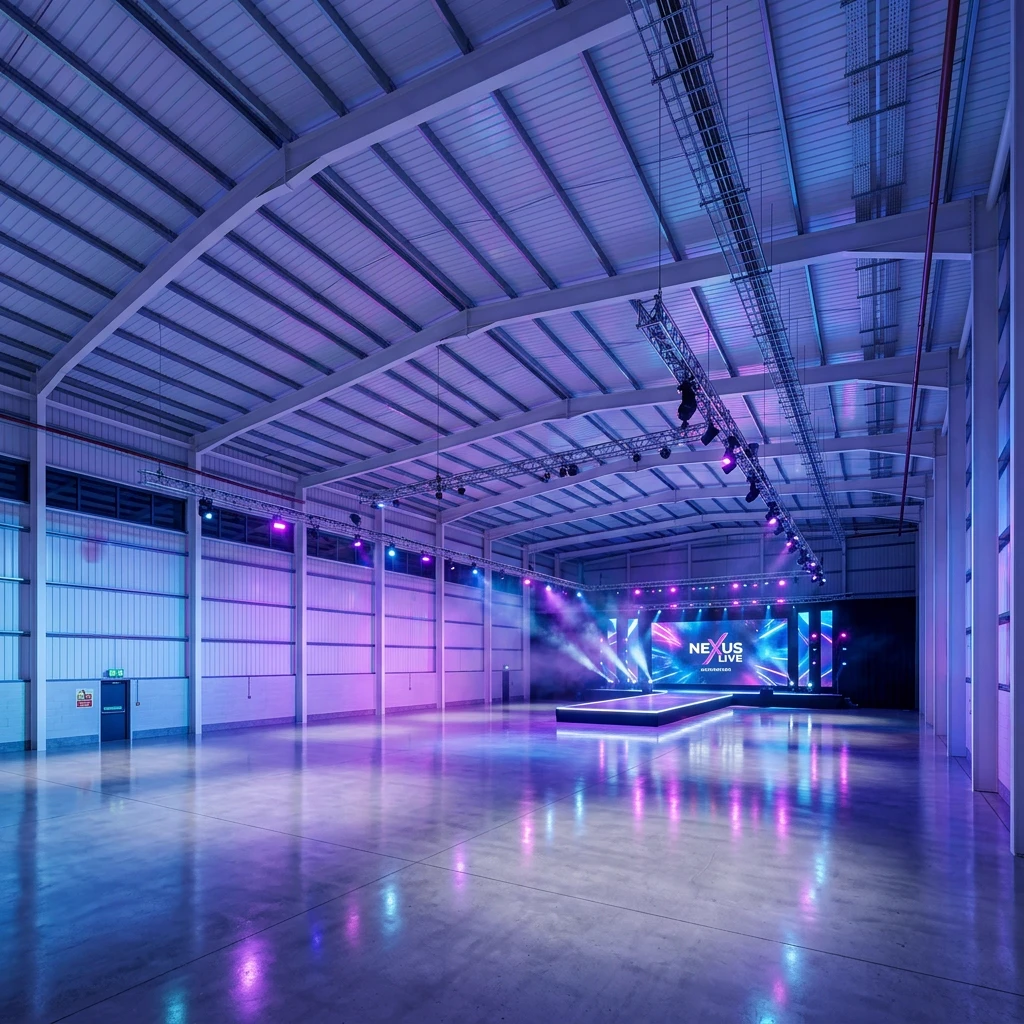
The envelope, access logic, and external planning facts stay fixed. Interior fit-out, occupancy cues, lighting treatment, and marketing emphasis shift per audience. Developers and agents test alternate uses on one approved shell without commissioning a new model each time.
Warehouse and logistics CGI is judged on planning scrutiny, occupier evaluation, and whether one model serves more than one audience. The director commentary below sets out that review logic behind the visuals.
Commercial and definitional gaps come first for most first-time warehouse and logistics clients, who need them answered before briefing the visuals.
Warehouse and logistics CGI is photorealistic architectural visualisation for distribution centres, fulfilment hubs, cold stores, depots, and freight facilities. It is used to show how the scheme looks and how it operates, including yard depth, dock positions, circulation, screening, and site access, before the building is constructed.
In construction, CGI stands for computer-generated imagery. On a warehouse project, that usually means a 3D model and rendered stills that turn site plans, elevations, and technical references into images for planning, leasing, investor review, or brochure use.
Warehouse exterior frames at StratumCGI start from £1,100 each. A six-frame planning and marketing package for a UK big-box warehouse typically runs £12,500 to £28,000, covering base modelling, material and lighting setup, the frames themselves, and post-production. Larger warehouse and logistics packages are quoted by view count, supplied information, context complexity, verification requirements, and whether the same model needs to serve planning, leasing, and investor outputs.
Warehouse CGI is judged more heavily on operational credibility than domestic mood or styling. The visuals need to communicate HGV circulation, dock rhythm, service-yard depth, office frontage, plant screening, and occupier flexibility, often across planning and commercial audiences at the same time.
Typical outputs include planning stills, verified or planning-grade viewpoints, marketing hero images, aerial estate views, cropped brochure assets, and investor-deck visuals. The deliverable mix depends on whether the same warehouse model needs to answer planning, leasing, or internal funding questions.
Logistics warehouse CGI includes accurate service-yard depth (typically 50 metres for 16.5 metre articulated vehicles), dock-leveller positions matched to the floor-to-ground height differential, HGV turning circles rendered from the transport assessment, dock-face rhythm matching the structural grid, and landscape screening from OS mapping. The detail scales up for cross-dock schemes where dual-yard activity has to read on both elevations.
Warehouse and logistics CGI reuses the same approved geometry when the warehouse envelope, yard layout, dock positions, and site constraints remain unchanged. Warehouse and logistics CGI needs a new model stage when the proposal geometry, servicing logic, or verified planning facts change.
Warehouse and logistics CGI keeps the approved warehouse envelope, yard structure, access pattern, dock positions, and landscape frame fixed between planning and pre-let marketing images. Camera position, lighting, staging, and crop change to suit the audience without changing the approved scheme.
A warehouse CGI model can support different logistics briefs when the approved envelope, site access, yard structure, and dock positions stay fixed. Planning views, leasing images, and occupier review frames can then be produced from the same source geometry, while the operational emphasis changes for distribution, fulfilment, cold storage, depot, or freight-led schemes.
Logistics warehouse CGI covers building massing, estate layout, HGV circulation, service-yard depth, dock-face geometry, cladding specification, and mapped landscape context. StratumCGI applies that production standard across distribution centres, fulfilment hubs, cold storage facilities, last-mile depots, and air cargo terminals.
Warehouse and logistics CGI in the UK costs between £12,500 and £28,000 for a typical six-frame planning and marketing package, with the range driven by modelling depth, AVR Type 3 verified view uplifts, drone survey requirements, and whether a consultation flythrough animation is included. A typical six-frame project covers four exteriors and two interiors.
4 exterior views: planning-neutral elevated aerial showing yard depth, dock rhythm, and estate context. Ground-level leasing hero showing office frontage, access, screening, and massing. Night-shift lighting variant of the aerial showing yard lighting and 24-hour operation. ESG frontage variant showing the rooftop PV array, EV charging canopies, and biodiversity buffer.
2 interior views: wide-aisle pallet racking layout proving standard 3PL capacity. Alternate-use fit-out on the same interior geometry, either a VNA high-density configuration proving maximum pallet positions or a mezzanine pick-and-pack layout proving e-commerce fulfilment fit.
Indicative mid-range total for 6 frames: An indicative mid-range six-frame package totals about £13,280 across four weeks. That anchor covers £3,400 for base modelling, £1,700 for material, lighting, and landscape setup, three full-rate frames at £1,700 to £1,800 each, three reuse variants at £680 to £720 each, and £900 for post-production with two revision rounds. A single planning photomontage frame is priced at £1,360 to £1,440, which sits 20% below the full-rate frame because the base model, viewpoint, and lighting setup are shared with the wider package. Extra crops for investor decks, portal resizes, and brochure layouts cost £150 to £350 per export. Major geometry changes trigger a re-quote from £900 upward against the revised scope.
StratumCGI's warehouse and logistics portfolio includes distribution centres, fulfilment hubs, cold storage facilities, last-mile depots, and air cargo terminals. Each case study documents the CGI scope, outputs delivered, and the specific communication challenges the visualisation addressed.
The grid below lists the logistics warehouse case studies StratumCGI has delivered across distribution, fulfilment, cold storage, last-mile, and air cargo briefs. For the broader proof set beyond this logistics cluster, the same portfolio index covers data centre and specialist industrial commissions.
Multi-unit distribution hub CGI showing estate layout, HGV circulation, and phased occupancy for a North West industrial belt location.
Warehouse CGI communicating facade quality, loading-bay rhythm, and yard layout for a West Midlands distribution scheme.
Compact urban logistics depot CGI addressing van circulation, frontage quality, and pedestrian separation on a constrained site.
Cold storage CGI showing insulated envelopes, plant screening, and service-yard discipline for a temperature-controlled logistics building.
Air cargo terminal CGI demonstrating airside and landside separation, apron geometry, and cargo handling infrastructure.
Big-box logistics park CGI for a UK Golden Triangle location, showing aerial masterplan layout, service-yard discipline, unit flexibility, and estate infrastructure.
Related service: StratumCGI industrial property marketing packages for warehouse and logistics schemes include Planning Pack, Pre-Let Campaign, and Occupier Programme tiers.
Where a scheme sits below the B8 logistics band as Use Class E(g)(iii) or B2 floorspace, light industrial unit CGI covers multi-let estates and trade-counter terraces rather than big-box warehouses.
Request a Quote