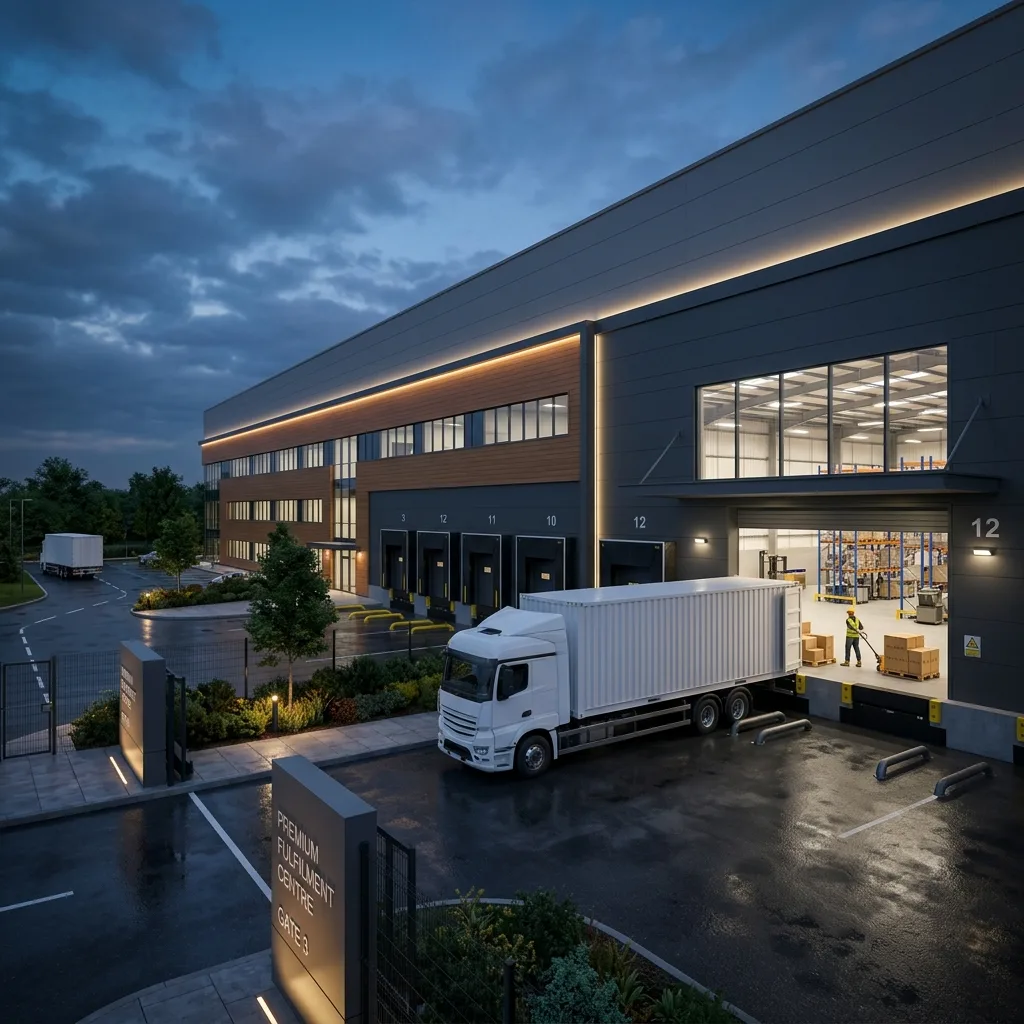
West Midlands Distribution Warehouse CGI
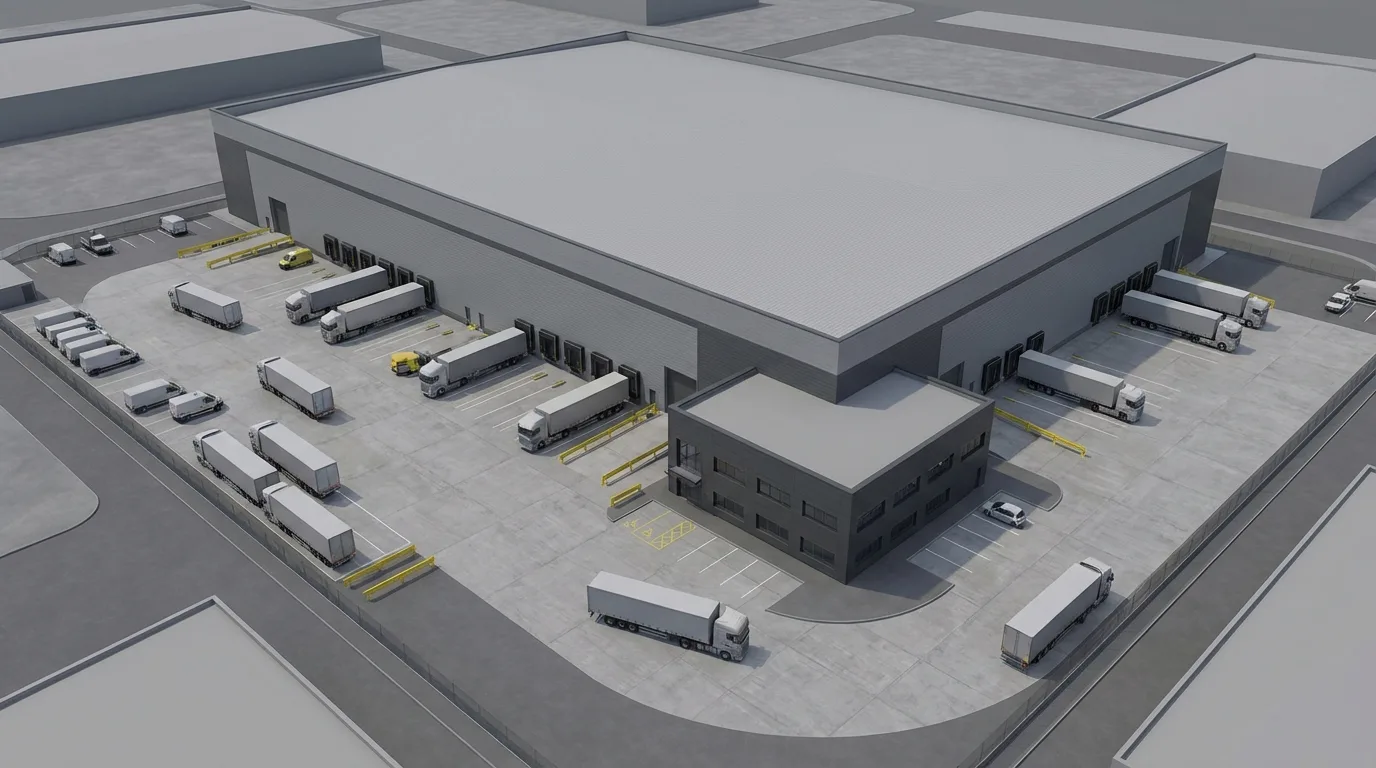
Warehouse-led CGI showing dock-face rhythm, office frontage, and yard discipline, useful as a close operational reference for fulfilment-centre proof work.
Fulfilment Centre CGI
Fulfilment centre architectural visualisation by StratumCGI covers UK schemes for parcel sortation buildings, mezzanine pick-pack layouts, van staging yards, and two-sided dispatch operations.
A fulfilment centre 3D model produces still-image packs in 1 to 4 weeks, typically 1 to 3, and the same approved shell building supports standard fulfilment, cross-dock, and van-heavy e-commerce views without changing the planning geometry.
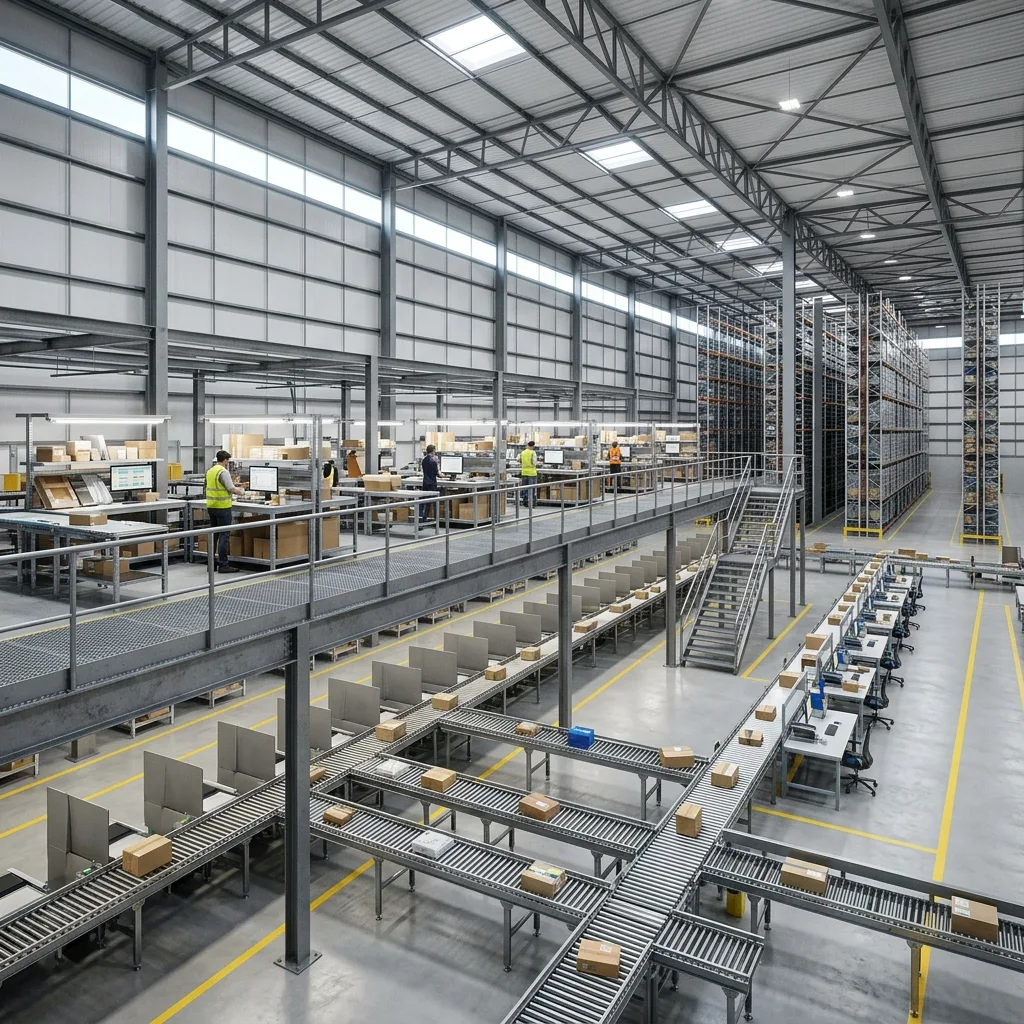
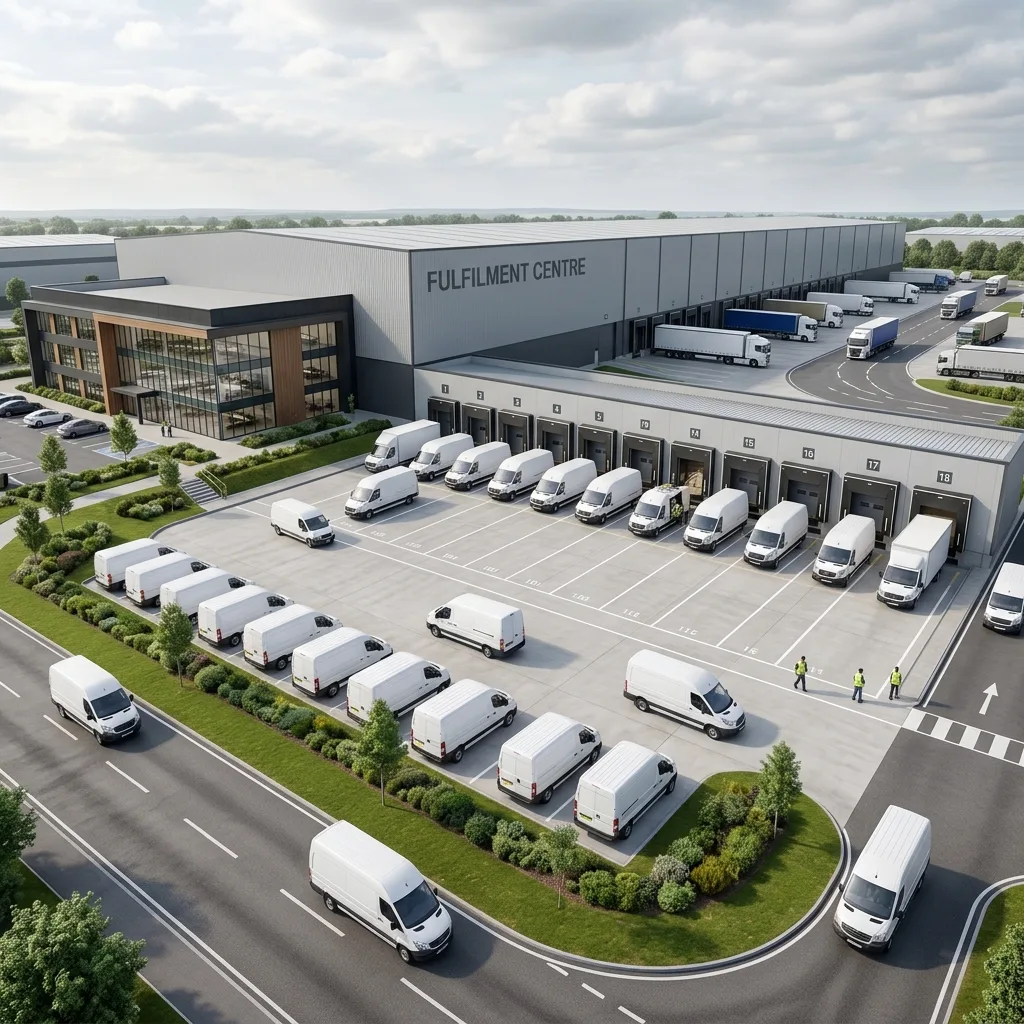
The image set covers four operational attributes: dock-face density, HGV circulation, van staging, and internal processing logic. Each is resolved to planning, pre-let, and occupier sign-off standards from the same approved 3D model.
A fulfilment centre brief resolves four operational attributes in the frame: sortation lines, van staging, mezzanine pick-pack activity, and two-sided dispatch. These sit alongside the shell and office frontage that a generic warehouse render shows on its own. The difference is what makes the scheme legible as a fulfilment asset to planning, pre-let, and occupier reviewers.
Proving processing capacity inside the developer shell.
Fulfilment centre CGI prioritises parcel throughput, internal processing logic, and dispatch-readiness over broad pallet storage and generic yard depth. It sits inside StratumCGI's warehouse and logistics CGI service as a dispatch-led specialism.
One approved 3D model renders three operating states from the same locked geometry: standard fulfilment, cross-dock throughput, and van-heavy e-commerce dispatch. The difference between them sits in the yards, dock faces, and vehicle mix, not in the building.
The indicative five-frame fulfilment package below totals £14,120, built from one coordinated 3D model. That sits inside the warehouse and logistics CGI pricing range of £12,500 to £28,000, weighted upwards by the mezzanine pick-pack modelling, sortation cues, and dual-yard staging the fulfilment brief adds to a standard distribution render.
Share the building size, dispatch model, mezzanine requirements, and whether the imagery is for planning, pre-let marketing, occupier review, or a combined proof pack. StratumCGI reviews each fulfilment-centre brief before confirming scope and price.
StratumCGI reviews fulfilment-centre briefs around throughput proof, dispatch logic, and planning-readiness first. Contact the studio directly if drawings are already issued or the image pack has to support more than one audience.
A fulfilment centre brief covers three operational attributes a planner, occupier, or investor each reviews separately: parcel throughput, processing sequence, and dispatch logic. Each attribute is rendered alongside the external shell that a standard warehouse visualisation covers on its own.
That means dock-face density, two-sided movement, vehicle separation, and internal processing cues all need to read clearly in the same frame. If those elements stay vague, the render slips back into generic warehouse territory and stops answering the real commercial question.
Fulfilment-centre imagery needs parcel sortation lines, mezzanine pick-pack floors, and conveyor-led processing to read clearly, otherwise the building looks like a standard distribution shed.
Proving operational intent beyond an empty storage shell.
Named automation systems like Vanderlande, AutoStore, or Ocado often sit behind the brief. While the CGI does not need to render proprietary kit perfectly, the building shape, mezzanine height, and dock cadence must accommodate that specific operating intent.
A fulfilment centre works only when van staging, HGV access, and dispatch apron movement are separated clearly enough to show how the site performs under peak operating load.
An undifferentiated yard hides the van and HGV separation the layout needs to prove.
This differentiates fulfilment models from last-mile urban edge depots, which are driven more by highway sensitivity and compact footprints than deep processing logic inside a large shell.
Cross-dock is one fulfilment operating mode. The image set proves two active yard faces and clear trailer sequencing between them on the same approved shell building.
The dual-sided yard needs enough circulation legibility to prove that goods are moving through the unit, not resting in it (unlike pallet-distribution storage).
Fulfilment-centre image sets answer different commercial questions for planning teams, pre-let agents, occupiers, and 3PL operators before the building is delivered.
One approved shell, three audiences, three proof emphases.
StratumCGI keeps the approved shell building fixed while adjusting camera position, vehicle mix, and staging to serve these different audiences without breaking project consistency.
Briefs increasingly split into micro-fulfilment centres (MFC), customer fulfilment centres (CFC), and dark stores serving e-grocery dispatch. Imagery can support these differences alongside sustainability evidence such as BREEAM rating signage, exposed embodied carbon reduction elements, or EV van charging bays.
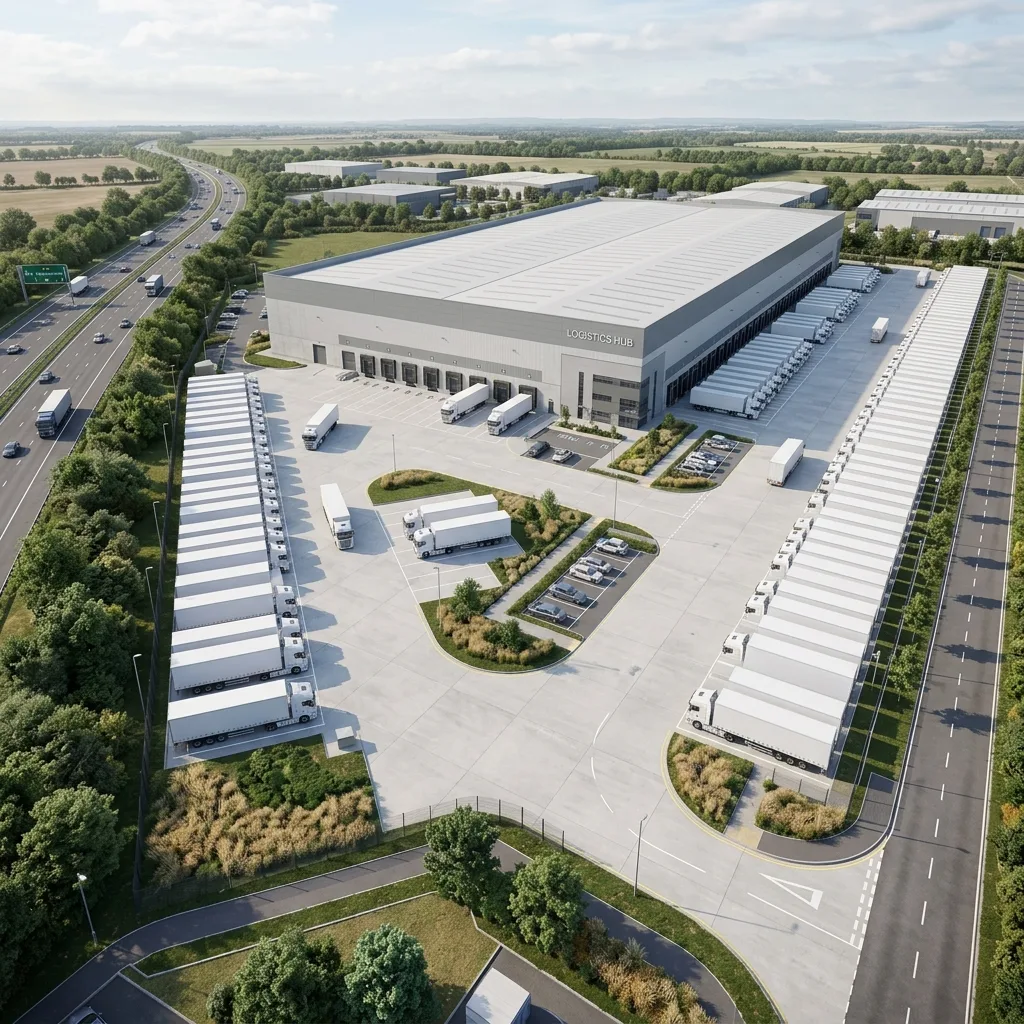
See the West Midlands Distribution Warehouse case study for warehouse-led CGI with strong dock-face rhythm and service-yard discipline. For broader logistics layout and multi-unit context, see the North West Logistics Hub case study.
A fulfilment-centre image set is a different brief from distribution-centre, warehouse-depot, or last-mile-depot work. The operational read has to render processing speed, not storage volume or highway frontage. The wrong brief produces a building that the occupier will not commit to.
For distribution-centre, warehouse-depot, and last-mile comparisons, see the warehouse and logistics CGI hub.
Common questions on fulfilment centre CGI scope, pricing, and operating modes.
Fulfilment centre CGI is photorealistic architectural visualisation for parcel sortation buildings, mezzanine pick-pack layouts, van staging yards, and dispatch-heavy warehouse operations. It is used to show how the scheme looks and how it operates before the building is constructed or occupied.
In fulfilment-centre planning, CGI stands for computer-generated imagery. On a fulfilment project, that usually means a 3D model and rendered stills that turn site plans, operating assumptions, and technical layouts into images for planning review, pre-let marketing, or occupier evaluation.
Fulfilment-centre CGI is judged more heavily on processing speed, parcel sortation, van staging, and mezzanine pick-pack logic. Distribution-centre CGI is usually judged on pallet storage, standard dock rhythm, broad yard depth, and HGV-led movement instead.
Yes. StratumCGI can keep one approved fulfilment-centre shell fixed while changing vehicle mix, staging intensity, dispatch rhythm, and operating emphasis to show standard throughput, cross-dock flow, or van-heavy e-commerce dispatch.
Most fulfilment-centre exterior briefs at StratumCGI are quoted from the warehouse and logistics CGI pricing model. Typical exterior packages start from around £1,800 for two agreed views, with wider packages priced by view count, context complexity, verification level, and how many operating variants reuse the same approved model.
Fulfilment-centre CGI keeps the approved shell, dock positions, service yards, access points, and landscape frame fixed between planning and pre-let images. Camera position, lighting, staging, and vehicle mix can change without changing the approved scheme.
Occupiers usually focus on dock density, mezzanine logic, parcel sortation visibility, van staging, HGV separation, and whether the approved shell can support more than one dispatch mode without losing operational clarity.
StratumCGI treats standard fulfilment, cross-dock flow, and van-heavy e-commerce dispatch as staging variants inside one coordinated service. The same model and shell stay fixed while the operating read changes for each review context.
Logistics projects with the closest operational brief to fulfilment centre CGI, selected for dock rhythm, service access, and occupier-facing credibility.
Warehouse-led CGI showing dock-face rhythm, office frontage, and yard discipline, useful as a close operational reference for fulfilment-centre proof work.
Multi-unit logistics CGI showing broader site layout, vehicle hierarchy, and planning-led massing control across a regional logistics context.
For the broader logistics subtype mix, review the warehouse CGI subtype comparison. It shows how fulfilment, distribution, depot, cold storage, and air cargo briefs sit inside one coordinated service.
Request a Quote